
Tantramar gas plant gets regulatory ‘thumbs up’ from EUB
Tantramar gas plant gets regulatory ‘thumbs up’ from EUB
Environmental and Mi’kmaw assessments still going on for 500-megawatt gas and diesel plant
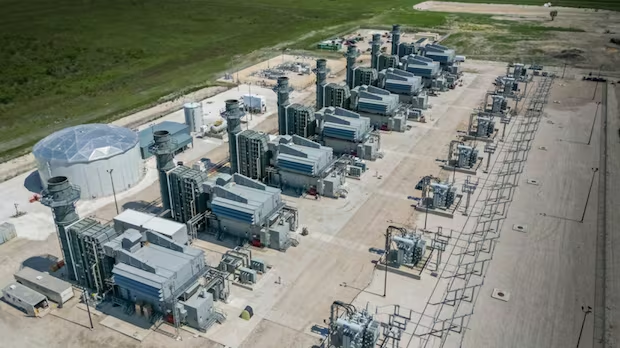
A 500-megawatt gas and diesel power plant project is one step closer to being built in rural Tantramar.
In an online session Thursday afternoon, the Energy and Utilities Board delivered its decision approving N.B. Power’s 25-year contract with U.S.-based ProEnergy to install and run 10 gas and diesel turbines at a rural site near Centre Village.
Before delivering final approval on the project, board chair Christopher Stewart took a moment to scold N.B. Power for not following its own investment governance framework and providing inadequate information to the board.
"But for the fact that the board was able to satisfy itself based on the evidence that it had before it … the board could not have found the current project prudent," Stewart said.
The project promises to provide up to 500 megawatts of electricity when needed to cover spikes in power demand during cold snaps in the winter months and to fill in lulls in wind or solar power generation.
Four hundred megawatts of that capacity is earmarked for New Brunswick, and another 100 megawatts is being purchased by the Nova Scotia system operator in a 10-year contract with NB Power.
Board heard conflicting opinions
The board spent eight days in hearings about the project in February and March.
Opponents argued that N.B. Power overstated its need for additional capacity and did not use up-to-date costing of alternatives, such as a large-scale battery project.
Tantramar gas plant greenlit by Energy and Utilities Board
N.B. Power maintained that the province could face rotating blackouts if the project was not online by 2028, and that battery storage projects would be too expensive.
The project is expected to cost at least $3.5 billion over the course of the 25-year contract, based on figures in a 2024 briefing note to the N.B. Power board of directors.
The utility has refused to share the actual costs of the contract signed with ProEnergy.
"This fight isn't done," said Terry Jones, the closest neighbour to the proposed gas plant in Centre Village.
"We're not happy with it. We don't want it in our woods."
Barry Rothfuss is executive director of the Atlantic Wildlife Institute, just kilometres from the proposed site for the gas plant. Rothfuss said he knew it would be an "uphill battle" to convince the EUB to reject the project.
"We realized that they were only looking at the the economic situation, the prudency of it financially," said Rothfuss, and not "the actual threats that building this infrastructure will have here in the Tantramar region."
Moe Qureshi, director of climate research with the Conservation Council of New Brunswick, said he was disheartened by the EUB decision.
"This kind of project is locking New Brunswick into decades of fossil fuel dependence," Qureshi said. "We know alternatives exist."
The council brought in expert Toby Couture to the hearings to testify about the increasing affordability of large scale battery storage solutions.
The council argued that N.B. Power's information on battery systems was outdated, but the EUB found too little detail in Couture's testimony.
Stewart said the evidence was "general in nature" and didn't address "the specific conditions, costs, and system requirements in New Brunswick."
Qureshi said the Conservation Council would continue to pursue alternatives to the gas plant, and ask the provincial government to "reassess the alternatives."
"We will ask premier Holt to reconsider this," Qureshi said.
The EUB’s decision can be changed or overturned by the Premier’s Office within a 30-day window, but Energy Minister Rene Legacy cast doubt on that possibility Thursday.
"If government starts reversing those kinds of decisions of a Crown corporation, how are we ever going to be able to approach any industry to come into this province?" Legacy said to reporters at the legislature.
Making room for more renewables
Yves Gagnon, a professor of engineering at Université de Moncton and a champion of renewable energy, said he would have been happy with either an approval or rejection of the project by the EUB.
While it may be a fossil fuel project, Gagnon said, it uses technology "that is used throughout the world in terms of dispatchable capacity," and it will allow for "better and easier integration of renewable energy" in the province.
Speaking to reporters after the decision, N.B. Power chief commercial officer Brad Coady touted the power purchase agreements the utility has already signed for 700 megawatts of wind energy.
"There's opportunities for several 100 megawatts of wind potentially to come," he said.
Just seven kilometres from the proposed gas plant site, a new partnership is proposing to build a 150-megawatt solar farm, which would be the largest in New Brunswick and one of the largest in the country.
Cookville Solar has yet to sign an agreement with N.B. Power for the energy it could provide.
The project is awaiting approval in a provincial environmental impact assessment process, which started in July 2025.
ProEnergy recently presented results of a water supply assessment for its project site, which showed the project would use too much water during winter months.
The report by Stantec says ProEnergy would need to store water, control its demand or change its water use assumptions to meet the capacity available on site.
ProEnergy is also engaged in a Mi’kmaq Rights Impact Assessment process with Mi'gmawe'l Tplu'taqnn Inc., known as MTI.
John MacIsaac, the head of ProEnergy’s Canadian operation, said a “first phase report with conditions is substantially advanced" and being considered by MTI leadership.
N.B. Power has a backup plan if the environmental impact assessment does not succeed, said Brad Coady, but, "unfortunately, that backup plan would add more time, more risk, and more cost for New Brunswickers."
The same report that kicked off the utility's pursuit of the Tantramar gas plant in 2024 also includes a second recommendation, to start planning for "an additional 600 MW as early as 2030."
When asked about that recommendation, Coady said, "we do see further combustion turbines as part of our long-term energy future."
But he said the utility will also pursue energy efficiency, demand reduction, and battery energy storage to help meet its needs.
"The EUB validated N.B. Power's thinking in this case," said Coady, that "at this time, under these circumstances:" the gas plant was "the least cost option."
"I can't say with certainty, the next time … will we find the same circumstances?"
Related Stories
 Technology
When Tech Companies Die, What Happens To The Products They Leave Behind?
54 seconds ago
 Technology
Two Finns supplying Russia with missile tech worth tens of millions
1 minute ago
 Technology
Drones with pepper spray, four
1 hour ago
 Technology
Micron Technology stock pre-market at EUR 800.50: memory storage - ad
2 hours ago
 Technology
TAIEX Ends at 4
2 hours ago
 Technology
ZAWYA: Technology, start-ups can double India
3 hours ago
 Technology
Czech government to consider CZK 1 billion fund for startups
3 hours ago
 Technology
GDIN Supports Eight Startups at CEATEC 2026 in Japan, Opens Door to Local Investor Collaboration
3 hours ago