
The Ambassador Bridge's monopoly was ending. What its owner wanted from Ottawa is largely a secret
Documents reveal Ambassador Bridge owner's private meeting with Ottawa ahead of Gordie Howe opening
Experts say unusual mix of private and public interest raises questions about transparency at the border
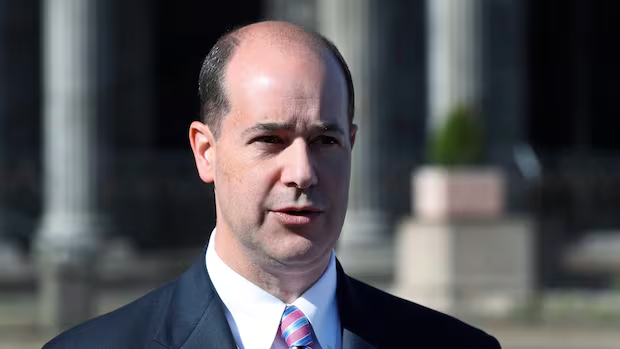
The American owner of the Ambassador Bridge, Matthew Moroun, sought a meeting with senior Canadian government officials about the new Gordie Howe International Bridge three and a half months before the rival crossing opened — but what was discussed at that meeting remains largely a secret.
CBC News learned of the April 7 meeting through federal briefing notes obtained under the Access to Information Act. The 17-page release package is available for public view at the bottom of this story.
According to the documents, Moroun, who's based in Michigan, was accompanied by Kevin Kalczynski, a senior lawyer with the family's companies, and Brennan Lee, a senior financial executive and Moroun's son-in-law.
On the Canadian side were Housing Infrastructure and Communities Canada deputy minister Paul Halucha, assistant deputy minister Marco Presutti and Jesse Tracey, a senior federal government lawyer.
The records show Moroun requested the meeting with Canadian officials, but portions of the agenda, as well as the government's account and analysis of the meeting, were redacted.
CBC News contacted the Ambassador Bridge seeking Moroun's account of the meeting and what he wanted from Canadian officials, but did not receive a response before publication.
The stakes were enormous. Moroun had a lot on the line financially — the new bridge was expected to take almost half the Ambassador Bridge's traffic, according to U.S. government estimates.
By itself, the Ambassador Bridge is a vital link between both countries, and in 2021 it handled more than $140 billion in merchandise trade — about $390 million a day and 26 per cent of Canada's exports by road, according to Transport Canada.
Gordie Howe bridge will cut deep into truck traffic at competing Ambassador Bridge: DHS
Michigan Senate candidate accuses Trump of keeping Canada-U.S. bridge closed to help donor
The Canadian government had its own interests going into the meeting. Officials were trying to get the $6.4 billion Gordie Howe bridge open under intense political pressure from the White House to stop.
Briefing materials prepared for Halucha describe his role in the meeting with Moroun this way:
"Note you are here to listen and look forward to hearing Mr. Moroun's perspective and better understand his views on corridor operations as the new bridge prepares to come into service, as well as views he may have on resolution of outstanding issues."
Much of the material detailing those issues and portions of the government's subsequent account of the meeting are redacted.
Laurie Trautman, director of the Border Policy Research Institute at Western Washington University in Bellingham, Wash., said the involvement of a private owner adds a dimension that would not ordinarily be present in the management of an international border crossing.
"It's not necessarily about better accessibility or more efficiency of trade flows. It's about profits," she said.
The arrangement itself may also be unique: Trautman said she knows of no comparable example of a fully privately owned international crossing operating alongside a publicly owned competitor.
She said the unusual relationship, with the inclusion of a private business, adds another layer to diplomacy, raising questions about transparency at a time when relations between Canada and the United States are strained.
"Those government-to-government channels are only as strong as the government-to-government relations," she said. "I think Canada and the U.S. are becoming a little bit more transactional in their diplomacy."
What's inside the new Gordie Howe bridge deal?
Housing Infrastructure and Communities Canada wrote in an email that discussions with private bridge owners are not unusual.
"Discussions with international bridge owners who facilitate trade and commerce to Canada are continuous and occur through various channels," the department said.
The department would not discuss the outstanding litigation, but said it continues to work with stakeholders to "strengthen a vital trade corridor that generates billions of dollars in economic activity on both sides of the border."
A federal briefing note written after the meeting dated April 24 and included in the package obtained by CBC News said, "Mr. Moroun acknowledged that GHIB will proceed to opening," referring to the Gordie Howe bridge. The note said that acknowledgement came a day after the April 7 meeting with senior Canadian officials.
Whatever was discussed behind closed doors, the competitive landscape changed soon afterward.
The same briefing note said 11 days after the meeting "the Ambassador Bridge announced reductions to toll rates for some of its users, positioning them slightly below those planned for the GHIB."
The Gordie Howe International Bridge is 'essentially complete.' The fight over it is not
John Sutcliffe, a political science professor at the University of Windsor, has studied the Moroun family's decades-long efforts to protect the Ambassador Bridge from a competing crossing.
"You have a classic case of moving from a monopoly situation to one where there's competition, and therefore prices come down in those situations usually," he said.
Sutcliffe said for the smaller, older and less accessible Ambassador Bridge, the new, publicly owned competition presents a significant challenge.
"Having a new competitor that is much larger, has state-the-art infrastructure and the capacity to handle traffic and deal with it more quickly is a huge problem," he said.
Sutcliffe said the tactics may have changed as the Gordie Howe bridge moved from proposal to reality, but the objective has remained the same: protect the family business.
Since 2014, that campaign has included strategic land purchases whenever a route for a rival bridge was identified and political lobbying on both sides of the border, Sutcliffe said. The briefing notes also identify 22 separate legal challenges launched by the Marouns over the past two decades.
"Trying to secure political support is sort of a long-standing part of the Ambassador Bridge's operation," Sutcliffe said.
Sutcliffe said the Trump administration may also represent a unusually receptive audience. He said he sees similarities between Trump's preference for private enterprise and the Moroun family's long-standing opposition to a publicly owned competitor.
"Moroun's position sort of fits with Trump's view of the world and so you have that political dynamic, the view that it's about what's in it for us and what's in it for the United States," Sutcliffe said.
Sutcliffe said the Morouns found themselves aligned with Trump's "America First" approach, even though disrupting cross-border trade could ultimately hurt the Ambassador Bridge itself.
Colin Butler is based in London, Ont., where he reports for Ontario and national audiences. He covers investigative, science, public policy and government accountability with a particular interest in using public records to uncover hidden stories.
Related Stories
 Canada
Geoff Russ: This is the land of the Canadian people
11 minutes ago
 Canada
Conservatives call on prime minister to reconvene Parliament over failure to secure Canada
1 hour ago
 Canada
Poilievre wants prime minister to reconvene Parliament to discuss rejected trade deal
1 hour ago
 Canada
Waterfalls of New Brunswick: Fall Brook Falls
1 hour ago
 Canada
‘I started yelling through the camera’: Overpayment scam leads to tree
1 hour ago
 Canada
Ottawa school breakfast program feeding 1,300 more students this September
2 hours ago
 Canada
Partial lunar eclipse to grace Canadian skies this week
2 hours ago
 Canada
Conservatives ask Carney to release U.S. trade offer details
3 hours ago