
The future is now: College of Computing & Artificial Intelligence officially launches
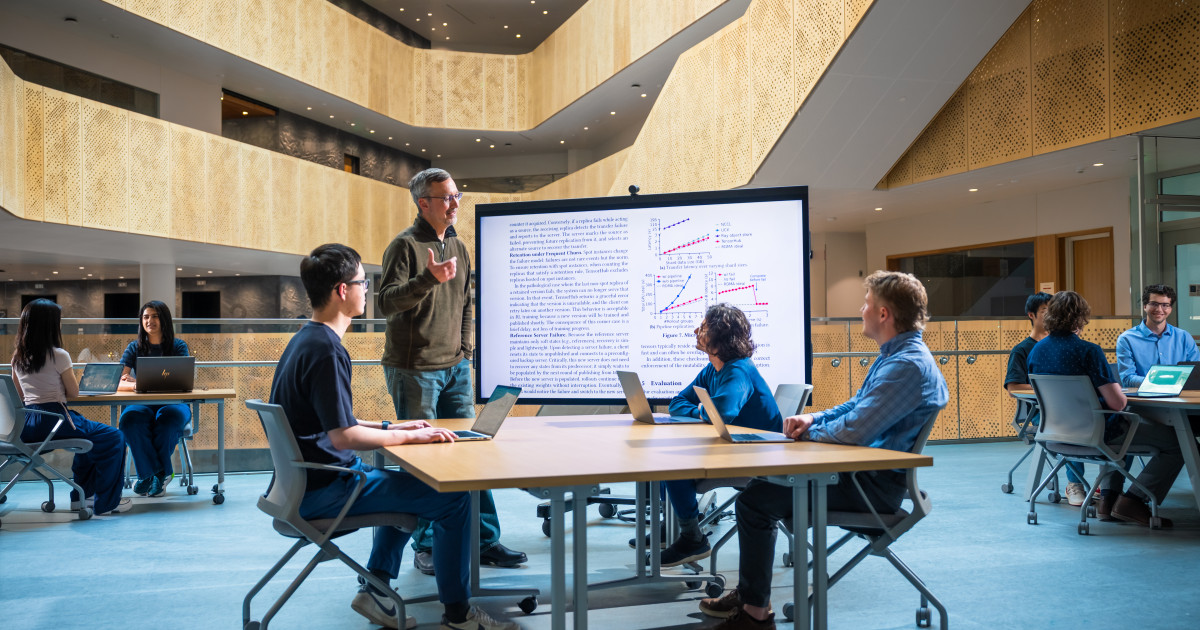
The future is now: College of Computing & Artificial Intelligence officially launches
UW–Madison’s first new college in more than four decades will explore and inform technological change for societal benefit.
Today, July 1, the University of Wisconsin–Madison officially launched the College of Computing & Artificial Intelligence (CAI), its first new school or college in more than 40 years. CAI positions UW–Madison to advance research, education, public engagement and thought leadership around computing and artificial intelligence.
CAI’s origins are rooted in the School of Computer, Data & Information Sciences (CDIS), which was created within the College of Letters & Science in 2019 and brought together the Information School and departments of Computer Sciences and Statistics. These three units now make up the new college.
The new college will allow UW–Madison to leverage its strengths across disciplines — from social sciences, arts and humanities to health and data science — to explore and inform the many ways in which AI is transforming society.
“When we brought together these departments in CDIS within L&S seven years ago, our goal was to bring together faculty, staff and students to explore and research rapidly changing technologies and provide our students with educational experiences they would need to thrive in the computing age,” says interim Chancellor Eric M. Wilcots. “Today is a stunning milestone reflecting the success of the investments we made and we are thrilled to welcome the College of Computing & Artificial Intelligence under Founding Dean Remzi Arpaci-Dusseau. I am looking forward to the work the new college will do in helping chart a course for the future at a pivotal time. What inspires me the most is the promise of the inherently collaborative mission and vision of the new college.”
In a recent essay, “Time to Dig,” Arpaci-Dusseau reflects on why this moment matters and the role universities should play as technology reshapes society. Below, he also discusses the vision for UW–Madison’s newest college.
Why is now the right time for UW–Madison to create a College of Computing & Artificial Intelligence?
People sometimes hear “new college” and assume we’re starting from scratch. In reality, it’s almost the opposite.
CAI brings together three long-established departments — Computer Sciences, the Information School and Statistics — that have spent decades educating students, advancing research and serving Wisconsin. Together, they include more than 100 faculty, roughly 5,000 students and nationally recognized programs. Those departments have already demonstrated what’s possible when they work together, including launching the data science major, which has quickly become the second-largest major at UW–Madison.
What changes today isn’t that we’re suddenly beginning this work. It’s that we’re bringing these strengths together under a shared vision and giving them the structure to grow in new ways.
Because we’re living through one of the most significant technological moments in decades, nearly every part of society is being reshaped — from how research is conducted to how businesses operate to how students prepare for careers that don’t yet exist. Universities have a responsibility not only to study these changes, but to help society navigate them.
That’s why this college exists.
There is a great deal of conversation and skepticism about artificial intelligence today. Looking beyond today’s headlines, what role do you hope CAI will play over the next decade?
I think computing is reaching an important point in its development. Like many disciplines before it, there comes a point where the questions become larger than simply what technology can do. They become questions about how technology should be developed, how it should be used and how it should benefit society. In many ways, the field of computing itself is maturing.
That’s where universities have a unique role to play. At a time when trust in technology has been tested, universities can serve as trusted voices and be places where difficult questions are welcomed, where ideas are challenged, and where students learn not only how to build technology, but how to exercise good judgment in applying it.
As a land-grant university guided by the Wisconsin Idea, UW–Madison has always believed its responsibility extends beyond the boundaries of campus. CAI is an opportunity to bring that same philosophy to one of the defining technological moments of our time.
I hope CAI becomes a trusted voice in those conversations — not because we have all the answers, but because we’re committed to bringing together researchers, students, industry, government and communities to ask the right questions and help shape thoughtful solutions.
What opportunities does becoming a college create for research, education and collaboration that didn’t exist before?
One of the things I’m most excited about is that becoming a college gives us the opportunity to think much more holistically about both education and research than ever before.
After more than two decades at UW–Madison as both a researcher and educator, I find that especially exciting because it’s an opportunity to think about the entire academic enterprise — not just individual programs or initiatives, but how education, research and partnerships reinforce one another.
As a college, we now have the opportunity to think intentionally about our educational programs — from new majors and degree pathways to learning experiences that prepare students for a world where computing and AI are becoming foundational across nearly every discipline.
We’ll continue investing in outstanding faculty — including hiring 50 new faculty members over the coming years (some with joint appointments across campus) — and strengthen both our educational and research missions. At the same time, becoming a college gives us a stronger platform to create new research partnerships across UW–Madison and with industry, because many of today’s most important breakthroughs happen where disciplines intersect. Our goal is to help drive innovation not only within computing and AI, but across medicine, engineering, agriculture, business, the arts and countless other fields.
Ultimately, that’s what becoming a college makes possible: the ability to think more ambitiously about how education, research and partnerships work together to create lasting impact for Wisconsin and beyond.
Twenty years from now, what do you hope people say about the College of Computing & Artificial Intelligence?
I hope people look back and say that we helped shape this technological moment thoughtfully. Of course, I hope they point to important discoveries, meaningful partnerships and research that advanced our understanding of the world.
But I hope they talk even more about our students.
I hope they say CAI prepared generations of graduates who not only understood these technologies deeply, but also had the judgment, curiosity and courage to use them wisely. Graduates who went on to improve healthcare, advance science, serve their communities, teach others, and tackle problems we can’t yet imagine.
Success won’t simply be measured by the technologies we create. It will be measured by the people we educate and the impact they have throughout Wisconsin and around the world.
If 20 years from now people see CAI as a place that developed both exceptional technology and exceptional people, I think we’ll have accomplished something meaningful.
Related Stories
 AI News
‘Witch
54 minutes ago
 AI News
Monaco authorities detain then release a person in their probe of this week's explosion
54 minutes ago
 AI News
Watch: England and DR Congo fans react to tense World Cup game
54 minutes ago
 AI News
Taylor Swift and Travis Kelce’s wedding fascinates, flummoxes media
54 minutes ago
 AI News
World Cup fans sweat through US 'heat dome'
54 minutes ago
 AI News
World Cup 2026: Concerning increase in racist social media posts
57 minutes ago
 AI News
Province says World Cup is boosting B.C. economy, but some businesses report softer demand
57 minutes ago
 AI News
PREVIEW | Australia vs Egypt: team news, lineups, predictions (World Cup 03/07)
57 minutes ago