
The incubator launching Scotland’s next generation of tech: ‘We need to pull the bigger players into the Scottish market’
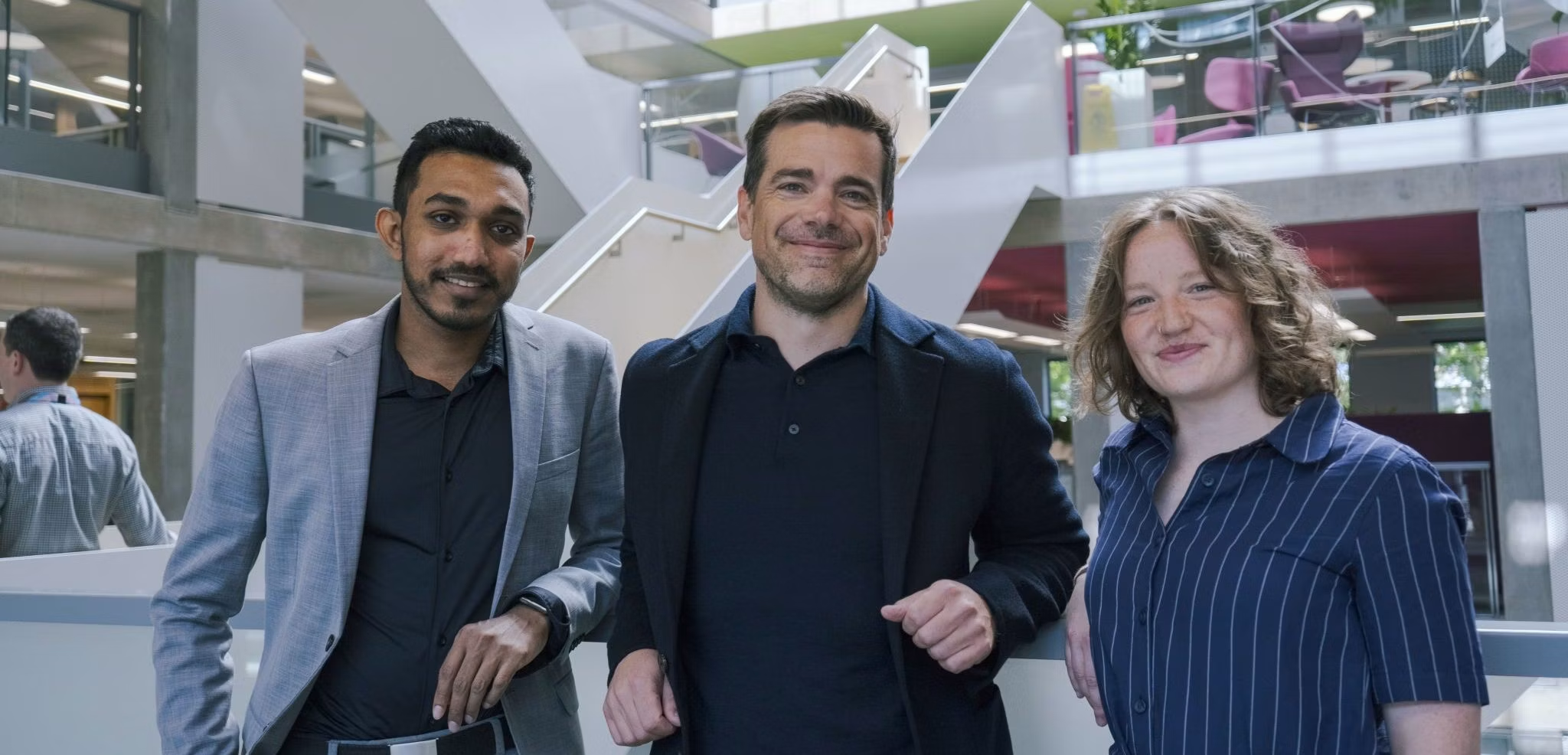
Scotland has developed into a booming hub for AI and quantum research, driven by the strength of the universities across the Edinburgh-Glasgow central belt and the country playing host to two of the UK’s five quantum hubs. But one of the biggest challenges for innovators there is scaling products from an early-stage research concept into a scalable startup. "The biggest barrier to commercialisation from a university setting is the lack of commercial skills and experience required to do so. To convince somebody who is at the top of their field to take a different path as an entrepreneur isn't always as straightforward as we might want,” says Andrew Parfery, SVP Commercial & University Lead at Scottish growth platform CodeBase. To support academic founders making the move into entrepreneurship, the University of Edinburgh in partnership with the Scottish government startup programme Techscaler and CodeBase, offer the Venture Builder Incubator (VBI), a five-month programme supporting deeptech founders in Scotland.
Sifted sat down with Parfery, alongside Shivoh Nandakumar, founder of robotic AI company Ridescan AI, and Eva Steele, cofounder of AI biotech startup Amytis, to unpack how Scottish entrepreneurs can turn their research into scalable businesses. Nandakumar and Steele took part in the VBI programme and benefitted from Techscaler support which included mentorship and access to international programmes.
For Steele and Nandakumar, taking a research project to market required identifying a problem and how it could be solved. Nandakumar came across the problem he’s solving with Ridescan — building safety and performance monitoring technology for robots — while working on automating robot behaviour during his PhD. He says he saw a robotic dog confidently claim it had picked up a box when it had actually picked up a table. “This made me question what would happen if we deploy robotic systems into the physical world which are confidently claiming things that aren’t correct,” he says. “We independently monitor these robots to ensure they’re safe and reliable when deployed into public spaces."
Steele wanted to develop a universal AI tool that would help biological and wet lab researchers map experiments and data more effectively. “We saw this initial need for better access to computational tools in biology and that was from the domain knowledge my cofounder and I have,” she says. “We realised AI is becoming an incredible tool in life science but there are still hurdles, especially for wet lab researchers who may not have the computational literacy to use it properly.” The pair also had to work on the mindset shift required to be a founder. After spending up to 10 years training to solve problems in theory, being thrown into a situation with unpredictable demands can be a difficult transition, says Steele. “As a researcher you have a bubble and you're surrounded by PhDs and professors,” adds Nandakumar. “Since you now have this idea and you’re moving towards commercialising it, you need a new bubble, and you can’t get that in academia.”
Since 2024, Techscaler has partnered with the University of Edinburgh to scale the VBI into a nationwide programme for university researchers across Scotland. The Incubator has supported 164 founders and businesses since 2021, and the companies going through the programme have raised a total of £58m in grants and investments. The programme offers founders the freedom and financial support to build their product, and is primarily led by former entrepreneurs, says Parfery.
“We try to encourage founders immediately to spend time with their customers,” he says. “Thinking about how they tell the story of what they're doing and the impact it will have for their customers. That's a big shift we find a lot of academic founders haven't got to yet.”
The incubator programme also focuses on equipping founders with sales skills.
“The VBI programme managers spend a lot of time on storytelling and pitching,” Parfery adds. “Every great founder is a brilliant salesperson because they have to sell not just to their customers but investors, employees, suppliers and other stakeholders as well.” Academics who are part of the programme also have the opportunity to connect with VC firms and speak to investors. “We educate founders on the investment journey,” says Parfery. “If a founder turns up and says they want to raise £20k for 20% at pre-seed, we’ll immediately put the brakes on that.” Nandakumar adds: “After the VBI, we had been getting interest from the venture arm of the University of Edinburgh,” he says. “I was able to establish that relationship because I was part of the VBI.”
Techscaler offers resources and networking opportunities to founders. Its Entrepreneurs in Residence programme offers access to a network of operators also building their own business. “There’s early-stage support, as well as specific mentors assigned," says Nandakumar. “You can select different mentors appropriate to your business at that specific stage. As a researcher, you usually don't have that kind of access.”
Steele says being a part of Techscaler’s peer community offered almost immediate returns for Amytis. “I signed up for Techscaler and we got their newsletter which had an advert for Bethnal Green Ventures,” she says.
Amytis was looking for match funding to release a Smart Scotland grant the company had received, and Bethnal Green Ventures matched it. “It enabled us to carry on doing what we were doing,” Steele says. Techscaler also offers international trips to connect founders with international markets, adds Parfery. Destinations include Singapore, Silicon Valley, New York, China and Japan. “We're trying to connect to wherever might be useful for them based on their next challenge,” Parfery tells Sifted. The primary goal of the Techscaler and VBI partnership is to support high potential deeptech founders from any University in Scotland to start and scale their business. “We need to start pulling the bigger players into the Scottish market rather than exporting all of our talent and ideas outwards. We want investors from outside of Scotland to come and see what Scotland's great universities have to offer." If you want to build a commercial business from university research in Scotland, applications for the next Venture Builder Incubator cohort are open until July 20th. Learn more and apply here.
Related Stories
 AI News
A tale of two Odysseys: Nolan's blockbuster gets AI
1 minute ago
 AI News
Newcastle news: Dan Burn's 'faultless' England World Cup appearances
46 minutes ago
 AI News
Tottenham news: Porro scores as Spain reach World Cup final
46 minutes ago
 AI News
Will Scots back the Three Lions against Argentina
47 minutes ago
 AI News
Colombia faces an invisible crisis of displacement
47 minutes ago
 AI News
Global childhood immunization coverage inches forward despite conflict and hesitancy
47 minutes ago
 AI News
Human rights campaigner finds solace in Jersey
48 minutes ago
 AI News
Most realistic ancient roman faces revealed at Budapest exhibition
49 minutes ago