
The museum charting how humans understand the world
The museum charting how humans understand the world
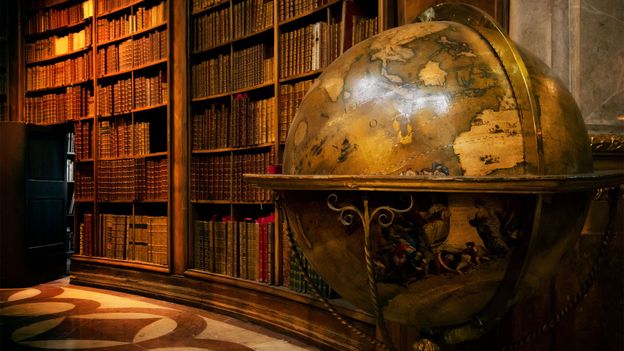
Beautiful, surreal and eerily empty, Vienna's Globe Museum the only public museum on Earth dedicated to globes, and it – quite literally – tells the story of our world.
It's a chilly afternoon in Vienna, and the line for the Austrian National Library has already spilled out the door, curling like a ribbon around the grand Josefsplatz square. I'm not in the mood to wait – I've already struck out at several crowded nearby attractions where timed-entry tickets were sold out.
Rather than join the queue, I walk down the street and stumble onto a smaller, somewhat hidden site: The Globe Museum. Tucked inside Vienna's 17th-Century Palais Mollard, it's the only public museum on Earth dedicated entirely to globes, and one of Vienna's greatest surprises.
I soon realise that I've wandered into another world – or more accurately, many of them.
Just steps from some of the city's most celebrated, crowded attractions, Vienna's Globe Museum displays more than 220 rare and antique spheres, most created before 1850, ranging from towering Coronelli globes to tiny, foldable pocket orbs.
Beautiful and surreal, the museum's extensive collection goes beyond geography to reveal how humanity has mapped and imagined the Earth and heavens above. It's a chronicle of human curiosity, and – quite literally – the story of our world.
"Globes show the change in our imagination of our planet," says Nikolaus Schobesberger, the director of museum. "And this is the only place in the world where you can see so many of them at the same time."
Visitors start by travelling through the Golden Cabinet, a lavish room with centuries-old frescoes depicting scenes from Greek mythology. It's the backdrop for a stunning array of globe-related instruments, like telluriums, which illustrate the Earth's orbit around the Sun, and armillary spheres, which use a framework of rings to visualise the movements of celestial bodies.
As I reach the museum's four main galleries, I realise the whole place is pin-drop quiet. I shuffle slowly from one glass case to another, holding my breath to not disturb the stillness, even though I'm alone with centuries-old objects.
I find myself marvelling at two spherical worlds suspended in time. One is terrestrial, with oceans awash in vivid blues and squiggly brown coastlines. The other is celestial, where mythological creatures and constellations spill across a tea stain-coloured backdrop. Barely bigger than beach balls, these two time capsules were made by the same craftsman 10 years apart in the mid-1500s and preserve a world as it was still coming into focus.
In one, Europe, the Mediterranean and Africa's coasts are filled with place names, while North America fades into the uncharted Arctic. Asia is distorted, a hypothetical southern continent stands in for Australia and Antarctica and the Pacific is populated by sea monsters instead of islands. In the other, Renaissance astrological observations exist alongside Pegasus taking flight and Perseus brandishing Medusa's severed head.
"They're some of the oldest globes we have in our collection," says Schobesberger.
Moving from one globe to the next, I notice how these relics extend beyond geography and depict what people once believed. Many fill the space of unexplored oceans with dragons, while some confidently depict my home state of California as an island. Some pieces also preserve colonial-era prejudices with elaborately painted scenes depicting Indigenous people as cannibals. On one, African coastlines are dotted with Spanish and Portuguese flags, showing "ownership".
"They're a part of this colonial thinking. And so, they're beautiful art, but you also have to think about the time they were created," Schobesberger says, explaining that every globe is as much a record of what people knew as what they didn't. That's why he believes the museum resonates with all types of people, not just historians or cartography enthusiasts.
One of Schobesberger's favourite objects is a lunar globe from 1961. The front portion of the Moon is meticulously mapped. The back, however, is a stark white strip, intentionally left blank because the far side of the Moon had not yet been seen. An updated lunar globe made two years later, also on display, contains the missing portion.
I can't help but circle back to a showstopper in the front hall, a replica of the Behaim Globe – completed by Martin Behaim in 1492, the year Christopher Columbus sailed west – which shows a world without the Americas. There's simply an expanse of ocean between Europe and Asia.
"A globe is such a great thing because it's a small-scale model of our planet, so you can tell stories about the world on it," he says. "Climate, geology, topography, trade routes, everything."
From curios to cultural cornerstones
Walking through the museum, visitors can see the globe's own journey unfold. The earliest examples were luxury objects reserved for aristocrats and wealthy merchants. Over time, globes lost their exclusivity, shrunk in size and became more affordable and popular. They entered schools, appeared in living rooms and even became playthings for children. Today, they are so commonplace that my son even won his desktop globe in a classroom raffle.
I entered the museum expecting to view globes as historic artefacts, but I'm surprised by how alive they still feel. Even with Google Earth at my fingertips, these tactile objects invite curiosity and imagination in a way that a screen doesn't.
"It's not just that the globe is a scientific instrument. It's also an object which lets you dream of foreign countries," says Schobesberger.
Beginning 24 September 2026, the museum's newest exhibition, Globes in Everyday Life, Art and Culture, will explore how globes evolved from a status symbol to a familiar fixture. It also showcases the globe's enduring place in pop culture, from architecture to art and film, like Charlie Chaplin's famous dance with an inflatable globe in The Great Dictator. "The main idea was to show that globes are almost everywhere as a part of everyday life," Schobesberger says.
Schobesberger's own fascination began as a young child, when he became captivated by the ships, sea monsters and mythical creatures that filled the blank spaces of historical maps and globes. He began to draw his own world maps when he was just six years old.
"You can think about what's possible on the other side of the world, even when you're sitting here in Europe," he says. "Nothing else can capture the imagination quite like it."
• The world's oldest medieval map
• The travel guides that charted our world
• The man who inks the world's borders
That sentiment resonates with author JF Penn, who stumbled onto the Globe Museum while researching her novel Spear of Destiny, based on a relic housed in Vienna's Imperial Treasury. Like me, she ended up lingering far longer than planned.
"I particularly loved the oversized antique globes with the patina of age and use," she says. "I considered how many fingertips have turned them over generations and wondered if they thought of travelling to these far-off places that I do."
Even after visitors leave Palais Mollard, the search continues. Across Vienna, some 50 globes are perched on rooftops and facades, hidden in plain sight. The museum even charts them on a virtual map in its new exhibit, encouraging people to look upward as they wander the city.
When I finally step back outside, the sky is dark and the streets are even more crowded. Earlier in the day, I had been seeking a quieter corner of Vienna. Instead, I was given a whole new way of seeing the world – a place that's constantly being redrawn and reimagined.
If you liked this story, sign up for The Essential List newsletter – a handpicked selection of features, videos and can't-miss news, delivered to your inbox twice a week.
For more Travel stories from the BBC, follow us on Facebook and Instagram.
Related Stories
 World
World
Manchester United weigh up stunning move for Real Betis and ex-Tottenham forward Troy Parrott
1 day ago
 World
World
Israeli police arrest 10 following weekend attacks by settlers on journalist and diplomats
1 day ago
 World
World
Trump says suspension of Russia sanctions is to keep peace negotiations going
1 day ago
 World
World
Ukrainian drones strike St. Petersburg oil facilities | NHK WORLD
1 day ago
 World
World
Victoria Falls stadium in Zimbabwe nears completion for CWC27
1 day ago
 World
World
‘The world will be amazed:’ Iran’s commanders prepare for further war
1 day ago
 World
World
Festival opens with musket salute in Sakai, Osaka
1 day ago
 World
World
Trump's new pitch for Republican candidates — they're really good
1 day ago