
This N.S. town wants to use 100% renewable energy. It’s more than halfway there
This N.S. town wants to use 100% renewable energy. It’s more than halfway there
Berwick, N.S., is using solar, hydroelectric and wind power in effort to become a zero-emissions community
The town of Berwick, N.S., is more than halfway to its goal of powering its community with 100 per cent renewable energy.
Berwick, a community of roughly 2,500 people, has invested in infrastructure that derives power from wind, solar and hydroelectric energy sources.
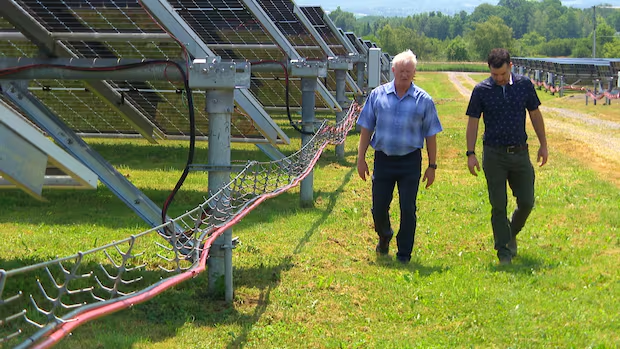
The town is utilizing a hydroelectric dam, which has been operating since 1921, a wind farm and a solar garden in an effort to become a zero-emission community. So far, approximately 60 per cent of the power it uses comes from sustainable sources.
“The start of energy creation in Berwick is well over 100 years old,” said Mike Trinacty, mayor of Berwick.
Wind turbines provide the majority of the renewable energy the town consumes, but the 12,000-solar panel garden powers the equivalent of 400 homes.
“It's really impressive what it does for our bottom line. I'm all smiles so far. I haven't seen its downside yet,” said Adam King, director of electric services for the Berwick Electric Commission.
Investing in renewable energy infrastructure is obviously good for the environment, Trinacty said, but it also lowers costs for residents.
“Historically, [town rates] have been well below Nova Scotia power rates. Right now for residents, we're probably three and a half per cent lower,” he said.
Rates will likely go up for Berwick customers to help cover the building costs of the new infrastructure but they will still be lower than Nova Scotia Power, Trinacty said.
The mayor believes the cost is worth it because having their own electric utility has resulted in fewer power outages and quicker response times when there are problems.
“It's more reliable and we hear that all the time because we have our own staff and we produce our own power,” he said.
The town’s hydroelectric dam gives the electrical utility some flexibility when it comes to power distribution, according to King.
“That generation allows us to have dispatchable power, not just power running all the time in the background," he said.
"We can hold on to it and release it at suppertime or at breakfast time or at peaks and we can use it to be deliberate.”
But Trinacty adds there are challenges to producing your own energy — especially if you’re relying on 100-year-old infrastructure to help do it.
The hydroelectric dam is currently out of commission as it undergoes $6 million worth of upgrades to extend its lifespan and expand its capacity.
The work is expected to take a couple of years during which time the town will be producing less renewable energy.
“Having your own electric utility is no easy task. Creating your own energy is no easy task,” Trinacty said.
There’s also a lot of provincial red tape to get through if they want to increase energy production or change rates, he said. He said he wants to see Nova Scotia introduce legislation like other provinces that allows municipal electrical commissions to make their own decisions.
The other challenge Berwick faces is determining how they’re going to close the gap on their energy goal.
Trinacity said he’s optimistic, though. Staff are looking at storing energy in batteries and purchasing power from wind farms that are expected to begin operating soon.
“I think that we're going to get there. We're going to work very hard to do that,” he said.
Full circle: 11 years after paralyzing accident, N.S. musician performs at Cavendish festival
Former N.S. premier John Hamm dies at 88
Liberal MP Alana Hirtle has no plans to enter provincial leadership race
N.S. midwives ‘excited’ to use new scope of practice, but waiting on province to take advantage
Former N.S. correctional officer faces sentencing hearing in jail cannabis case
Josh Hoffman is a reporter for CBC Nova Scotia. Josh worked as a local radio reporter all over Canada before moving to Nova Scotia in 2018.
Related Stories
 AI News
Argentina
44 minutes ago
 AI News
From The Sports Desk: Spain, France meet in star
44 minutes ago
 AI News
WORLD CUP DAILY, July 14: Semi
44 minutes ago
 AI News
Church of England votes against plan to rewild 30% of its land by 2030
44 minutes ago
 AI News
EU rejects Trump administration claims that ICC threatens US sovereignty
45 minutes ago
 AI News
Canadian, world music icons headline Islands Folk Festival in Cowichan
46 minutes ago
 AI News
Evacuees from Armstrong, Whitesand and Collins First Nations in Thunder Bay following wildfire evacuations
46 minutes ago
 AI News
The Trump era sees Canadians — and Americans
46 minutes ago