
Thousands of jobs, billions in tax dollars: Iron Bear Project readies its pitch for N.L.
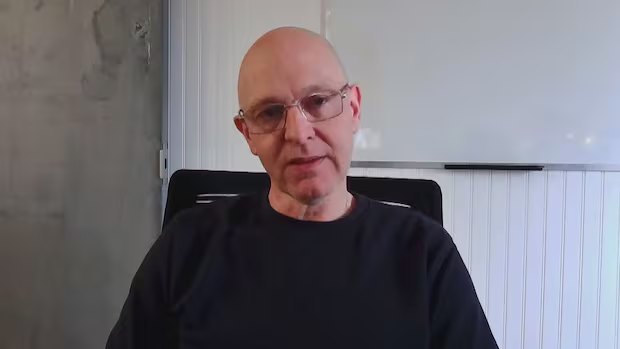
Thousands of jobs, billions in tax dollars: Iron Bear Project readies its pitch for N.L.
Iron Bear: the largest, potential natural resource development you've not yet heard about
Developers of the Iron Bear mining project in Western Labrador say they could end up producing more iron ore product each year than even the Iron Ore Company of Canada — if they can get into production.
Project leaders have been quietly working to firm up numbers, completing a scoping and now pre-feasibility study. They're readying their pitch for broader, public support.
As a rough sketch, the project — should it ultimately move ahead — would involve a mine just on the Labrador side of the Quebec-Labrador border, about 35 kilometres north of Schefferville, Que. There would be processing in Quebec, with potentially secondary processing in Canada as well, and new investments in regional transport.
Managing director of developer Iron Bear Resources Ltd. Paul Berend told the CBC the intention is to register for environmental assessment by the end of this year. That registration document will offer anyone interested the latest numbers and clearest look. Regardless, the idea that's been quietly advancing is big.
"It is a massive project. It requires a lot of power. It requires co-ordination between at least two provinces and the federal state," Berend said.
Should it move ahead, Iron Bear is large enough it will need about eight years to ramp up to full production.
Berend told the CBC it will have the equivalent of about 9,600 full-time jobs before full production, about 6,500 of those in Newfoundland and Labrador. Once in production, he estimated about 4,000, with two-thirds being in Newfoundland and Labrador.
He said the project could deliver about $300 million a year in tax revenue to Newfoundland and Labrador, with about a $1 billion regular contribution to GDP. More exact figures will only come as — and if — details advance and settle through the assessment stage, with required, formal discussions with Indigenous leadership, the provincial government and regional representatives all in the mix.
The provincial government is aware of the project and the scale being considered. Unprompted, Newfoundland and Labrador's Energy and Mines Minister Lloyd Parrott mentioned Iron Bear and the Iron Bear Project more than once in the estimates meeting for the department at the House of Assembly on May 4. The estimates meeting involves members from opposition parties posing line-by-line questions on the government's budget for the year.
Parrott was speaking generally about mining activity in the coming years in the region. He mentioned Champion Iron's Kami iron ore project, Tacora Resources' work on manganese, Tata, the Julienne Lake prospect, IOC.
"You've got companies such as Iron Bear up around Schefferville that have a deposit that they could bring to fruition that would eclipse — eclipse — what IOC does," he said, crediting IOC for its activities and plans, but making it clear Iron Bear is an attention-grabbing prospect.
Berend separately said the developers are envisioning a mine producing "a little bit more than what IOC currently produces."
Failure of Churchill River MOU 'a concern'
Power is an essential component of figuring out if the numbers on any proposed project will shake out to a green-lit development. In the case of Iron Bear, it's a clear challenge.
"We based all of our [initial] assumptions on the public MOU [on Churchill River development] which was between the two provinces, Newfoundland and Quebec. Now that MOU has dissipated, let's put it that way. That is a concern," Berend said.
Iron Bear is looking for "nearly a third of all the expansions of Churchill Falls" for its project, he said.
"We have received some comfort from the minister, Lloyd Parrott, that efforts would be made to ensure that we get the power required for this ... So we're hoping we'll get access to the power," he added.
It's unclear exactly how and on what schedule that might be possible, and how it lines up with proposed development timelines. It's all in the air for now.
In the region, there's curiosity about how any additional power needs in Labrador West and the Labrador Trough might be met.
"We're bound by the power. That's a limiting factor here," said Labrador West Chamber of Commerce executive director Michael Ward this week, not for the first time.
Ward said he spoke casually with Iron Bear representatives at the MINEx conference, an annual chamber-hosted event, over the last couple of years. He's taken notice of how much support is within reasonable reach of their potential mine site.
"A good chunk of the infrastructure is already there for them to get the ore out," he suggested.
However, he added, power is a central consideration. And Ward said there is blanket tension in the region that's really up to the provinces and their utilities to break.
"I guess at a certain level, the fact that I'm not hearing something is more promising than if I was hearing trickles of this and trickles of that," he said.
Any agreements between Quebec and Newfoundland and Labrador would be just one piece to Labrador West's power puzzle.
Ward called one more time for movement on construction of a new, high-voltage power line, capable of carrying more Churchill River or Quebec power into Labrador West, particularly to the area of Labrador City, Wabush and surroundings.
Labrador City Mayor Jordan Brown said he hasn't had contact with Iron Bear, though it may be because the development is closer to 250 kilometres north of his town. The concern he has is Iron Bear hasn't been a part of public power estimates for needs in Western Labrador and ongoing study work for the new transmission line, separate from the Churchill MOU.
Still, he wished the company well in their development work.
"We're just holding our breath hoping something comes through [on new power], because how this government has operated so far has really took the wind out of the sails for the region," he said, noting the town's needs for residential and commercial development as well as any new mines.
Newfoundland and Labrador Hydro public affairs representative Jill Pitcher confirmed Hydro — with federal, provincial and industry funding — is still actively studying options to expand transmission infrastructure for serving Labrador West communities, and mining projects.
She confirmed Hydro is not only aware of Iron Bear but "preliminary conversations" have happened on the project's potential power requirements.
"We would add that expanding electricity infrastructure in Labrador West remains a priority for both the provincial government and Hydro," she stated.
Berend remains positive and driving towards next steps for the Iron Bear project. His excitement, he suggested, is tied to knowledge of iron ore in larger supply chains, particularly steelmaking. About 98 per cent of all iron ore is used to make steel. He said what can be produced from the Labrador resource is a high-purity pellet, classified as a critical mineral.
As it stands, there's as much as 13.6 billion tonnes of ore identified for Iron Bear, with an indicated resource of 4.5 billion tonnes at just under 30 per cent iron content. An indicated resource is a mid-level measure, more confident compared to a lower-level inferred resource estimate.
Berend's roots are in Australia, the world's largest iron ore producer. He also comes from the steelmaking sector and, big picture, said pellets from Iron Bear could be used in a new green steel industry, as part of the re-industrialization of Canada, as has been pressed by the federal government and Prime Minister Mark Carney.
It's why Iron Bear has applied for referral to the federal Major Projects Office — something Berend hopes will help with the intergovernmental affairs and other matters involved in Iron Bear's development.
Green steel is so called mainly because its production, using natural gas, releases less in greenhouse gas emissions than traditional production relying on coal. You also need the right material to work with.
Iron Bear potential has already drawn the interest of Vale. The Brazilian mining giant signed an agreement to fund ongoing early-stage assessment work for the project. The company “will evaluate Vale’s participation in subsequent phases in due course," a spokesperson told CBC.
Download our free CBC News app to sign up for push alerts for CBC Newfoundland and Labrador. Sign up for our daily headlines newsletter here. Click here to visit our landing page.
Ashley Fitzpatrick is a reporter with CBC News based in St. John’s. She can be reached at ashley.fitzpatrick@cbc.ca.
Related Stories
 Careers
MUN cuts 107 jobs in latest move to reduce spending, address shortfalls
10 hours ago
 Careers
Helping businesses adapt, grow, create jobs through new grants
22 hours ago
 Careers
Nepal
1 day ago
 Careers
Jurors to resume deliberations in the Lindsay Clancy murder trial
1 day ago
 Careers
Watch: Six months into the Iran war: What has Trump accomplished?
1 day ago
 Careers
Norway's crown prince becomes King Haakon VIII after his father's death
1 day ago
 Careers
Canada 'will continue to fight' for auto jobs, says industry minister
1 day ago
 Careers
U.S. trade rep disputes why talks fell apart | Canadian exclusive
2 days ago