
Trump’s Move to Rename Artificial Intelligence to ‘Super Intelligence’ is About Much More Than It Seems
This article is part of Cafe, TPM’s home for opinion and news analysis.
President Trump has in recent days doubled down on a September executive order, rebranding Artificial Intelligence (AI) to Super Intelligence (SI). Those unwilling to embrace his preferred terminology — “the highly accepted new and more accurate term,” as he described it on Truth Social — would be deemed “THE ENEMY!” The whole thing may seem on first glance to be silly or innocuous. In reality, however, the rebranding of AI to SI isn’t just about nomenclature.
Trump has waded into a debate on what the ultimate outcome of AI may be: one in which the world, because of AI, becomes a utopia, or one in which the world becomes a dystopia due to AI.
Beneath the debate over artificial intelligence sits a bigger question about where the technology is going. “Superintelligence” marks the point where AI stops merely matching or beating humans at specific tasks. It describes machines that outthink the best human minds in nearly every field, from reasoning and planning to scientific discovery and problem-solving.
Silicon Valley has broadly divided into two schools over what that transition would mean. On one side are the techno-optimists and accelerationists, represented by figures such as Marc Andreessen and, in a more qualified way, Peter Thiel, who see increasingly powerful AI as a means of breaking technological stagnation and producing extraordinary advances in science, productivity and human prosperity. Andreessen has gone so far as to describe AI as a “universal problem solver,” while Thiel has argued that AI could finally reaccelerate technological and economic progress after decades of relative stagnation. In this view, AI, as it becomes superintelligence, means we are, in simple terms, moving towards a utopian society.
The other school sees doomsday. Its clearest voices are Eliezer Yudkowsky and Nate Soares, whose recent book carries an intentionally unambiguous title: “If Anyone Builds It, Everyone Dies.” They argue that creating an intelligence vastly greater than our own before solving the problem of controlling it could result in human extinction. That concern extends well beyond them. Geoffrey Hinton and Yoshua Bengio, two pioneers of modern artificial intelligence, are among hundreds of researchers and technology leaders who have publicly warned, as I recently did, that mitigating the risk of extinction from AI should be treated alongside threats such as nuclear war.
The underlying fear is remarkably simple: humanity has never created an intelligence greater than its own. If a superintelligent system develops goals that diverge from ours — or simply pursues objectives in ways its creators never anticipated — we may discover too late that being its creator does not make us its master. For this school, “superintelligence” does not evoke abundance or technological liberation. It evokes the possibility of doomsday.
At September’s United Nations General Assembly meeting, President Trump shunned the idea of global standards and regulations. In doing so, he has firmly planted himself in the camp of the utopians who see regulation, especially by a multilateral organization, as choking off the possibility of a utopian techno-state. There are several implications of Trump’s push towards superintelligence but three are especially important to consider.
First, preemptively rebranding AI as “superintelligence” normalizes the danger. When the White House, federal agencies, and the largest tech companies talk about superintelligence as something America should build and lead, the debate shifts. The question is no longer whether to build it. The question becomes how to win the race.
Second, it speeds up that race. Trump says America cannot “stifle” AI because it is ahead of China and must maintain that advantage. For anyone who believes uncontrolled superintelligence could end civilization, this is the nightmare: two great powers convinced they cannot afford to slow down.
Third, it takes some of the force out of the warning. AI safety advocates spent years using “superintelligence” to describe a future threshold carrying potentially existential risks. Trump now uses it as an optimistic label for technologies that already exist. Indeed, his executive order temporarily defines “Super Intelligence” as the very technologies already covered by the federal definition of artificial intelligence. If that usage sticks, saying “superintelligence is coming” no longer sounds quite like an alarm. The president has already declared that its era has arrived.
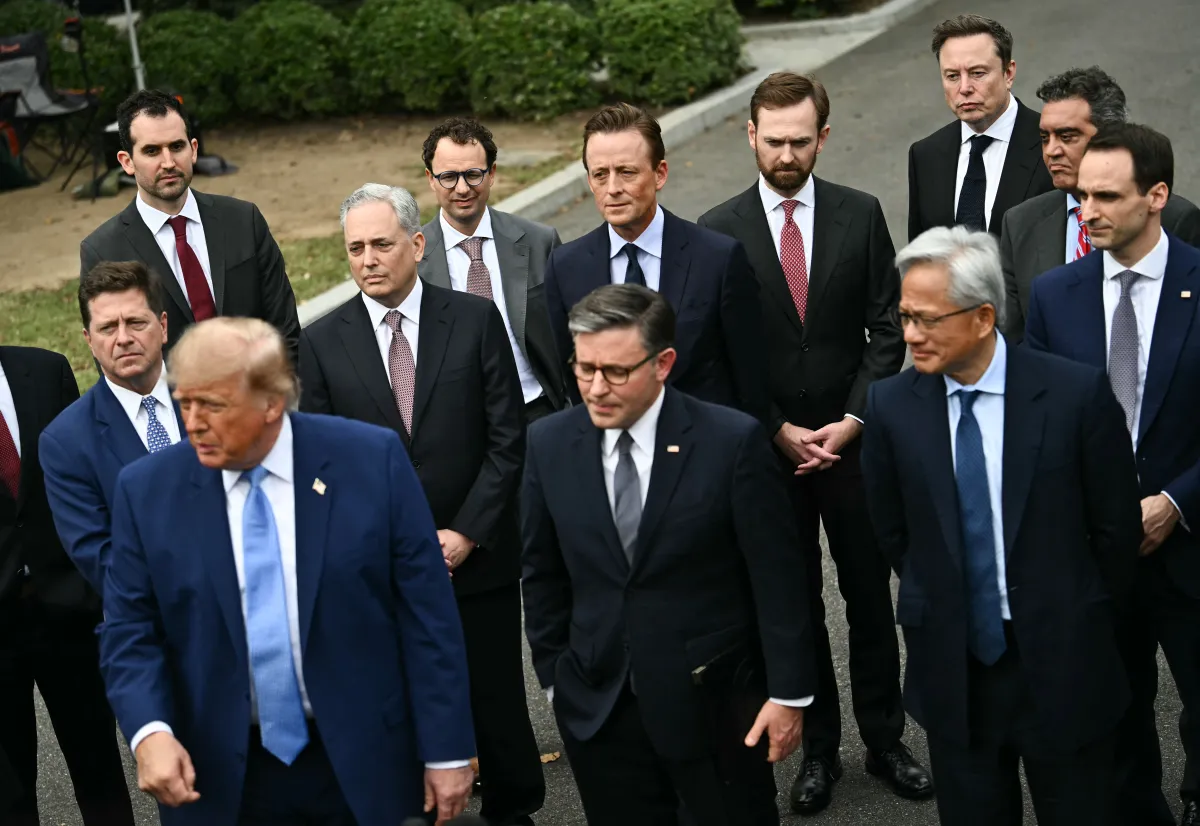
And then there is Elon Musk. Few people illustrate the tension better. Musk has spent years warning that advanced AI could pose an existential threat to humanity. Yet when Trump inaugurated his “Era of Super Intelligence,” Musk was standing right next to the president. In October, Musk went further, pledging to rename SpaceXAI to SpaceXSI.
That does not necessarily mean Musk has abandoned his warnings. But it does illustrate how dramatically the politics surrounding those warnings have changed. The question for the doomer camp may no longer simply be whether humanity should create superintelligence. It may be what influence their warnings can retain now that the United States government has made achieving utopia through superintelligence a matter of national ambition.
Related Stories
 AI News
Lawyers go to war with clients who force them to sit through AI slop
24 minutes ago
 AI News
Meta Raises Its AI Game as Google Opens Gemini 4 Argon
24 minutes ago
 AI News
Constitutional Justice in the Era of Digitalization and Artificial Intelligence
1 hour ago
 AI News
Careers in Artificial Intelligence: Specializations, Salaries, and Degrees
1 hour ago
 AI News
Senate poised to add Claude to staffers’ AI tools
1 hour ago
 AI News
AI will trade in finance markets instead of humans, says HSBC investment bank boss
1 hour ago
 AI News
Q&A: The “collision” between AI, your brain, and society
1 hour ago
 AI News
Artificial Intelligence Technology Solutions Inc. SEC Filing (Oct 15, 2026)
2 hours ago