
Typhoon Dolphin batters Japan's southwestern islands
Typhoon Dolphin batters Japan's southwestern islands
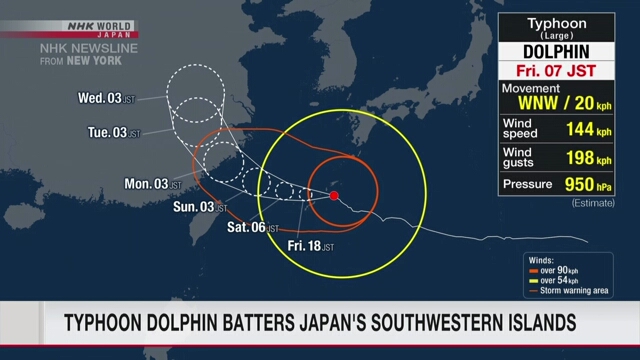
A large typhoon's storm zone has engulfed Japan's southwestern islands. Weather officials are warning of violent winds, high waves, landslides and other storm-related disasters.
The Japan Meteorological Agency says that as of 5 a.m. Friday, Typhoon Dolphin was over waters 140 kilometers east-southeast of Okinoerabu Island and believed to be moving west at 20 kilometers per hour.
Dolphin is packing sustained winds of up to 144 kilometers per hour near its center, with gusts of up to 198 kilometers per hour.
The typhoon's storm zone is believed to be covering Kagoshima Prefecture's Amami region, as well as Okinawa Prefecture's main island region and Daitojima region.
On Friday, sustained winds of up to 144 kilometers per hour are forecast for Okinawa and Amami, and up to 79.2 kilometers per hour for southern parts of the Kyushu region. Gusts of up to 216 kilometers per hour are expected in Okinawa and Amami, and up to 126 kilometers per hour in southern Kyushu.
Powerful winds capable of destroying some homes could batter Okinawa and Amami. People in the areas are urged to remain on alert for violent winds through Saturday.
Rain is also expected to intensify in Okinawa, Amami and southern Kyushu.
Bands of heavy rain clouds could develop over Okinawa's main island region through Saturday morning and over the Amami region through Friday night. Torrential rain from the clouds could sharply increase the risk of disasters.
Rainfall over the 24-hour period through late Friday night could reach 200 millimeters in Okinawa, Amami and southern Kyushu.
Weather officials are urging people in Okinawa and Amami to remain on high alert for violent winds, high waves, landslides, flooding in low-lying areas, and rising and overflowing rivers.
People in Pacific coastal areas of western and eastern Japan should also remain on alert for high waves.
Related Stories
 World
World
Maltese tycoon found not guilty of involvement in Daphne Caruana Galizia murder
27 minutes ago
 World
World
Global’s ‘TMS2’ announces Brad Smith as co
27 minutes ago
 World
World
Iran fires on its Gulf neighbors, retaliating for U.S. strikes after a monthlong lull
27 minutes ago
 World
World
Faisal Islam: Why bond market wildfire is keeping world leaders up at night
27 minutes ago
 World
World
Climate change past the point of no return, UN says, as worst impacts are now unavoidable
1 hour ago
 World
World
World must prepare for ‘reality’ of missing 1.5C goal: UN
1 hour ago
 World
World
US and Iran exchange more airstrikes, fuelling fears of wider return to hostilities
1 hour ago
 World
World
‘Wheel of Fortune’ announcer Jim Thornton suspended amid ‘allegations’
3 hours ago