
Union, Opposition call for better health
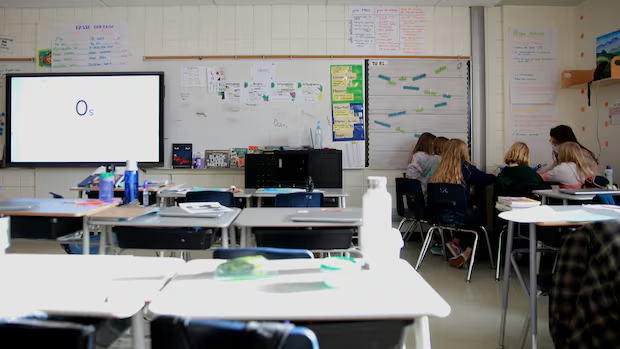
Union, Opposition call for better health-care support in Sask. schools
CUPE survey suggests many school support workers administer medical care without training
Saskatchewan's Opposition and the union representing the province’s educational assistants (EAs) and support workers say those workers are having to provide medical support to students in the classroom.
The Canadian Union of Public Employees (CUPE) and the Saskatchewan NDP held a news conference Monday. They spoke about a survey done by the union that suggests EAs were regularly attending to medical issues, including administering EpiPens, providing feeding tubes and responding to seizures.
“If some of these medical procedures were performed in hospitals instead of schools, the law would require them to be done by registered nurses,” Kent Peterson, CUPE Saskatchewan’s president, said at the news conference.
Jennifer Simmons spoke at the event about her daughter's health struggles in the classroom. Eight-year-old Kinsley was diagnosed with Type 1 diabetes last November and was only able to attend class five times after the diagnosis due to a lack of support at school, her mother said.
Simmons said education assistants weren’t properly trained to monitor Kinsley's glucose levels, which led to a big health scare at school.
“Her blood sugar continued to fall, she began stumbling, she began losing her vision and she progressed into a severe hyperglycemic shock,” Simmons said.
“This happened at school, where she has the right to a safe and dignified accommodation.”
Simmons said the classroom EA wasn’t trained on how to handle students with diabetes, and gave Kinsley a candy to level out her blood sugar.
CUPE said it's calling for consistent provincial standards and policies, proper training delivered by professionals, and a commitment that workers will not be expected to take on medical responsibilities without the training and support to do them safely.
“Caring about students should never should never mean being expected to perform medical procedures without proper training, clear direction, support or protection,” said Karla Sastaunik, chairperson of CUPE Saskatchewan’s education workers’ steering committee.
CUPE said it brought the survey results to the provincial government and made practical recommendations on how school systems can improve.
The province told CBC in a statement that it has a policy requiring school divisions to co-ordinate with medical professionals and families on how to provide the best care, and that it’s up to individual school divisions to make staffing decisions to best serve the health and safety of students.
Simmons said the school division her daughter was attending recommended finding another school more suited to handling students with diabetes. She said her daughter will be moving schools, but that the whole process has been frustrating, prompting her to speak out.
“We want the next family to find a standard waiting for them instead of a fight,” Simmons said.
“So families don’t have to fight this hard and so education workers have the training and support they deserve.”
Halyna Mihalik is a journalist and weather specialist for CBC Saskatchewan. She holds a degree in journalism from the University of Regina. Halyna enjoys stories about advocacy, local politics and rural communities. Send Halyna news tips at halyna.mihalik@cbc.ca
Related Stories
 Education
Hong Kong pro
14 hours ago
 Education
Indian students are warming up to foreign university campuses at home
19 hours ago
 Education
SBS and oOh!media Launch News Content Partnership
1 day ago
 Education
Beauty spot inappropriate campers moved on
3 days ago
 Education
Exeter University approves deal with Saudi Arabia to train military officers and officials
4 days ago
 Education
After autistic student denied, Quebec faces calls to reform French exemption process
4 days ago
 Education
Minister: Appointing MPs, MLAs to free campuses of politics
1 week ago
 Education
Caribbean
1 week ago