
Venezuelans on the front line of earthquake relief: 'It's all improvisation'
Venezuelans on the front line of earthquake relief: 'It's all improvisation'
The coastal state of La Guaira, one of the hardest-hit areas, has faced natural disaster before
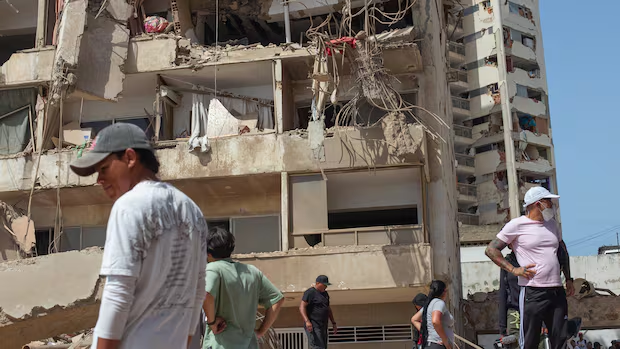
Death is everywhere in Playa Grande, a beachfront neighbourhood in Catia del Mar, a city in the Venezuelan state of La Guaira which was devastated by Wednesday's back-to-back earthquakes, says Rober Javier, who has spent the past two days searching for survivors and bodies.
Javier, a musician who plays the French horn, says he came across more than a dozen unclaimed bodies Friday within a 300 metre radius — not far from the local Marriott hotel where he and a group of doctors, paramedics and volunteers have set up a base camp in the city, which sits along the Caribbean Sea, about 30 kilometres north of Caracas.
"They've [dug out] many more people," he said, in a telephone interview with CBC News.
"The whole city smells of putrefaction.… It smells like death."
The official death toll continues to rise following Wednesday's successive earthquakes which registered a magnitude of 7.2 and 7.5, respectively. Venezuelan authorities said Friday that 920 people had been confirmed dead, with 3,360 injured and about 172 who remained trapped.
A list maintained by a website created to crowdsource missing persons reports has grown to more than 50,000 names.
Rescuers dig through rubble for Venezuela earthquake survivors
Vicente Villarroel, a former federal lawmaker from the city of La Guaira, said that the government's response has been haphazard and that the civilian population has shouldered the brunt of the rescue and recovery work with their bare hands, picks and shovels.
Villarroel said he went by motorbike to two areas of La Guaira state called Carballeda and Macuto that were completely devastated by the earthquake. He said he saw over two dozen pieces of heavy machinery working without any real co-ordination.
"There is no planning, it's all improvisation," he said. "This is a state that is lacking in security services to deal with this type of emergency. Our firefighters and first responders don't have the proper equipment."
Global aid coming, president says
Villarroel, who is setting up a donation centre in his city, said Venezuela desperately needed international help.
Venezuelan President Delcy Rodríguez visited Macuto on Thursday and said that international help was coming. Teams from Mexico, El Salvador, Chile, Spain, Switzerland and Colombia have all arrived in the country to bolster the search and rescue effort. The U.S. is also contributing on-the-ground support.
The state of La Guaira suffered a major natural disaster in 1999 after torrential rainstorms triggered flooding and massive landslides that destroyed thousands of buildings and left a casualty count that surpassed 10,000.
Villarroel said he believes damage from the earthquakes is much worse.
Venezuelans in regions that escaped the brunt of this week's earthquakes have rallied to support their fellow citizens.
Javier said he was in Barquisimeto, which sits about 370 kilometres west of the capital Caracas, preparing to fly to Spain Wednesday to play at a music festival when the earthquake struck.
While there was minimal damage in his hometown, it soon became clear that parts of the country had suffered severe damage.
'We thought that nothing worse could happen'
Javier said he joined a convoy, organized by a medical services company, with three buses and two trucks loaded with supplies which left Barquisimeto for La Guaira on Wednesday night. He said the group included doctors, paramedics, nurses and volunteers.
Javier said they are working with people from all over the country.
"With everything that has happened to Venezuela in the past few years, we thought that nothing worse could happen," he said.
"But what has happened is a real catastrophe, a tragedy."
Venezuela was in crisis even before quakes struck, says Caracas journalist
Venezuela has suffered through over a decade of political upheaval and economic collapse which has led millions of people to leave the country.
Angel Bermudez, a social media content creator in Barquisimeto, has been involved in city-wide donation drives since the earthquakes struck. He said there has been an outpouring of support, with people lining up in their vehicles to transport supplies to Caracas, which also suffered collapsed buildings in several neighbourhoods.
"Our land is noble. When one suffers, we all suffer," said Bermudez.
"Venezuelans have been through a lot, we are the definition of resilience."
Raquel Mercedes Contreras Manrique is the president of the student centre at the University of Los Andes in San Cristobal, a city about 800 kilometres southwest of Caracas.
The third-year medical student has been organizing a donation drive at the university that has so far led to two truckloads worth of supplies — including food, blankets, medicine — for shipping to Caracas and other hard-hit zones.
"What motivates me to become part of this movement is the empathy I feel for all Venezuelans who have lost their homes, their families, their will to live because they have been left with nothing," said Contreras Manrique.
"I think, as Venezuelans, more than ever, we are united for different reasons. Many of us have families in the impacted zones, others do it from a desire to help, but in the end it's all the same objective."
Jorge Barrera is a Caracas-born journalist currently based in Mexico City for CBC News. He previously worked with CBC's Investigative Unit and CBC's Indigenous Unit. Follow him on X @JorgeBarrera or email him jorge.barrera@cbc.ca.
Related Stories
 AI News
Trump
45 minutes ago
 AI News
5.9 magnitude earthquake shakes Pakistan and Afghanistan, no damage reported
45 minutes ago
 AI News
Cape Verde makes history as the smallest nation to reach knockout stage
45 minutes ago
 AI News
Why offside was called on Iran goal in controversial ending vs. Egypt to deny World Cup win
45 minutes ago
 AI News
U.S. strikes Iran after Trump claims ‘foolish violation’ of ceasefire
46 minutes ago
 AI News
BJP accuses Congress of vote bank politics over Sonia Gandhi’s Gaza remarks
46 minutes ago
 AI News
Narendra Modi’s India: A decade of popularity and polarisation
46 minutes ago
 AI News
India's government to 'continue unabated' despite shocking RCMP allegations, Sikh activist says
46 minutes ago