
What is Artificial intelligence really doing to students?
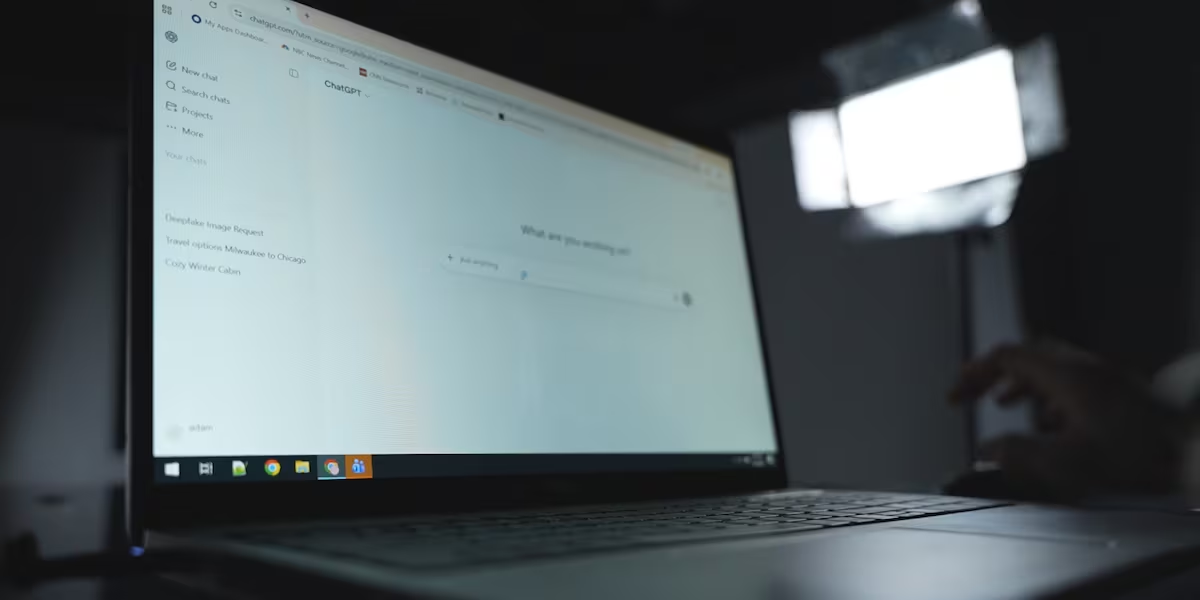
DULUTH, Minn. (Northern News Now) - As students across the Northland head back to school, artificial intelligence is becoming an increasingly common part of their everyday lives. Experts say there are concerns about dependency, privacy, misinformation and mental health as students spend more time interacting with AI.
University of Minnesota Duluth Computer Science Professor Dr. Ted Peterson discussed the potential risks of AI use among students.
Peterson explained the informal term “AI psychosis,” which he said refers to excessive AI use causing a disconnection from reality, including beliefs, delusions or paranoia fed by the AI.
“This is an informal term that is used to mean when excessive use of AI causes a kind of disconnection from reality, and maybe beliefs and delusions or paranoia that is being fed by the use of the AI, usually chat bots,” Peterson said.
Peterson said if a user tells a chatbot that their friends are out to get them, the chatbot may agree with them and increase that worry or paranoia.
Peterson said there is a risk of children becoming overly dependent on AI, regardless of age group.
“I think there’s a real risk of that, actually, for any age group, and I think the key warning sign is if the use of AI in a chatbot is coming to replace personal relationships with human beings,” Peterson said.
He said asking AI for homework help instead of a teacher, tutor or parent cuts users off from human connections, which he described as often the first stage of becoming overly dependent.
Peterson said AI is becoming a shortcut for homework, saying the technology can answer many kinds of homework questions and write essays in a way that looks reasonable.
“The problem, though, and the reason it becomes a shortcut is a lot of the times, when we have a student write an essay for our example, it’s not that we just want them to produce an essay. We want them to go through the thinking and creation that goes into creating that essay,” Peterson said.
Peterson said relying on AI for opinions and ideas can remove critical thinking from the process and limit students’ ability to think for themselves.
To address overuse of AI in education, Peterson said students should be encouraged to use human resources available to them.
“I think, really encouraging students at all levels, to take advantage of the human resources around them, be they teachers, or professors, or a writing center, or a counselor. It’s really important, given the availability of AI, to emphasize to students that getting help from people is an important skill to develop,” Peterson said.
Peterson said AI chatbots can turn into relationships when users rely more on the chatbot for advice or companionship than the people in their lives. He said in cases of extreme use, people cut off humans in their lives to spend more time with the chatbot.
“I think we’ve certainly seen it among younger people, because I think when you are young and growing up, life can feel very difficult, and you can feel isolated, or that nobody understands you. And so having the chat bot to confide in, and the chat bot will normally agree with you and affirm you, and it’s very easy for that to become a very important kind of relationship to the exclusion of humans around you,” Peterson said.
" there’s a big misconception that the AI is actually thinking and getting to know you, but the truth is, it’s not thinking, it doesn’t know you, and it doesn’t, in the end, care about you," Peterson said.
Peterson said one of the biggest misconceptions among AI users involves privacy.
“Everything you say or type to the AI is recorded and added to the training data of that model, and I’ll also use to create a profile of you. And they have access to enormous amounts of information, and I don’t think most people are fully conscious or aware of that even,” Peterson said.
Peterson said all users are vulnerable to AI-generated deepfakes and misinformation because the quality of the fakes is increasingly lifelike. He said younger people may be more vulnerable because they have limited experience in the world and with people, and may be more willing to believe what they see or hear.
Click here to download the Northern News Now app or our Northern News Now First Alert weather app.
Copyright 2026 Northern News Now. All rights reserved.
Related Stories
 AI News
Tumbler Ridge mass shooting victims file 30 new lawsuits against OpenAI
39 minutes ago
 AI News
Teachers, students file new wave of lawsuits against OpenAI over Tumbler Ridge shooting
40 minutes ago
 AI News
Fintechs race to deploy AI agents, but revenue payoff remains elusive
43 minutes ago
 AI News
AI: when Grok, ChatGPT, Gemini, and Claude become radio hosts for six months
44 minutes ago
 AI News
Kindsight puts AI to work for fundraisers, launching its new agents and expanding Kindsight Intelligence at KindCon 2026
44 minutes ago
 AI News
RRC Polytech triples seats for cybersecurity program as it works to fill growing demand for AI skills
44 minutes ago
 AI News
Autonomous aircraft: Pilot
1 hour ago
 AI News
Anthropic introduces zero
1 hour ago