
When paintings became politics: Emily Eden and arts of the empire | Latest News Delhi
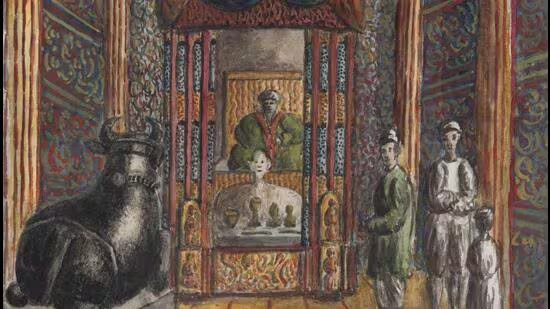
When paintings became politics: Emily Eden and arts of the empire
In the 1830s, Emily Eden's portraits in India fostered diplomatic ties for the East India Company, capturing diverse lives beyond imperial confines.
Empires are usually remembered for the wars they fought, the treaties they signed and the territories they conquered. Rarely are they remembered for the paintings that helped forge key alliances.
Yet, in the early decades of the 19th century, as the East India Company scrambled to secure its hold over India against the shadow of an expanding Russian Empire under Nicholas-I, one of the Company’s most effective diplomatic allies was not a soldier or a statesman, but a young Englishwoman carrying a sketchbook.
The younger sister of George Eden, the then governor-general of India, Emily Eden accompanied him on an extraordinary journey from Calcutta to Lahore in the early 1830s, when the Company was courting influential rulers such as Maharaja Ranjit Singh and Raja Karam Singh. As her brother negotiated alliances, Emily painted.
Those portraits proved to be far more than souvenirs of an imperial tour.
Displayed before the princes who sat for them, the paintings delighted their subjects, softened introductions and deepened relationships. In their own understated way, they became instruments of diplomacy, helping the East India Company cultivate the goodwill it desperately sought.
“I believe that Emily wanted to produce the portraits of the Indian royalty, seeing them as spectacular and good-looking, with George Eden’s approval. They weren’t given away as gifts but shown to the sitters, who greatly admired them. One of Emily’s portraits, of Queen Victoria in an elaborately bejewelled frame, was among the official presents given to Ranjit Singh, which delighted him and led to a torrent of questions about the young Queen,” said art historian Mary Ann Prior, author of The Life and Work of Emily Eden (2012).
Nearly two centuries later, those same paintings have acquired an altogether different significance.
DAG (formerly Delhi Art Gallery) on Friday has launched an exhibition of more than 20 works created during Emily Eden’s two-year journey across northern India, alongside journals, letters and material from the Eden family archives. Together, they tell a story that reaches far beyond empire.
For while Emily travelled through India as part of the colonial establishment, she painted with a curiosity that often escaped it.
Kings, queens and courtiers found space in her sketchbooks. So did a family of traders from Shimla, a student of Hindu College, attendants, servants, labourers and wandering ascetics. She seemed less interested in rank than in presence.
“Eden’s main drive was to record her experience in India for her friends and family in England. Whoever she saw, she would persuade them to sit down for a painting, without discriminating whether they were from a royal background or commoners,” Prior said.
The DAG exhibition, titled “Princes and People of India”, also displays Eden’s journals and correspondence, all of which help provide insights into colonial life.
“Every servant at Government House is a picture by himself, in his loose muslin robes, with scarlet and gold ropes round his waist, and his scarlet and gold turban over masses of black hair, and on the esplanade I hardly ever pass a native that I do not long to stop and sketch,” she wrote from Calcutta.
At a time when many colonial accounts flattened India into spectacle, she lingered over faces, occupations, gestures and ordinary lives.
The DAG exhibition also includes a watercolour of a fakir who travelled with the Eden camp, staff in one hand and drum in the other, guiding the caravan across unfamiliar country. At the end of long, punishing marches, Emily wrote, the man was rewarded with contributions collected from members of the camp.
“Their journey from Calcutta to Lahore was very long and an incredible feat. The paintings depict places along a route that was not much travelled on. It is difficult for Indians to visit Pakistan today, and some places along the route they took, even I was not able to reach while researching for the exhibition,” Prior said.
Prior began to research for her book in 2008, visiting the British Museum and the Victoria & Albert Museum in London, and browsing through the Countess of Avon Anne Clarissa Eden’s private collection. In India, she visited the Victoria Memorial Collection to view the Emily Eden watercolours, and also travelled to the Sundarbuns, Delhi, Agra, Mussoorie, and Shimla.
The paintings, Prior said, are a rich historical repository of Indian society in the 19th century.
Eden’s paintings are also significant because they are some of the few available documentations of the country by a woman traveller.
According to Prior, Emily’s importance lay not only in her artistic ability but in the extraordinary access she enjoyed.
“There may be female artists we don’t yet know about, but there were not many who received the same public attention she did. Other people also did not have access to Indian kings. She was also very consistent in documenting people, and ended up producing a very valuable record of the Indian people at that time,” she said.
Perhaps no relationship better captures the spirit of the journey than her encounters with Maharaja Ranjit Singh.
In George and Emily Eden: Pride, Privilege, Empire and the Punjab (2024), biographer Brigid Allen recounts the growing personal relationship between the Edens and the royal family. “From a quiet corner on his blind side, Emily had begun sketching the Maharaja, and when ‘he found out, he begged [the artist] might not be interrupted,” Brigid Allen wrote in the biography of Emily and George Eden, “George and Emily Eden, Pride, Privilege, Empire and the Wings” (2024).
The exhibition draws on DAG’s recently acquired Eden Family Archives, bringing together Emily Eden’s published works, journals and related material from Punjab. “Emily Eden occupies a unique place in the visual history of nineteenth-century India. Her portraits are remarkable not only for their artistic accomplishment but also for the breadth of people she chose to represent—from rulers and military leaders to attendants, artisans and communities she encountered along the way,” said Anish Anand, CEO and managing director of DAG.
The exhibition is on display at DAG from July 10 to August 1.
Related Stories
 India
India
Rahul Gandhi questions India PM Narendra Modi's 'culture shock' comment over women swearing at CJP protest
3 hours ago
 India
India
US military kills four in strike on alleged drug smuggling boat in Caribbean
5 hours ago
 India
India
The question dominating Indian politics: Is it worse when women swear?
5 hours ago
 India
India
What we know about deadly Nepal
7 hours ago
 India
India
India news: Police used 'excessive force' on CJP protesters
8 hours ago
 India
India
24 Canadians among missing in Nepal flash floods: local spokesperson
9 hours ago
 India
India
The politics of religious 'purification'
9 hours ago
 India
India
24 Canadians among hundreds missing after flash floods kill at least 157 in Nepal, Tibet
9 hours ago