
White House AI Responsibility Accord & Super Intelligence Task Force: What Businesses Need to Know
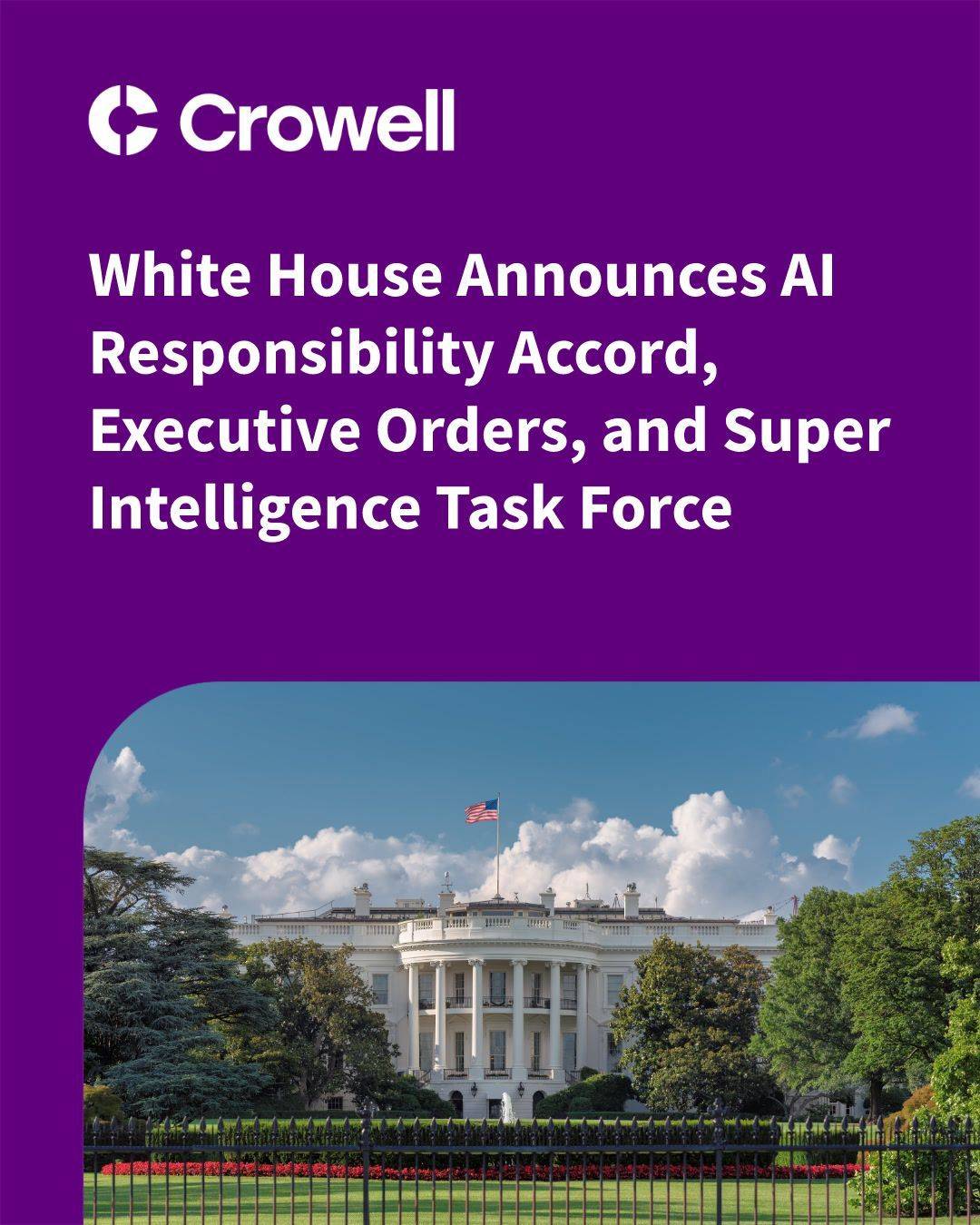
In June, the president, seemingly in reaction to the cybersecurity risks of frontier artificial intelligence models, ordered the establishment of a voluntary regulatory regime for the government to scrutinize frontier models prior to public release.
In the past week, amid still rising concerns over the safety of AI models and mounting calls to regulate against their dangers, the White House apparently went in the other direction, endorsing a light regulatory approach that the president characterized as corporate “self-policing.”
On September 29, President Trump signed a “White House Accord on Super Intelligence” (Accord) with half-a-dozen tech industry leaders. They voluntarily agreed to adopt safety policies that include audits and third-party evaluations and risk reviews.
The same day, the president issued two executive orders. “Inaugurating the Era of Super Intelligence” directed the Executive Branch, “to the maximum extent permitted by law,” to adopt the term “super intelligence” instead of “artificial intelligence” in correspondence, communications, and “non-statutory documents.” The White House intends the move to “capture[] the promise, potential, and rapidly advancing capabilities of these technologies.”
The executive order “Streamlining Access to Government Services Through America.gov” revamped the America.gov website to streamline Americans’ access to information and services speckled across government websites through an AI chatbot.
And, on October 4, the president announced the creation of an interagency “Super Intelligence Force” (SIF) to “coordinat[e] the effort of the Federal Government to ensure that America continues to lead the World in Super Intelligence.” The SIF will coordinate with consumers, public interest groups, religious organizations, critical infrastructure providers, and AI companies and issue a report in 120 days on the risks and opportunities presented by AI, according to reports.
After meeting in the White House, executives at six leading AI companies signed the one-page Accord, agreeing voluntarily to adopt safety policies that include four layers of controls and audits, in addition to any other precautions:
“Inaugurating the Era of Super Intelligence” mandates that the executive branch use the terms “Super Intelligence” and “SI” in place of “Artificial Intelligence” and “AI,” and the order says the Trump Administration will no longer “acknowledge the usage of ‘Artificial Intelligence’ or ‘AI’ in any applicable setting.” The order is not retroactive and does not require alteration of “previously issued regulations, Presidential actions, contracts, grants, or other historical documents.” The term SI may have limited public appeal; a recent poll showed that 53% of respondents considered “artificial intelligence” the preferred term while 9% favored “super intelligence.”
“Streamlining Access to Government Services Through America.gov” establishes a digital point of entry through which individuals in the U.S. can access federal information, services, and transactions. The order states that America.gov will provide access to “covered services,” that is, public-facing federal services that serve more than 100,000 users per year and are accessible online, excluding IRS tax filing services, Department of War services, and elements of the Intelligence Community. Each agency should preserve control of its respective records, systems, statutory responsibilities, and adjudicatory authority.
The SIF will be led by Director of National Intelligence Jay Clayton, Chairman of the Federal Trade Commission Andrew Ferguson, Under Secretary of War for Research and Engineering and Chief Technology Officer Emil Michael, and Director of the Office of Personnel Management Scott Kupor. The SIF will have four months to coordinate with, in the president’s phrase, “Consumers, Public Interest Groups, Religious Organizations, Critical Infrastructure Providers, and Super Intelligence Companies” and write a report on AI’s risks and opportunities.
Industry may have opportunities to engage with the SIF. While the SIF goes about its work, private plaintiffs, state attorneys general, federal regulators including the Federal Trade Commission and Securities and Exchange Commission, congressional committees, state legislators, and foreign governmental bodies are acting with increasing aggressiveness to investigate alleged harms, in light of evolving technological capabilities and darkening public perceptions. AI developers now face layered and evolving compliance obligations that are unlikely to abate in the near term.
Related Stories
 AI News
Anthropic reveals Haiku 5.5 model as AI pricing war intensifies
10 minutes ago
 AI News
The Future of Data Analysis in the Age of Artificial Intelligence
39 minutes ago
 AI News
Meta Is Refusing to Remove AI
39 minutes ago
 AI News
Watchdog group says ChatGPT should be restricted for teens
1 hour ago
 AI News
LibreOffice touts ‘no AI’ as a feature
2 hours ago
 AI News
WSU turns to artificial intelligence to assist sports communications
2 hours ago
 AI News
Sam’s Side: Artificial intelligence makes Halloween scarier than ever
2 hours ago
 AI News
AI could take advisors back 3 decades. That's a good thing
3 hours ago