
Why is Canada spending tens of billions on new submarines?
Why is Canada spending tens of billions on new submarines?
Multibillion-dollar program is expected to be the largest in Canada's history
Canada is looking to spend tens of billions of dollars on a contract with German shipbuilder ThyssenKrupp Marine Systems (TKMS) to replace Canada's aging fleet of submarines with up to a dozen new vessels.
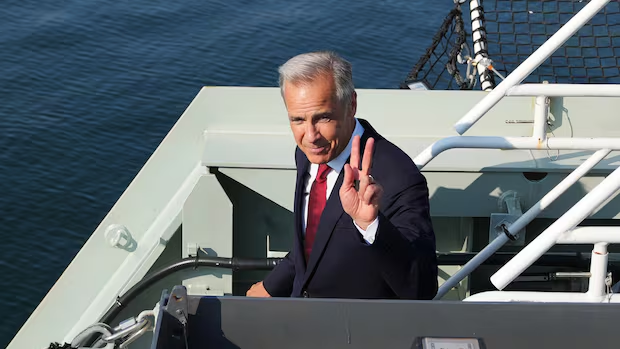
Prime Minister Mark Carney called it the biggest defence procurement project in Canada's history.
Here's why the purchase could stack up to a major price tag of $100 billion or more over the lifetime of the deal.
Responding to a 'dangerous and divided world'
Whether or not it was purely convenient timing, Carney met with Ukraine's President Volodymyr Zelenskyy one day after announcing his submarine plan.
Carney reiterated Canada's opposition to Russia's ongoing invasion of Ukraine, issuing a stark promise that Russia's full-scale war since 2022 "will not succeed."
"The resolve of the Ukrainian people, first and foremost, but also of your allies, is absolute," Carney said. "Let's end this. The pressure on Russia is only going to increase."
The threat of Russia's war in Ukraine is a major motivator for NATO countries to drastically increase their defensive capabilities. By the end of the fiscal year on March 31, Every NATO country had met the alliance's defence spending benchmark of two per cent of gross domestic product — including Canada.
German defence minister warns NATO to stop hitting ‘snooze’ on Russian threat
NATO members continue to build up their capabilities toward the next defence spending target of five per cent of GDP by the mid-2030s. Canada is no different and is now set to spend tens of billions of dollars in just the initial phase of its submarine contract with TKMS.
Making the case for the need for new submarines, Carney cited a more "dangerous and divided world," saying "authoritarian regimes are increasingly assertive."
Arctic sovereignty a major focus
As the ice in Canada's Arctic recedes, Carney was clear that the increasingly open northern seas bring "new threats and opportunities" here at home.
"As threats grow faster and harder to detect, Canada's Arctic is becoming integral to the security of both North America and NATO's western flank," Carney said.
Defending distant, unsurveyed Arctic 'more complicated,' top naval commander says
On top of an order of up to a dozen submarines, the federal government is also looking to invest in tools like Saab's GlobalEye airborne early warning aircraft to survey Canada's vast Arctic, a significant challenge for the Canadian Armed Forces.
In announcing the submarine investment, Carney was clear that defending the Arctic "is why we are here today."
The Royal Canadian Navy's current submarine fleet only amounts to four well-worn Victoria-Class vessels — only one of which is currently operational.
"We have one submarine that's operational in Canada. We have three coasts," Carney said. "We do not have enough submarine capacity."
There is no domestic Canadian submarine manufacturer, so the government is looking to procure its new boats from Germany's TKMS. Still, the project promises much of the legwork to put the submarines together — like manufacturing, building components and developing technology — will be done by Canadian workers.
Canada chooses German supplier for new submarine fleet
Defence analyst Dave Perry, president of the Canadian Global Affairs Institute, said negotiating a full suite of a dozen submarines would completely transform the Royal Canadian Navy.
"This should really make a huge change in terms of the operational ability for the Canadian navy to put submarines to sea," Perry told CBC's Power & Politics.
He said part of that shift comes from how the partnership with TKMS would grant Canada's future submarine arsenal "membership in a wider fleet" that comes with an increased parts supply and maintenance availability.
"If you had a smaller fleet, like we do with our old ones, we're basically the only supplier," Perry said. "It's like maintaining an antique car — you've got to get bespoke parts."
The TKMS Type 212CDs currently in development for Germany and Norway come with the promise of interoperability with NATO forces — given that TKMS is already a supplier for the alliance.
Having met NATO's two per cent defence spending target, the government is now looking to reach the alliance's next benchmark of five per cent of gross domestic product by 2035 spent on defence and defence-related infrastructure.
Perry said the scope and scale of Canada's submarine purchase "definitely helps" meet that goal.
"The Royal Canadian Navy is going to need completely new infrastructure," Perry said. "They're going to need at minimum a tripling of the existing infrastructure footprint as well as a modernization of it."
Carney hails submarine deal as NATO win, moves to ease South Korea's disappointment
5 key takeaways from Canada choosing Germany's submarine bid
While the government has yet to release any exact numbers around the developing TKMS contract, it is believed the initial purchase could cost up to $24 billion with the overall program running up a price tag of around $100 billion or more when including the cost of maintaining the boats.
Perry said an overall cost in that ballpark would likely be spread out over 10 to 15 years and would stimulate "about a few billion dollars a year annual uptick in spending just on the submarine project alone over a sustained period of time."
With Canada's slew of new defence and security investments and pursuing its NATO commitments, Perry said, "I think we've gone about as fast as we can trying to rehabilitate some of our credibility as an ally in a short time period."
"Canada's actually serious about defence now and it's becoming a habit that we make commitments and actually deliver on them."
David Cummings is a reporter for CBC News.
Related Stories
 Canada
What newly released 911 calls reveal about the failed execution of the death row inmate
29 minutes ago
 Canada
Kimberly Guilfoyle, U.S. ambassador to Greece, resigns after reports alleging corruption
30 minutes ago
 Canada
Alberta leaving Canada? Here's a primer on the vote to redraw the country
30 minutes ago
 Canada
Ontario Costcos now sell Ottawa Senators tickets
30 minutes ago
 Canada
She fled Ukraine to safety in Alberta. Now, she’s worried about her place after the referendum
30 minutes ago
 Canada
Canada, allies say they 'deeply regret' Palestinian elections being postponed
30 minutes ago
 Canada
Agents search U.S. Rep. Omar’s Washington home in criminal probe
1 hour ago
 Canada
B.C. party leaders make campaign stop at Vancouver trade board ahead of election
1 hour ago