
Wildfire smoke engulfs millions in US ahead of World Cup final
Wildfire smoke engulfs millions in US ahead of World Cup final
Dense wildfire smoke billowing down from Canada set off unhealthy air quality alerts across the United States on Friday, triggering concern over the weekend's World Cup final outside New York.
Detroit and Chicago posted air quality index readings in the "hazardous" range, with tracker IQAir saying they were the top polluted cities in the world.
Winds drifting south meant the capital Washington was also hard-hit, coming in at the second-highest "very unhealthy" ranking on the index, when authorities urge all people to avoid unnecessary outdoor activity.
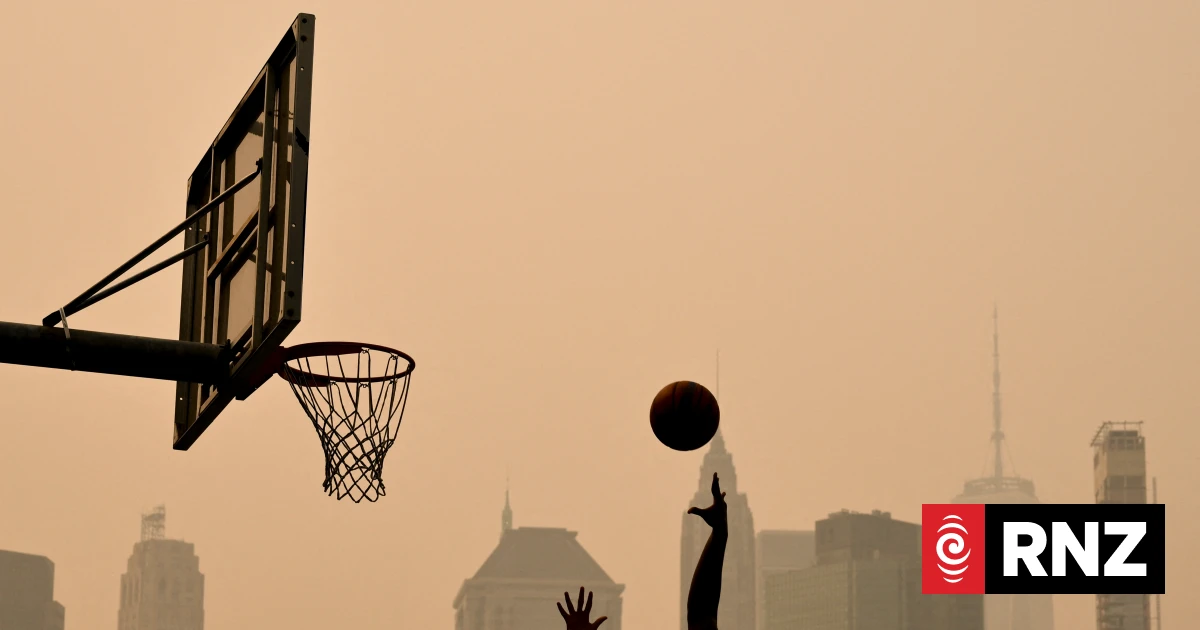
In New York and neighboring New Jersey, where the final will be played on Sunday in an open stadium, the metro area was experiencing air that could be unhealthy for sensitive groups, an improvement after smog on Thursday made the Manhattan skyline barely visible.
But forecasters at the National Weather Service warned the smoke may thicken overnight into Saturday morning.
Tournament organisers are "monitoring closely," White House World Cup task force executive director Andrew Giuliani told a briefing.
Peter Mullinax, a meteorologist for NWS, told AFP that winds over the Great Lakes could push more smoke into the Northeast, which could keep skies hazy.
But he said forecasts for that region are expecting some improvement.
"I don't believe that this should be as impactful as if you might be playing a game today," Mullinax said.
The issue for Sunday's game, said Joel Dreessen, an air quality forecaster for the state of Maryland, is whether more smoke spills south after weekend storm systems.
"Some of the models are starting to indicate that we'll start to pull down some smoke," he told AFP.
Smog on Thursday made the Manhattan skyline barely visible.
In cities across the Midwest and Northeast, people wore masks outdoors to filter out the dangerous air. In New York, libraries and train stations were handing them out for free.
The upper Midwest that's closer to the fires was especially affected, with parts of Michigan, Minnesota and Wisconsin all recording air quality readings deep into the "hazardous" range for days.
The NWS extended its air quality alert in Chicago through Friday, adding "wildfire smoke may return tomorrow evening and continue into Sunday."
Advocates have stressed the connection between repeated episodes of wildfire smoke and climate change.
"Increasingly smoky skies underscore the importance of a rapid transition to clean energy rather than building more polluting fossil fuel infrastructure that further contributes to climate change," said Paul Mathewson, the science program director at the organisation Clean Wisconsin, among the states that have seen a sharp uptick in smoky days in recent years.
Mark Parrington, a scientist at the Copernicus Atmosphere Monitoring Service, told AFP that climate change was providing conditions for a longer fire season, with higher surface air temperatures and lower soil moisture.
So, he explained, "when there's an ignition we see these really large-scale, persistent burning where these fires can burn for weeks and weeks at a time through summer."
The blazes were worsening on Friday in Canada, where more than 200 fires were burning out of control, especially in Ontario, according to authorities there.
The damage remains far off the pace of 2023, Canada's worst wildfire season on record, when nearly 18 million hectares burned in the country.
But the intensity has rapidly escalated over the past week, with nearly 2.8 million hectares burned since the start of the year, per the latest government figures. As of last Friday, that figure had stood at nearly 1.6 million hectares.
Fires in Ontario have not caused any casualties, and several remote communities have been evacuated.
Related Stories
 World
World
Netanyahu’s UN belligerence wins cheers at home as world walks out
6 minutes ago
 World
World
The World of Motorcycling- News detail
1 hour ago
 World
World
Ethiopia risks a wider war. Here are 5 things to know
1 hour ago
 World
World
Nakashima levels the score 1
1 hour ago
 World
World
News outlets back at White House
2 hours ago
 World
World
At least 2 injured, 5 missing after explosion in Greece collapses building
2 hours ago
 World
World
GAMEDAY: Team USA Takes On Czechia in WBSC U
3 hours ago
 World
World
Trump, 80, Botches National Anthem on World Stage
3 hours ago