
86 leaders from 16 countries will gather in Rome to discuss major leadership challenges in the era of artificial intelligence
How can human dignity be protected when algorithms begin to intervene in decisions that affect work, information, economy, and democratic life? How should political and business leadership be exercised in deeply polarized societies? What answers can the Social Doctrine of the Church offer in the face of wars, migration, inequality, the crisis of trust in institutions, and the profound transformations introduced by artificial intelligence?
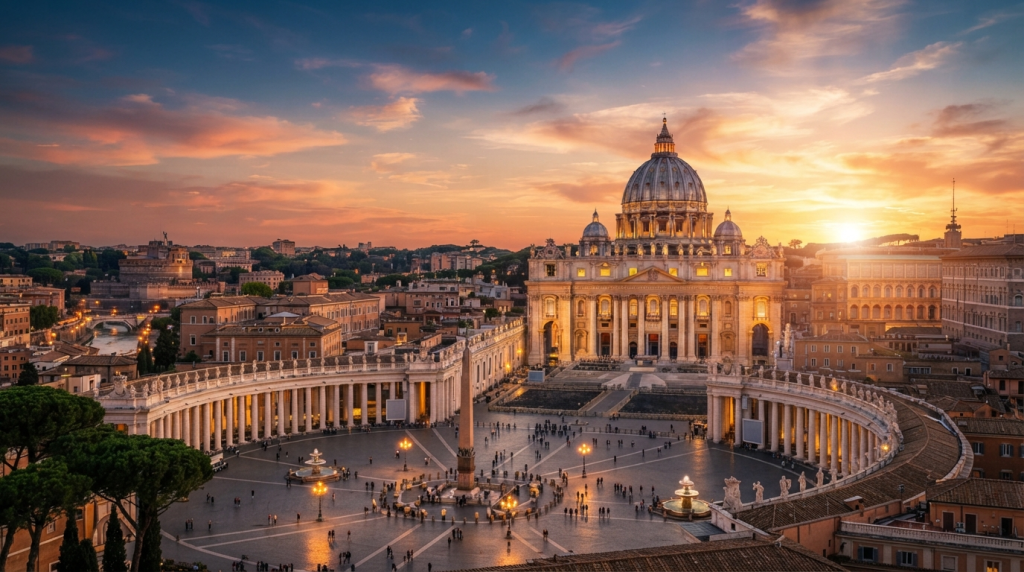
These questions will be at the core of the 11th International Diploma Course on the Social Doctrine of the Church, “Leadership for Equity,” which will bring together in Rome, from October 5 to 9, 2026, 86 leaders from 16 countries, connected to the political, business, academic, ecclesial, social, and communications spheres.
Organized by the International Academy of Catholic Leaders, together with the Pontificia Università Antonianum, the meeting aims to translate the great principles of the Social Doctrine of the Church into some of the most urgent debates of the present, at a particularly significant moment for the Church following the publication of Magnifica Humanitas, the first encyclical of Pope Leo XIV, dedicated to safeguarding the human person in the age of artificial intelligence.
Rather than studying the Social Doctrine of the Church as a theoretical body, the Diploma Course seeks to confront it with real decisions that politicians, business leaders, educators, communicators, academics, and social leaders must make today: what it means to place the person above efficiency; how to protect work against automation; how to prevent technology from deepening inequalities; how to rebuild a culture of dialogue in polarized societies; what responsibilities those who exercise political and economic power hold; and how to recover the pursuit of the common good in an international scenario marked by wars, human displacement, and deep social fractures.
The 2026 edition acquires particular significance in light of the new social magisterium of Leo XIV. One hundred and thirty-five years after Leo XIII responded to the transformations brought about by the industrial revolution with the encyclical Rerum novarum, the Church once again faces a transformation capable of profoundly modifying work, the economy, social relations, and the distribution of power.
Artificial intelligence will therefore run through various sessions of the Diploma Course, not merely as a technological challenge, but fundamentally as an anthropological and social issue.
Participants will reflect on the relationship between artificial intelligence and human dignity; the changes that automation introduces into the world of work; the impact of algorithms on information and communication; the concentration of technological power; corporate responsibility; the protection of human freedom; and the need to ensure that innovation is at the service of the person and the common good.
“The question we want to pose in Rome is not only what artificial intelligence will be capable of doing, but what kind of society we want to build with it and what place the human person will continue to occupy in the decisions that will shape our future. The Social Doctrine of the Church cannot remain locked inside a library: it must help us discern power, the economy, work, technology, and the concrete political decisions of our time,” points out Lara Bersano Calot, executive director of the International Academy of Catholic Leaders.
Another major focus will be the exercise of political responsibility in complex contexts.
During the academic phase of the Diploma Course, an international conversation has been opened regarding the relationship between politics, faith, public service, and the common good, with the participation of leaders with direct experience in public life from different countries.
The proposal stems from a question currently running through numerous democracies: how to exercise public responsibilities without turning faith into a partisan tool and, at the same time, without renouncing the principles of human dignity, solidarity, subsidiarity, justice, and the pursuit of the common good that form part of Christian social thought.
The Diploma Course will also address the impact of polarization, the crisis of trust in institutions, social inequalities, and new forms of economic and technological power on the capacity of democracies to build agreements.
Among the prominent figures who have participated in the 2026 edition are Rocco Buttiglione; Cardinal Christophe Pierre; Guzmán Carriquiry; Miguel Ángel Rodríguez; Margarita Zavala; Marisol Pérez Tello; Paola Binetti; Alejandra Segura; Juan Pablo Faúndez; and Jimena Hernández, alongside academics, business leaders, communicators, priests, and specialists from different countries.
The building of peace will be another of the guiding threads of the Roman week.
The Diploma Course takes place against an international backdrop marked by armed conflicts, forced displacement, the growth of geopolitical confrontation, and a progressive normalization of the language of war. Faced with this context, participants will analyze the role that political, social, business, and religious leaders must play in creating conditions that allow for the recovery of dialogue, international cooperation, and a culture of encounter.
The reflection on peace will be closely linked to the concept of leadership: not only with the ability to manage institutions, but also with the responsibility to build trust, listen to the adversary, protect the most vulnerable, and prevent political, cultural, or religious differences from becoming mechanisms of exclusion.
The situation of women will likewise constitute one of the major themes of this edition.
Through the participation of the International Network of Women Leaders, the program will analyze the obstacles that still condition the full participation of women in labor, economic, political, and social spheres, as well as one of the least visible challenges of contemporary societies: the recognition of care work.
Motherhood, the reconciliation of family and professional life, the distribution of care tasks, access to positions of responsibility, and the economic and social valuation of care work will be addressed not as exclusively female issues, but as matters that concern the organization of society as a whole.
This reflection seeks to move beyond both a purely statistical discussion on representation and opposing ideological responses, in order to ask what concrete conditions allow women and men to fully develop their family, professional, and social responsibilities.
The business world will also have a specific space during the days in Rome.
Business leaders and specialists will reflect on the relationship between profitability, work, innovation, social responsibility, and the common good, particularly in a context where artificial intelligence and automation are rapidly modifying production models.
The question guiding these conversations will be especially concrete: how is the assertion that the person must be at the center translated into practice when a company must make decisions regarding employment, automation, wages, investments, and growth?
The Academy aims for business leaders and executives to share real experiences and concrete dilemmas, avoiding the reduction of business ethics to abstract declarations and bringing into discussion the decisions that determine the quality of work and the life of communities.
The international composition of the group will also allow for a comparison of experiences coming from different social realities.
Participants from Latin America, the United States, and other countries will bring to Rome concrete situations related to poverty, human mobility, inequality, education, violence, institutional fragility, and development opportunities.
The migration phenomenon will be addressed from one of its most complex tensions: the right of States to manage their borders and, simultaneously, the obligation to protect the dignity of individuals fleeing wars, persecution, violence, political crises, or extreme poverty.
The exchange among representatives from countries with very different realities seeks precisely to avoid responses constructed exclusively from a single region of the world and to foster a dialogue between experiences of the Global North and the Global South.
The transformation of communication constitutes another central issue of the Diploma Course.
Journalists, communicators, and specialists will analyze the crisis of trust in the media, the circulation of disinformation, the building of digital communities, the role of algorithms in public conversation, and the growing difficulty of communicating hope in ecosystems dominated by speed, confrontation, and the pursuit of attention.
The reflection will focus particularly on the challenge of preserving the human face of communication in times of artificial intelligence and on the responsibility of those who produce, distribute, and consume information.
As part of the institutional program in Rome, participants will hold a meeting on Wednesday, October 7, with Cardinal Pietro Parolin, Secretary of State to His Holiness, at the Vatican.
The meeting will offer a particularly significant framework for an academic experience centered on the relationship between the Social Doctrine of the Church and some of the principal international challenges of the present: peace, multilateralism, technological transformations, political responsibility, and the pursuit of the common good.
That same day, participants will make a special visit to the Vatican Apostolic Library, organized in international groups.
On Thursday, October 8, the experience will move to Assisi, during the year commemorating the 800th anniversary of the death of Saint Francis.
The pilgrimage will be an integral part of the educational experience rather than a mere cultural visit. In light of the wars, inequalities, and tensions running through the contemporary world, participants will reflect on the relevance of evangelical poverty, fraternity, and peace in Franciscan spirituality.
The contrast between a society marked by the pursuit of power, accumulation, and efficiency, and the radical nature of Francis’s proposal will serve as one of the spiritual keys for thinking about what it means to exercise Christian leadership in the 21st century.
The 11th Diploma Course is part of the work of the International Academy of Catholic Leaders, an institution dedicated to the formation of leaders in the light of the Social Doctrine of the Church and present through an international network of schools, programs, and alumni.
The 86 participants in this edition represent diverse generations, professions, and experiences. Among them are social leaders, business executives, academics, professionals, priests, educators, communicators, and individuals linked to public responsibilities.
This diversity constitutes one of the central traits of the experience: bringing together in the same space people who normally observe problems from very different institutional perspectives and having them work jointly around concrete dilemmas.
“Rome allows us to bring together people from different countries, generations, and professions around a common question: what does it mean to lead when the world changes at extraordinary speed and when our decisions can make that change produce greater dignity and fraternity or, on the contrary, greater inequality and exclusion. We want to train leaders who can understand those tensions and who have the courage to act upon them,” states Bersano Calot.
Academic activities will culminate on Friday, October 9, with the final day and the graduation ceremony at the Pontificia Università Antonianum in Rome.
The closing session will seek to gather the conclusions of an experience that will have combined academic training, interdisciplinary dialogue, spirituality, international exchange, and meetings with Church institutions.
For the Academy, the ultimate goal is not merely for participants to return to their countries with new knowledge, but for them to translate the reflections developed in Rome into concrete decisions within governments, businesses, universities, social organizations, media outlets, communities, and ecclesial institutions.
Main Academic Venue: Casa La Salle, Via Aurelia 472, Rome
Graduation: Pontificia Università Antonianum
Organized by: International Academy of Catholic Leaders
Program: http://www.liderescatolicos.net/Roma2026/
Related Stories
 World
World
Israel facing water shortages caused by destruction of Gaza’s treatment plants
51 minutes ago
 World
World
Delegates walk out as Netanyahu addresses UN
51 minutes ago
 World
World
China is excelling in health tech. That’s good news for the world
56 minutes ago
 World
World
Venezuela’s acting leader promises elections at the ‘right moment’
1 hour ago
 World
World
News outlets back at White House
2 hours ago
 World
World
Second reactor manufactured for floating nuclear plant
2 hours ago
 World
World
Ukraine war live: Putin could attack a Nato country, warns Denmark
2 hours ago
 World
World
A month after Nepal
3 hours ago