
AI Drones Bring Real Time Intelligence to Warehouse Automation
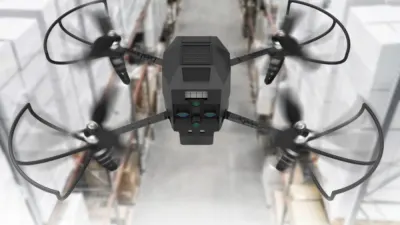
Labor shortages and supply chain volatility are putting additional pressure on warehouse operations to be faster and more adaptable. “In this environment, real-time visibility becomes foundational. Physical AI enables warehouses to operate with a continuously updated understanding of their environment, allowing them to respond quickly to disruptions and optimize performance,” Joseph Mirabile, Vice President of Operations at Gather AI, a Pittsburgh-based startup developing drone-powered inventory solutions.
According to Mirabile, this technology represents a shift toward self-verifying operations. Instead of relying on manual checks, systems can independently detect and correct issues, enabling a more resilient and intelligent warehouse.
Mirabile is a veteran with over 20 years of experience in robotics and supply chain innovation, currently overseeing the scaling of Gather AI’s customer lifecycle and support teams. In this role, Mirabile is driving the expansion of Gather AI’s solution — including its autonomous drones and new Material Handling Equipment (MHE) vision technology — to provide warehouses with a unified, real-time view of their inventory.
In this interview, he discusses how drone-based systems make warehouse automation more efficient, the role of Physical AI in making these drones more intelligent and safer by enabling them to interpret complex, real-world conditions as well as offers advice for engineers evaluating Physical AI–enabled drones for warehouses.
Joseph Mirabile: Despite significant investment in automation like WMS, ASRS, and robotics, most warehouses still lack reliable, real-time visibility into what’s actually happening on the floor. Systems of record tell you where inventory should be, but not whether it’s truly there, correctly placed, or in good condition. This creates a persistent “ground truth gap” that leads to inventory distortion, mispicks, and operational inefficiencies. Drone-based systems address this by continuously capturing visual data across the facility, transforming static records into dynamic, verified intelligence. Instead of relying on periodic manual cycle counts — which are labor-intensive and often inaccurate — drones enable always-on auditing at scale. The result is a shift from reactive operations to proactive decision-making, where issues are identified and resolved before they impact fulfillment, labor planning, or customer experience.
Mirabile: Autonomous drones operate safely in active warehouses by combining advanced sensing, navigation, and AI-driven perception. They use onboard cameras and sensors to dynamically map their environment, avoid obstacles, and adapt to constantly changing conditions like moving forklifts or shifting inventory. Unlike traditional automation that follows fixed paths, Physical AI enables drones to interpret what they see in real time — identifying pallets, reading labels, and understanding spatial context. This allows them to make decisions on the fly, rather than relying solely on pre-programmed routes. Safety is further reinforced through redundant systems, geofencing, and integration with warehouse workflows to ensure minimal disruption. These systems don’t just navigate — they understand the environment and turn visual data into actionable insights.
Mirabile: Traditional automation systems like ASRS and AGVs are highly effective but inherently rigid. They require significant upfront infrastructure and are optimized for specific workflows, making them difficult to adapt as conditions change. Manual cycle counting offers flexibility, but it is labor-intensive and prone to error. This creates a tradeoff between adaptability and accuracy that most warehouses struggle to balance. Physical AI bridges this gap by delivering both. Because it relies on vision-based intelligence rather than fixed infrastructure, it can be deployed quickly and adapt to changing layouts. At the same time, it continuously validates real-world conditions against system records, enabling faster error detection and resolution.
Mirabile: While drones were the initial entry point, the broader vision is a physical intelligence platform that captures and interprets data across the warehouse using multiple sources — drones, fixed cameras, and sensors embedded on material handling equipment. Core use cases today include automated inventory tracking, location validation, damage detection, and workflow visibility. Our MHE Vision solution extends this capability directly to forklifts and other equipment, capturing data continuously as operators move through the warehouse. This means every pallet movement becomes a data point — without requiring dedicated scans or workflow changes - unlocking a real-time, always-on view of operations. Customers are also using the platform for real-time operational insights, including identifying bottlenecks and improving slotting decisions.
Adoption is strongest in environments where accuracy and speed are critical, including third-party logistics providers, retail distribution centers, and cold storage facilities. These operations benefit from continuous visibility and typically expand deployment quickly after initial implementation.
Mirabile: The impact is both immediate and measurable. On inventory accuracy, customers are achieving up to 99.9 percent verified accuracy, even in complex environments. This significantly reduces mispicks, stock discrepancies, and fulfillment delays. From a labor perspective, drone and MHE-powered systems eliminate the need for manual cycle counting. This allows teams to focus on higher-value work like exception handling and process improvement, often saving hundreds of labor hours per week. Financially, return on investment is typically realized within 4–6 months. This is driven by reduced shrink, improved throughput, and better use of existing resources, alongside more confident and data-driven decision-making.
Mirabile: The most important starting point is to focus on outcomes, not just technology. Engineers should define the operational problems they want to solve and evaluate solutions based on measurable impact. From a design perspective, flexibility and ease of integration are critical. Systems should work within existing infrastructure and integrate seamlessly with WMS, ERP, and analytics platforms. Safety and reliability are also key. Look for solutions with robust navigation, fail-safes, and the ability to operate in dynamic environments. Finally, ensure the system is scalable, so it can expand from a single site to a broader network without requiring a major redesign.
This article was written by Chitra Sethi, Editorial Director, SAE Media Group. For more information, visit here .
No transcript is available for this video.
Related Stories
 AI News
Bill Gross bets AI can help mass
3 days ago
 AI News
Nigeria records 93% rise in AI micro
3 days ago
 AI News
The Italian gelato maker using AI to invent new flavours
3 days ago
 AI News
Closing the Gap Between Agentic CX Pilots and Production
3 days ago
 AI News
New Brunswick data centre debate highlights cross
3 days ago
 AI News
How to Structure an AI Agent Referral Fee Agreement Between Startups
3 days ago
 AI News
No, AI didn’t delete a Swedish reality TV series
3 days ago
 AI News
There is no AI in Armageddon. Artificial intelligence is a tool, not an apocalypse
3 days ago