
Algorithm optimizes machine learning techniques that use linear, tunable resistor networks
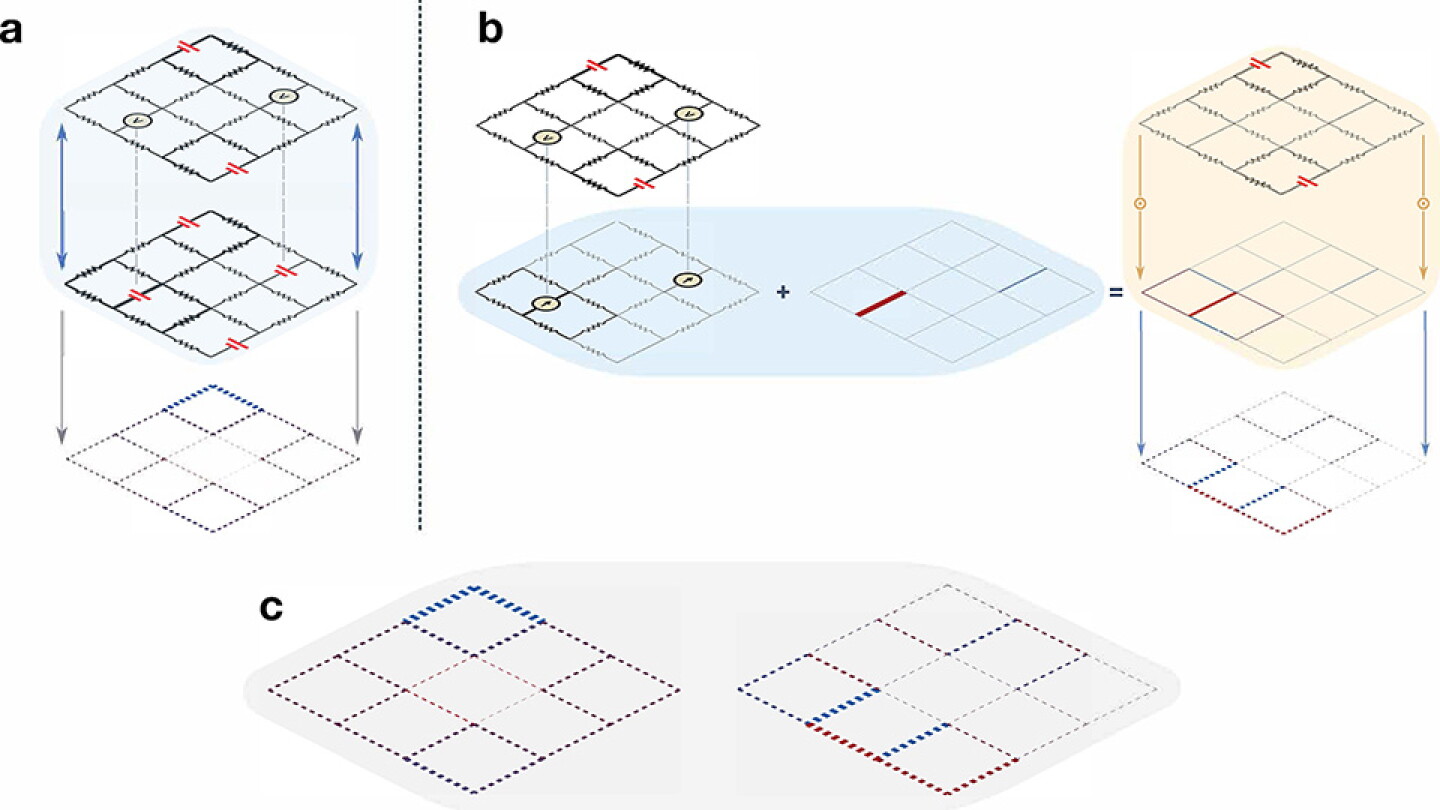
Analog computing has shown promise for circumventing many concerns about energy usage associated with large-scale artificial intelligence applications. Questions persist, however, regarding how to train systems with such local computing constraints. Local learning algorithms such as equilibrium propagation and coupled learning have been proposed to address this issue.
Lin et al. have demonstrated an algorithm capable of testing a wide array of machine learning approaches based on linear, tunable resistor networks. Drawing on Kirchoff’s laws for current flow and voltage changes in circuits, the group’s approach represents resistor networks as a graph and derives explicit mathematical operators that describe how imposed electrical signals produce voltages and currents throughout the network. The operators calculate the exact direction that each adjustable resistance should be tuned to reduce learning errors.
“Standard machine learning algorithms generally assume that error information can be transmitted and processed globally,” said author Francesco Caravelli. “A physical circuit, by contrast, naturally provides local voltages and currents. We wanted to understand whether a tunable resistor network could calculate useful learning updates using those physically available signals, and whether we could predict explicitly how each resistor should change.”
In numerical simulations, both the group’s analytical approach and a previously used two-phase learning approach yielded similarly accurate results, but the analytical method followed a smoother and more stable training path. It also performed more consistently when only a subset of resistors could be adjusted.
Along with this algorithm, the group also introduced a framework called generalized equilibrium propagation that unifies the study of equilibrium propagation, coupled learning, and related two-phase learning rules.
The group looks to extend the analysis to nonlinear and history-dependent devices such as memristive components as well as hardware validation.
Source: “How to train your resistive network: Generalized equilibrium propagation and analytical learning,” by J. Lin, A. Desai, F. Barrows, and F. Caravelli, APL Machine Learning (2026). The article can be accessed at https://doi.org/10.1063/5.0326359 .
Related Stories
 AI News
Bill Gross bets AI can help mass
5 hours ago
 AI News
Nigeria records 93% rise in AI micro
5 hours ago
 AI News
The Italian gelato maker using AI to invent new flavours
5 hours ago
 AI News
Closing the Gap Between Agentic CX Pilots and Production
5 hours ago
 AI News
New Brunswick data centre debate highlights cross
6 hours ago
 AI News
How to Structure an AI Agent Referral Fee Agreement Between Startups
6 hours ago
 AI News
No, AI didn’t delete a Swedish reality TV series
6 hours ago
 AI News
There is no AI in Armageddon. Artificial intelligence is a tool, not an apocalypse
6 hours ago