
Asteroid set to be nearest to Earth since 1600s can be seen from Canada
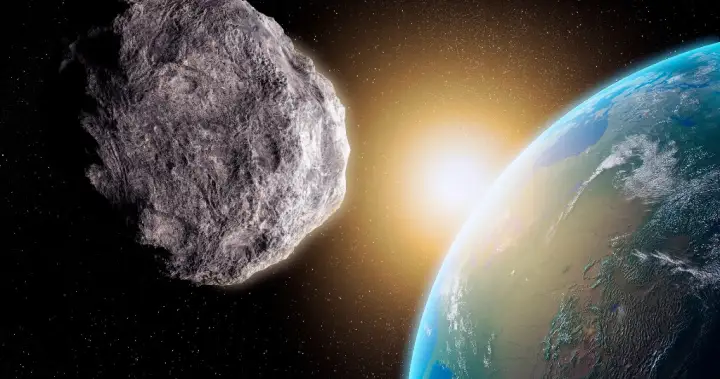
A large asteroid experts believe to be as big as three CN Towers stacked on top of each other is about to pass Earth this weekend at its nearest point since the 17th century, and will be visible from parts of Canada.
According to a statement provided by the Canadian Space Agency (CSA), the asteroid, named 1997 NC1, “will pass relatively close to Earth on June 27.”
The CSA says “this poses no risk.”
Asteroids, according to the CSA, are small rocky or metallic bodies that orbit the sun. They are considered a type of “minor planet,” meaning they contain a lot of the same elements that make up many planets in the solar system, but are not otherwise classified as a planet.
Most asteroids, the agency says, are found in the asteroid belt between the orbits of Mars and Jupiter, and sizes can vary from less than 10 metres wide to the largest ever detected, named Vesta, which is over 500 kilometres wide.
Large asteroids impacting Earth “are quite rare,” the CSA says, adding: “When they do happen, these cosmic events can not only change a planet’s landscape – they can even cause mass extinctions.”
According to a National Aeronautics and Space Administration (NASA) document updated on Thursday, the pass-by of 1997 NC1 will be the closest “since before the year 1600, which is the farthest back that its motion has currently been computed.”
NASA also says 1997 NC1 has been designated as a “Potentially Hazardous Asteroid.”
How large is the asteroid and how close will it get?
A spokesperson for the Dunlap Institute for Astronomy and Astrophysics at the University of Toronto said the asteroid is believed to be up to 1,650 metres across.
For perspective, the CN Tower is about 550 metres high, meaning 1997 NC1 could be as much as three times that height measured across.
But how close will it get to Earth?
“The term ‘close’ is relative here,” astrophysicist Heidi White, at the University of Montreal’s Trottier Institute for Research on Exoplanets, says in a note.
White and the CSA say the 1997 NC1 asteroid will pass by Earth at a distance of between 2.5 million and 2.6 million kilometres, which is 6.5 to seven times farther than the moon is from the Earth.
“To put that scale into perspective, if the Earth were shrunk down to the size of an orange, the asteroid would still be passing 20 metres away,” White says.
White also says these types of events are “uncommon” as they occur about every five years.
NASA also says the 1997 NC1 asteroid won’t get this close to Earth again until the year 2133.
White says the 1997 NC1 asteroid will be visible from parts of Canada on June 27, when the sky is fully dark, but Canadians will likely need a small telescope to see it.
If Canadians want to look out for the asteroid in the night sky, White says they can look with their telescope for the Ophiuchus constellation, which is usually common to see during the summer from across southern Canada.
The asteroid can then be found within the constellation.
“Through a telescope, it will appear as a very faint point of light slowly moving against the background stars,” White says.
White says close pass-by events, like that of 1997 NC1, provide “valuable scientific opportunities.”
“Astronomers can use them to make detailed observations that help determine an asteroid’s size, shape, and composition, while also refining its orbit,” White says.
“In many ways, these pass by events are like a free reconnaissance mission, allowing us to study this lone traveler in much greater detail!”
Related Stories
 AI News
NRIs pull out $2 billion from bank deposits
1 minute ago
 AI News
In the News: Manjeet Rege on AI and Cybersecurity Threats
5 minutes ago
 AI News
AI Companies Are Learning an Ironic Lesson as the People They Pay to Improve Their Chatbots Are Just Feeding AI Slop Into Them
5 minutes ago
 AI News
'It's way too much'
59 minutes ago
 AI News
The World Cup Pride Match Is A Winner
59 minutes ago
 AI News
Toronto police say they've intercepted 18 drones over World Cup event spaces
59 minutes ago
 AI News
US says it struck targets in Iran over ‘continued aggression’ against shipping
59 minutes ago
 AI News
Meet the walkers, making their way across Canada to raise money for charity
1 hour ago