
Brazilians weigh the benefits of AI facial recognition against the costs
Brazilians weigh the benefits of AI facial recognition against the costs
Aug. 13, 2026, 2:53 p.m. ET | Rio de Janeiro
In a downtown office building near Rio de Janeiro’s famous Sambadrome avenue, a dozen police officers sit behind desks staring up at a large bank of computer monitors. Mug shots, camera footage, and interactive maps blink from the screens.
This is Rio’s Integrated Command and Control Center, or CICC, the state security forces’ technological nerve center.
Facial recognition cameras operated by the military police are a key part of this infrastructure. Using artificial intelligence, smart cameras scan the biometric data of passersby against a database of outstanding arrest warrants. Officers at the CICC are alerted if there’s a match and send the closest patrol to conduct a stop.
Who suffers when AI gets things wrong? In Brazil, where fighting crime is a top priority for citizens, facial-recognition technology is exploding, even though the legislature is still working on laying out clear rules.
Fear of crime that for many outweighs concern for data privacy has made Brazil fertile ground for the mass adoption of these kinds of surveillance technologies. There are more than 560 projects using facial recognition technology across the country – more than double the number in use two years ago, according to civil society organization O Panóptico. The majority are run for public security purposes by local governments or police forces, but they’re also implemented in some private spaces, such as schools.
While advocates say smart cameras can help bring down crime, the explosion of this technology without a clear legal framework raises questions about oversight, privacy, and who suffers the most when AI gets things wrong.
It’s a public policy that has widespread support, says Thallita Lima, research coordinator at O Panóptico. “Public security is a problem, and technology is presented as a supposedly quick solution.”
The Brazilian experience stands in contrast to Europe, where the European Union’s Artificial Intelligence Act specifically prohibits the use of real-time biometric surveillance of “publicly accessible spaces” in most cases. The “untargeted scraping of facial images from the internet or CCTV footage” is also prohibited in Europe. In the United States, the growing use of facial recognition by local police and federal agents has become controversial, amid increasing reports of wrongful arrests, the technology’s use to identify protesters, and a substantial body of evidence that shows facial recognition tools frequently misidentify dark-skinned people.
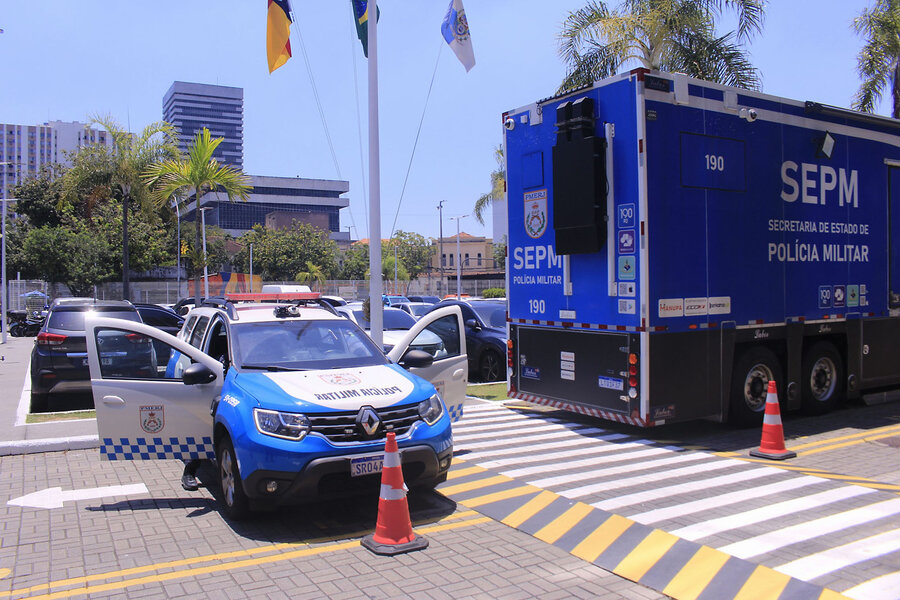
Rio’s state-run military police currently has 330 street cameras using Russian facial recognition software, NTechLab’s FindFace, says Maj. Agdan Miranda Fernandes, who heads the department’s infrastructure and technology division. A further 1,300 cameras attached to police cars were deployed in recent months using Chinese company Dahua’s software to scan faces and license plates, and Major Fernandes says there are plans to deploy the technology to body-worn cameras later this year.
In total, thanks to partnerships that range from cities to private security companies to condominium associations, the force has access to images from around 70,000 cameras. That footage can be run through the military police’s facial recognition algorithm.
“It’s like an episode of ‘Black Mirror,’” says Antônio Marcos, a sales representative in Rio, referring to the British sci-fi television series. He says the idea of being watched all the time makes him uncomfortable. But as someone who has cameras at home, Mr. Marcos adds that he does believe surveillance helps improve security. Some 40% of Brazilians say they have been the victim of a crime, including theft or fraud, within the past year.
In Rio, the government says facial recognition has played a part in some 950 arrests by the military police since the technology was rolled out in 2024. That’s about 10% of the total arrests recorded during this period, Major Fernandes says. Overall, there is one arrest made for every two police stops when facial recognition is used, compared with one for every 506 stops otherwise, he says.
“It’s incredibly efficient.” But the police’s own data shows that more than half the arrests carried out with the aid of facial recognition were for failure to pay child support – a situation that can lead to imprisonment under Brazilian law, but is not a direct threat to public security.
Surveys commissioned by the city of Sao Paulo have shown support upward of 90% for its Smart Sampa surveillance system during big events, such as Carnival. Sen. Flávio Bolsonaro, who seeks to present himself as the tough-on-crime candidate in the October presidential election, said he would implement a nationwide network of facial recognition cameras if he wins top office. Mr. Bolsonaro is the son of former President Jair Bolsonaro.
While the AI programs are being trained to avoid human error, they can make mistakes with very real impacts for victims.
“We know facial recognition ... carries an algorithmic bias of racial discrimination,” says Emerson Betta, a lawyer at Rio de Janeiro’s public defender’s office. In Sao Paulo, a man who was wrongfully stopped five times in nearly as many months after being mistaken for someone who shares his name argues that the city’s surveillance system is biased against Black men.
Police also rely on outdated databases from judicial authorities, which means individuals can end up in police custody for expired or revoked arrest warrants.
Major Fernandes says they take precautions to avoid these pitfalls. That includes seeking out the best possible algorithm – the military police requires the software it contracts be evaluated by the United States’ National Institute of Standards and Technology, considered the gold standard – to implementing a three-step protocol between receiving a facial recognition alert and performing an arrest.
But, “there is always room for improvement,” says Mr. Betta. Even well-structured protocols on paper can fall short in practice, he says.
There are also concerns over transparency in how Brazil’s facial recognition programs collect, share, and store data.
Data privacy in public security is not being talked about at the policy level, Ms. Lima of O Panóptico says. “There’s a very serious privacy issue with the growing integration between private cameras and public cameras, without clear legislation” on how the shared data should be managed.
Brazil has a strong data-protection law, but it provides specific exemptions for public security. A bill currently under discussion in the lower house of Congress would allow widespread use of facial recognition cameras by public transport companies, but it doesn’t include guidelines on how to store and protect the data.
A bill regulating AI – modeled on the EU’s AI act and designating facial recognition technology as an “excessive” risk – is stuck in Brazil’s Congress. Lawmakers influenced by opposing interest groups have failed to reach a consensus.
Implementing technology like this is about calculating the trade-offs, says Mr. Betta, the lawyer. That means looking at whether the technology is effective enough to justify interrupting someone’s right to move freely and their right to privacy.
On the latter point, Natalia Queiroz, a marketing coordinator from Sao Paulo, says she feels that ship has sailed; she gave up her personal data long ago.
“It’s kind of out of my control. And if my data can be used for a greater good, to reduce criminality, then let it be used,” she says.
Related Stories
 AI News
High blood pressure and diabetes: how artificial intelligence detects them using a video of the face
50 seconds ago
 AI News
Not a token effort: beer meets AI at bar in China’s capital
1 hour ago
Enterprise and Telecom Technology Industry News
2 hours ago
 AI News
Mastercard Lighthouse UAE Picks Six AI Startups
2 hours ago
 AI News
OpenAI Files a $400M Second Startup Fund
3 hours ago
 AI News
Shopping with AI: Consumers ask artificial intelligence for advice but less than half trust it
3 hours ago
 AI News
Tech news: EY to bring tailored AI solutions via Integrated Solutions portfolio
5 hours ago
 AI News
Apple unveils M5 Ultra and M6 chips with focus on artificial intelligence
5 hours ago