
Canada faces questions over treatment of Iranian conscripts as U.K, Australia take different approach
Canada faces questions over treatment of Iranian conscripts as U.K, Australia take different approach
Legal fight grows over Canada's treatment of IRGC conscripts
Mostafa Tasbandi lost his job last Thursday.
It's just one of the many ways his life has taken a turn since he and hundreds of other Iranians living in Canada received letters on Aug. 6 and 7 informing them they may be inadmissible to stay in the country because of mandatory military service they were forced to complete in Iran as young men.
"I don't have a future right now," Tasbandi, who lives in Halifax, told CBC News this week.
For years, Tasbandi, who arrived in December 2023, had been waiting for a work permit renewal, a situation that prevented his wife from getting a work permit of her own. His 11-year-old daughter has had serious trouble at school since she discovered her father's immigration troubles, he said.
Tasbandi, a computer engineer, isn't sure he will be able to renew his own work permit following his dismissal at work. His boss told him he was letting him go because the company didn't have enough work for him, but Tasbandi suspects a sudden decrease in his productivity due to the stress of his immigration situation had something to do with the dismissal.
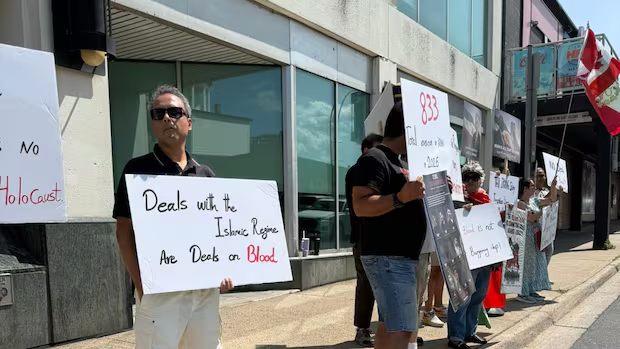
"If I can't get another work permit, I don't have money to pay my bills and I cannot go back to my country because I am afraid. I'm stuck. What shall I do?" said the 44-year-old who has participated in several protests against the Iranian regime while in Canada. Iran has since undertaken campaigns to identify and punish citizens demonstrating abroad.
CBC reported last week that former conscripts of Iran's Islamic Revolutionary Guard Corps and their family members increasingly face inadmissibility to Canada because of Ottawa’s designation of the IRGC as a terrorist organization. Men across the country who were forced into that military service now tell CBC they feel branded as terrorists by the country they sought refuge in.
They are calling on federal Immigration Minister Lena Metlege Diab to publish guidance distinguishing conscripts who were forced into service and didn’t commit any terrorist acts from full-fledged, regime-supporting members — similar to what the United Kingdom and Australia have done.
"Canada has a very aggressive policy vis-a-vis national security issues that leads to some decisions which I would say are absurd," said Lorne Waldman, a Toronto-based immigration lawyer representing nearly 40 former Iranian former conscripts targeted by the procedural fairness letters (PFLs).
Tasbandi and five other Iranians who were forced into mandatory IRGC service in their late teens and early 20s tell CBC they self-disclosed the mandatory military service in their permanent residency applications and now feel penalized for their honesty.
"Why is Canada doing this? We trusted them. They’re treating us differently than other countries [would]," Tasbandi said.
In response to questions from CBC, a spokesperson for Immigration, Refugees and Citizenship Canada (IRCC) said the department recognizes "that some individuals may have served as a result of conscription."
The department "cannot disclose details of our screening processes," spokesperson Mary Rose Sabater wrote in an email, adding the procedural fairness letters sent out in August provide "applicants with an opportunity to respond before a decision is made."
They came to Canada for safety. Now they’re suspected of supporting the regime they fled
They fled Iran after years of fear and protest. Canada's new asylum law has put them in limbo
But Yalda Ghani, an Iranian immigration consultant in Toronto, says several of her clients were deemed inadmissible before the August wave of procedural letters was sent out, despite having been conscripted and performing only menial tasks for the IRGC and are challenging the decisions in Federal Court.
"I have many clients who are scared to death, honestly," Ghani said. "They are afraid that if they become inadmissible in Canada, they will lose their chances for other countries, too, because this is a very serious thing to be labelled inadmissible under security and being a ‘member’ of a terrorist organization."
Canada designated the Islamic Revolutionary Guard Corps a terrorist organization in 2024, following the lead of the United States.
Every conscript CBC spoke with say they agree with the designation itself.
"I want Canadian immigration to … understand that we are not members of them and we were not members of them," Tasbandi said.
U.K., Australia recommend examining cases closely
The United Kingdom and Australian appear to have taken different approaches, where conscripts are not automatically considered "members" of an organization. In March, Australia's Parliament published guidance on the matter, saying authorities should distinguish involuntary conscripts from supporting members.
The U.K. government published similar guidance in August, stating military service is compulsory for men and that conscripts are unlikely to be required to commit acts "contrary to the basic rules of human conduct."
The six Iranians CBC spoke with for this story, who received PFLs in August, say they or their family members were randomly assigned to IRGC service among Iran's military and security organizations and were tasked with menial or administrative work. None were in a combat role, nor did they carry weapons, they said.
Tasbandi said that when he completed his service in 2008 and 2009, he was appointed to the guard's sports office, due to its substantial involvement in state sports, and was tasked with printing posters and booking appointments. He also briefly worked in a library. After he finished the service, he got an unrelated job in a refrigerator factory in his hometown of Mashhad.
The impact of the letters has extended beyond former conscripts themselves. In some cases, family members have also received procedural fairness letters because of a relative's past IRGC service.
Reza Rajaei, who came to Canada with his wife and daughter in 2022, said his wife and four-year-old daughter also received PFLs because they are part of his permanent residency application.
"What should I respond for her?" Rajaei said of his daughter. "She is four years old."
Samira Chahargoli, who lives outside Toronto with her family, said she also received a PFL because of her husband's compulsory military service in 2002, when he was 18 years old.
"We built a life in Canada. Canada is our home right now," Chahargoli said.
Iranian told he may have to leave Canada over past IRGC service
Without a specific policy, immigration officers and some Federal Court judges appear to be basing their decisions on a recent Federal Court ruling that upheld the inadmissibility of Mohammedreza Vadiati, an Iranian former IRGC conscript, according to Ghani and Waldman.
The Federal Court ruled in Vadiati v. Canada that mandatory service with Iran's IRGC can still count as "membership" for Canadian immigration purposes.
"That's the albatross hanging around our neck," said Waldman.
"The problem is now the immigration officers are relying on Vadiati and they're saying, 'Well, based on Vadiati, if you're a conscript, you're still inadmissible,'" Waldman said. "But the answer to that is there are a whole series of other legal arguments that should have been made that were not made in Vadiati."
Waldman says immigration officers should instead be basing their decisions on the Supreme Court's 2023 Mason decision, which requires immigration decision-makers to meaningfully consider the evidence and circumstances of each case.
What remains unclear is why such a large number of people received letters advising them of their potential inadmissibility over the same two days in August.
Tasbandi belongs to a Telegram messaging group with 19,000 people in it. He says nearly 2,000 members of the group said they received one.
Waldman believes it may have been an attempt by immigration officials to clear a massive backlog in immigration-related Federal Court applications.
In June, the Federal Court published a news bulletin stating immigration proceedings could exceed 30,000 files in 2026, representing nearly five times the volume it handled before the pandemic caused "significant and sustained operational pressures" on the court.
Related Stories
 Canada
Quad bike seized after ride 'with babies up front'
36 minutes ago
 Canada
Waterfalls of New Brunswick: Williams Falls
37 minutes ago
 Canada
Record diesel prices hit northern Ontario businesses
37 minutes ago
 Canada
Quebec election campaign enters 26th day
1 hour ago
 Canada
‘A disaster’ – Merz’s migraine
1 hour ago
 Canada
Man, 27, dies after being shot in car in city's east end: Toronto police
2 hours ago
 Canada
Two arrested in counter
2 hours ago
 Canada
1 dead, 2 injured after 2
3 hours ago