
Canada wants to build up to 10 new nuclear plants. Will our pension funds pay for them?
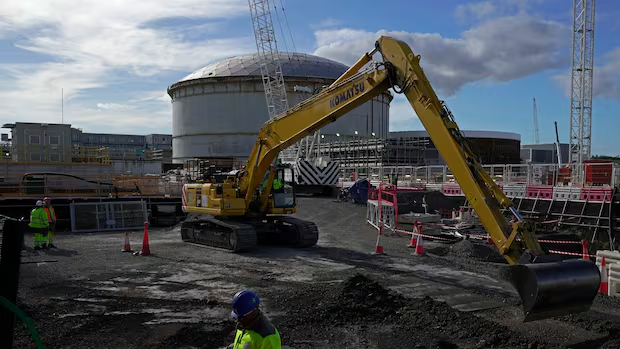
Canada wants to build up to 10 new nuclear plants. Will our pension funds pay for them?
Massive private investment needed for ambitious, expensive nuclear strategy
When Tim Hodgson, Canada’s natural resources minister, announced the federal government’s plan to dramatically expand the nuclear energy industry, he cited a project in the U.K. as a model.
That plant, Sizewell C on the Suffolk coast of England, is set to cost 38.2 billion pounds ($72.3 billion Cdn). But a key detail is that private investors are taking a 55 per cent stake in the project by sharing the construction costs.
Hodgson wants to emulate that model to achieve his government's lofty target of building up to 10 new reactors in Canada.
The prospect isn't far-fetched: one of Sizewell C’s investors is La Caisse, the public pension fund of Quebec, which has taken a 20 per cent stake in the reactor through an investment of $3.2 billion Cdn.
But attracting this kind of investment isn't easy, especially for risk-averse pension funds.
Nuclear energy in Western countries has developed a reputation for going eye-wateringly over budget. Hinkley Point C, the newest nuclear plant in the U.K., began construction in 2017 with an initial budget of $34 billion. It is now estimated to cost more than $64 billion.
Another recent project, Olkiluoto 3 in Finland, began construction in 2005 and took until 2022 to complete. Its cost ballooned from $5.1 billion to $17.8 billion.
WATCH | New nuclear strategy to boost jobs, economy:
Canada's nuclear strategy will lead 'to at least a doubling' of industry jobs: minister
"There's a reason why the nuclear industry has had really very flat growth over the last couple of decades. It's not about governments deciding not to build nuclear; in fact, there's been a ton of government support for nuclear projects," said Adam Scott, executive director of Shift Action, a Canadian initiative to push financial institutions and pensions to align their investments with green energy and climate action.
"It's that the projects have gone over budget and been incredibly expensive at such a scale that it has limited the ability to keep building these types of projects."
"If you want to have private sector investors, they need some de-risking," said Yrjo Koskinen, professor of sustainable finance at the University of Calgary.
That means that convincing private investors — such as pension funds, investment firms, energy and infrastructure companies — to invest in nuclear plants, they need some protection from the risks of huge cost overruns or long construction delays.
Koskinen says someone has to pay for covering that risk, and it will likely be taxpayers or electricity consumers.
Pension funds in particular need a reduction in risk, because of their duty to protect their members’ retirements.
Sizewell C in the U.K relies on a new funding scheme called the regulated asset base (RAB) model. Under the RAB, private investors such as La Caisse start getting paid back during the construction phase of the project, and don’t have to wait until the plant is actually operational and selling electricity.
Investors are paid through a levy on every British ratepayer — a one-pound charge on their monthly electricity bill — meaning investors see returns even if there are construction delays.
The RAB model also limits the risk to private investors if the project's costs balloon.
It works like this: Sizewell C is currently estimated to cost 38.5 billion pounds ($78.9 billion). If costs rise to an upper limit of 47.7 billion pounds ($90.3 billion), all the investors — public and private — will share the cost overruns equally. If costs go over that limit, the private investors won’t be forced to fund the overruns and the government may have to cover them.
The prospect of taxpayers being on the hook has left some locals critical of the deal.
"I think the thing that really sticks in our throats is that the way it's set up, the investors cannot lose," said Alison Downes of Stop Sizewell C, a campaign group in Suffolk, England, that opposes the project due to financial and environmental concerns.
"It puts risk onto energy bill payers, who are the people least in the world able to influence the outcome of a big construction project like Sizewell C."
In addition to being protected from major cost overruns, investors get attractive returns. The U.K.’s National Audit Office estimates investors will see returns of 11 to 13 per cent after construction is completed.
The British government says the Sizewell C plant will lower electricity bills by producing cheap energy — possibly into the next century. But the auditor’s report also said that the cost to consumers will not be outweighed by the benefits until at least 2064.
Renewables, yes, but big push for nuclear
Critics of this technology point to the issue of nuclear waste. Like Canada, the U.K. does not yet have a facility for the long-term storage of nuclear waste. All the waste generated until now has been stored on site, at the nuclear plants themselves. (Both Canada and the U.K. are planning an underground storage site for permanent disposal of the waste.)
Critics also frequently point out that solar and wind energy, along with battery storage, are rapidly falling in cost and becoming more efficient. In recent public procurements conducted by Ontario’s energy system operator, renewables and battery storage won out with lower rates than previous procurements.
But Canada isn’t alone in also doubling down on nuclear. The new Hinkley and Sizewell plants combined will provide about 14 per cent of the U.K.’s electricity. The Trump administration is changing nuclear safety rules and providing loans to help build new plants in the U.S. France is undergoing a $110-billion Cdn nuclear expansion plan that could build six new reactors. Even Japan, still recovering from the memory of the 2011 Fukushima nuclear disaster, is planning to refurbish existing plants and build new ones.
It’s a global boom this country wants to join.
"Canada has a really strong track record of nuclear deployment, particularly in Ontario. There's a 50-year history of delivering and running these plants," said David Pickup, director of the electricity program at the Pembina Institute, an energy think-tank.
"We're encouraged by that sort of vision of a global nuclear industry that Canada would be a big part of, while cautioning that that shouldn't come on the backs of Canadians at home."
Ontario gets almost half of its electricity from nuclear, via massive plants like Darlington, Pickering and Bruce. All of the plants have CANDU reactors, a Canadian nuclear design developed in the 1950s that was exported around the world.
But experts are doubtful that nuclear plants can be built without cost overruns — at least for the first few reactors that Canada builds, before it regains the experience it used to have.
"Canada had a sort of a heyday from 1970 until about 1991-92, when there wasn't a year we weren't building a nuclear reactor somewhere. And what that meant is that we developed a workforce that was very skilled, very trained, very good at their jobs," said Warren Mabee, professor of energy and environmental policy at Queen’s University in Kingston, Ont.
"It's really hard to build nuclear when you haven't been doing it for a while."
Despite the financial and logistical challenges, experiences in other countries show that large energy projects are often seen positively, even after massive costs.
The reactor in Finland came online just as Russia invaded Ukraine in 2022 and started cutting off energy supplies to the rest of Europe.
Without the new reactor, the Finnish people may have faced the skyrocketing energy prices suffered by other countries in the region. Instead, Finland now has some of the cheapest electricity in Europe.
"So in that sense, thank goodness Finland has this new reactor," Koskinen said. "But of course, when it was commissioned, nobody knew about that."
Inayat Singh covers the environment and climate change at CBC News. He is based in Toronto and has previously reported from Winnipeg. Email: inayat.singh@cbc.ca
Related Stories
 Canada
Court slashes US$50M judgment against Infowars’ Alex Jones over falsely calling school shooting a hoax
45 minutes ago
 Canada
Booze ban ‘had its time.’ Ending it may be the key in reaching deal: trade advisor
46 minutes ago
 Canada
42% drop in Vancouver housing starts prompts worry from development advocate
46 minutes ago
 Canada
2 injured in 'violent incident' at Edmonton Sikh Temple, World Sikh Organization of Canada says
46 minutes ago
 Canada
Media Roundup: Dade on Tariffs and Canada
46 minutes ago
 Canada
World’s oldest person Ethel Caterham celebrates 117th birthday
1 hour ago
 Canada
JD Vance reportedly mocks Carney for trying to ‘out
1 hour ago
 Canada
Statistics Canada reports retail sales up 0.6 per cent in June at $74.3B
1 hour ago