
Canadian canola has seen some tough years. This could be one of its best
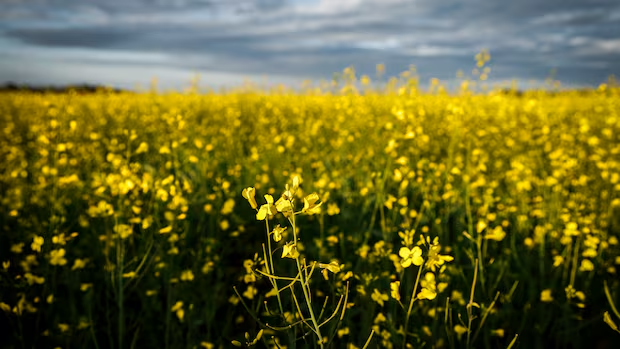
Canadian canola has seen some tough years. This could be one of its best
On heels of tariff relief, Canada’s production in full bloom as biofuel industry grows
Leroy Newman has battled hail and pests in his canola fields this season.
But he’s still expecting a big payoff.
The crop’s price is up about 30 per cent from last year, which Newman calls “encouraging for the bottom line.”
It’s no surprise the southern Alberta farmer is looking for a little motivation — he remembers the severe drought in 2021 that wiped out roughly a third of Western Canada’s canola production.
Then, in 2025, Chinese tariffs on canola products took effect, driving down how much he earned per bushel.
Like many farmers, the volatility of his work has taught him to appreciate the good times.
“When you hit a home run, remember that because you probably will strike out next time, right?” he said.
But it could be time for canola farmers to get comfortable on deck, as a growing biofuels industry drives significant demand for their crop.
Canola farmers across the Prairies are hauling in what could be one of the country’s biggest harvests ever, with producers reporting a record 23.4 million acres planted earlier this season.
And those small seeds are ripe with opportunity.
The Canadian Canola Growers’ Association (CCGA) estimates about a third of that production is now being crushed for biofuels.
“The biofuel market, we see some robust growth there in certain countries like the European Union, like the United States and others,” said Rick White, president and CEO of the CCGA.
As demand for renewable fuel grows, major players in global energy are already making “significant investments” in Alberta.
Last year, Imperial Oil’s refinery in Strathcona, Alta., started producing renewable diesel.
Touted as the largest facility of its kind in the country, at full capacity the refinery is able to squeeze up to 20,000 barrels a day, primarily from Canadian canola.
It uses about two and a half million metric tonnes each year.
White says the demand from that one refinery rivals some of Canada’s top seed export markets.
“So that would be bigger than our current Japanese market is, and that would go to biofuels,” said White.
“One of the largest oil and gas companies on the planet decided to make their first large-scale renewable diesel investment in Canada,” said Fred Ghatala with Advanced Biofuels Canada.
He’s hopeful that momentum will continue.
“Anyone who watches how the traditional oil and gas sector is participating in the energy transition definitely took notice of that investment and what it means for Canadian fuel security and the North American biofuel sector.”
Imperial says it opened the refinery “to bring lower emission fuels to Canada’s road transportation sector,” in alignment with parent company ExxonMobil’s “broader plans to produce low-emission fuels globally.”
But the opportunities don’t end there, says White.
Planes, boats, and automobiles
Canola’s biofuel future could further expand, as different modes of transportation include more renewable fuels, he said.
“We haven't seen much, if any, renewable aviation fuel coming on stream yet, and that is a big potential demand in the future,” said White.
Accessing that potential is being supported by both federal and provincial regulations, and increased conditions for renewable fuel capacity expansion, said Ghatala.
“We expect renewable fuels to be more so included in aviation and marine fuels. British Columbia now includes renewable jet fuel within its low-carbon fuel standard,” he said.
“So if it is a liquid fuel, I expect to see more renewable content in it.”
Ghatala thinks that future capital will be attracted to growing opportunities for domestic biofuel production, as well as an “increasingly stable” policy environment.
“We have never had as great a focus on renewable fuels in the last years as we have had under this current government,” he said, specifically noting the Federal, Provincial, and Territorial Biofuels Working Group and the federal Clean Fuel Regulations.
As prospects for canola-based biofuels grow, experts say that a homegrown seed-to-fuel production pipeline can also provide Canada with security-based advantages.
Trade fights, oil price spikes
White says China’s recent tariffs “totally” shut down the canola seed trade while they were in effect, and ongoing trade disputes with the United States have made him increasingly uneasy.
“That's our biggest export market,” said White.
“So we're holding our breath every day, waiting to wake up in the morning to see what kind of nonsense went on overnight.”
The U.S. and China are Canada’s two biggest canola buyers.
“If we've learned anything in the past two years, it’s that having durable, domestic markets for the crops that we produce is very essential to our long-term sustainability as an economy,” said Ghatala.
He also expects a growing supply of biofuels will help reduce Canada’s reliance on fossil fuels.
“It diversifies the materials that are used in our fuel supply, so we're not completely impacted by changes in crude oil pricing.”
Ghatala says to continue growing, the industry needs policy continuity.
“At the end of the day, biofuels are not necessarily a natural market. They have relied on government intervention to say, ‘of this total fuel supply, a specific portion of it must be from renewable resources.’”
Other countries are also looking to turn their raw canola exports into biofuels.
On Aug. 26, the Australian government announced its National Bioenergy Feedstock Strategy, recognizing its “strong agricultural and forestry sectors, the potential to grow feedstock production and the economic opportunities this creates for producers and regional communities.”
In June, Australian canola production for the 2026-27 season was forecast at 6.2 million tonnes.
For the same season, Agriculture and Agri-Food Canada estimates about 19.2 million tonnes in Canadian canola production.
Jo Horwood is a CBC News video journalist based in Calgary. She spent her internship at CBC News Network in Toronto and previously worked at CityNews Calgary while wrapping up her broadcast media studies degree at Mount Royal University. If you want to shine a light on a story you think is important, contact her at Jo.Horwood@cbc.ca.
Related Stories
 Canada
Albertans head to polls in historic referendum on whether they want to stay in Canada
2 days ago
 Canada
In the news today: four soldiers killed, Alberta referendum, AI privacy fears
2 days ago
 Canada
How a grass fire at a Canadian military base killed four soldiers
2 days ago
 Canada
How will household electricity rebate reduction, temporary winter pricing change impact Ontarians?
2 days ago
 Canada
Residents told to boil tap water due to bacteria
2 days ago
 Canada
Oil
2 days ago
 Canada
Albertans vote on path to independence as Carney fights to keep Canada united
2 days ago
 Canada
Two of 4 soldiers killed in fast
2 days ago