
Carney's comments over possibility of U.S. invasion reveal how contingency plans are always in place
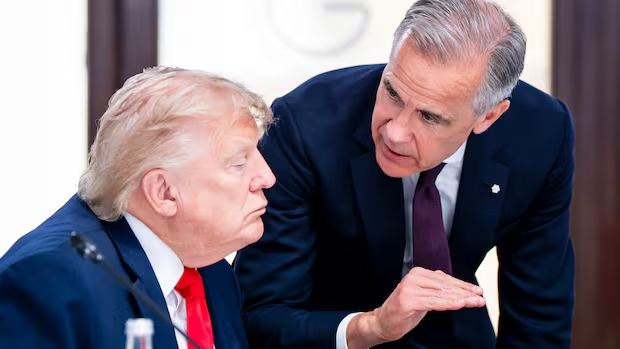
Carney's comments over possibility of U.S. invasion reveal how contingency plans are always in place
Former army commander says defence plans would have been amended in light of Trump's threats to sovereignty
A senior U.S. military commander recently dismissed a journalist's hypothetical question about a feared American invasion of Canada as "absolutely and utterly preposterous."
The head of U.S. Indo-Pacific Command, Admiral Samuel Paparo, added: "Would you ask me please, also, what my attack plans are for the Martians?"
It seems, however, it hasn't been such a far-fetched notion for Prime Minister Mark Carney, nor his senior defence officials who have dusted off various long-established — in some cases decades old — contingency plans and worst case scenarios.
In an interview with the New York Times on Wednesday, Carney said he had prepared for the "extreme tail risk" that the Trump administration might order military action against Canada.
That's his way of saying there's a really, really low probability of this happening, but the risk is not zero.
Carney tells NYT he studied risk of U.S.-led military action in Canada
The Times reported that the prime minister, after being pressed on whether he took U.S. President Donald Trump’s threats to make Canada the 51st state seriously, "suggested that he had carefully examined the possibility of a U.S.-led military invasion," but declined to discuss in detail what that involved.
"All militaries in the world spend time analyzing risk scenarios," Defence Minister David McGuinty said Thursday. "Canadians should take it as described to the prime minister: a tail risk."
McGuinty also refused to discuss details of the contingency planning.
Defence minister says preparations for possible U.S.-led military action are 'normal'
Vault full of contingency plans
While the default vision of the phrase "American military action" for many is one of heavily armoured tanks, jets and drones roaring across the Canadian border, an overwhelming number of experts agree such a scenario is unlikely given the vastness of Canada and the difficulty in securing the whole country.
It's generally agreed that in a conventional conflict the Canadian military would be quickly overwhelmed and resistance would take the form of a guerilla campaign.
There are, however, a number of other different scenarios. They range from the kind of rapid regime change that took place when former Venezuelan dictator Nicolás Maduro was captured by U.S. commandos, to the limited air campaign that's been fought over Iran.
As for contingency plans, the Department of National Defence, like militaries across the world, has a vault full of them — some dating back decades.
As Canada deepens ties with Europe, could it leave U.S. banks and dollars behind?
Retired Lt.-Gen. Andrew Leslie headed the section at the defence department that writes and updates the plans.
He said they are amended as world circumstances dictate, often when a new leader takes power in a country where Canada has an interest.
"You make judgment calls on what is likely to happen, what is unlikely to happen," Leslie said in an interview with CBC News.
"You consult with other departments, with other experts, and then you put it away again."
'Heightened focus' in light of Trump's threats
The planning, Leslie said, would have been updated after Trump's re-election in 2024 and would have been pulled out regularly, especially in light of the Trump administration's threats in January to seize Greenland by force.
"In the context of the threats that the White House has issued against Canada … those would have probably resulted in a heightened focus," Leslie said, citing talk of a 51st state and maps showing Canada as part of the U.S.
Over a year ago, Trump ruled out military action against Canada, saying he'd use economic coercion instead to force the country into the Union.
Given everything that's been said, it would have been natural for Carney to call for defence plans to be revised, Leslie said.
"What a lot of people sometimes forget is that a political leader's first remit at the national level is the safety, security of Canadians," said Leslie, who also served as commander of the Canadian Army.
"So it would be his duty to ensure that all due diligence and prudent steps have been taken to see what might have changed from the way that the old plans were written or updated. And it would be the duty of the Chief of the Defence Staff [Gen. Jennie Carignan] to advise them accordingly, which I'm absolutely sure she did."
Carney considering U.S. invasion of Canada shows 'profound change' in relations: NDP MP
Impact of Trump's threats go unnoticed in U.S.
The notion of U.S. military action is a hot-button issue for many.
"I think every Canadian worries about it," New Democrat MP Gord Johns said going into the House of Commons on Thursday. Canadians are paying attention when Trump calls the country the 51st state or refers to Carney as the governor of Canada, Johns added.
There is, however, an increasingly puzzled reaction among some Americans who have grown accustomed to Trump's threats, taunts and trolling.
Matthew Schmidt, an associate professor at the University of New Haven in Connecticut and a former instructor at the U.S. Army War College, said many Americans, including himself, are unaware of how Trump's words affect people in other nations.
"I don't think I have a visceral sense of what Canadians are feeling about the United States," Schmidt said. "We really don't have a sense of the impact of what the president is saying has on other places."
Trump says Canada is 'destroying itself' with immigration. Ministers say that's bogus
He dismissed the notion of the U.S. military taking action against Canada, but said Carney has taken the prudent, responsible course of a leader and measured the risk.
Schmidt said he also wonders whether the prime minister's reference was intended as more of a political signal to not only the Canadian public, but Americans and others.
"When Mark Carney stands up and says that, it just highlights the absurdity of what the American president said. Right? It's a way to emphasize that absurdity," Schmidt said.
Senior reporter, defence and security
Murray Brewster is the senior defence writer for CBC News, based in Ottawa. He has covered the Canadian military and foreign policy from Parliament Hill for over a decade. Among other assignments, he spent a total of 15 months on the ground covering the Afghan war for The Canadian Press. Prior to that, he covered defence issues and politics for CP in Nova Scotia for 11 years and was bureau chief for Standard Broadcast News in Ottawa.
Related Stories
 Canada
Canada names Montreal Victoire's Kori Cheverie head coach of women's team
57 minutes ago
 Canada
‘Analyzing risk scenarios’ normal, defence minister says amid Carney’s U.S. invasion comments
57 minutes ago
 Canada
TSB calls for new process to identify deteriorating railcar wheels after 2023 derailment in Alberta
57 minutes ago
 Canada
Belleville synagogue shooting a ‘hate
1 hour ago
 Canada
‘I will not stay if Alberta leaves’: Students nervous about potential separation
1 hour ago
 Canada
Downtown Winnipeg gathering aims to bring Indigenous, newcomer communities together
1 hour ago
 Canada
Alberta separation group releases report touting affordable transition to independence
2 hours ago
 Canada
When will Quebec voters get bilingual mail voter cards?
2 hours ago