
TSB calls for new process to identify deteriorating railcar wheels after 2023 derailment in Alberta
TSB calls for new process to identify deteriorating railcar wheels after 2023 derailment in Alberta
Agency says data could be used to predict wheel failures earlier
The Transportation Safety Board of Canada (TSB) says it has found data trends that suggest railcar wheel failures could be predicted sooner, which could help reduce the risk of future train derailments.
The TSB released its recommendations — which it says it is making “in collaboration with the rail industry” — for how to address the issue in a news release on Thursday. The government agency said its investigation of a 2023 train derailment near Uncas, Alta., 31 kilometres east of Edmonton, spurred the recommendations.
“This report confirms other research that has come before it,” TSB chair Yoan Marier wrote in his recommendations. “Advanced analysis of data that is already collected can help identify wheel condition issues early.
“By better leveraging this data, Transport Canada and the rail industry have an opportunity to help prevent future derailments.”
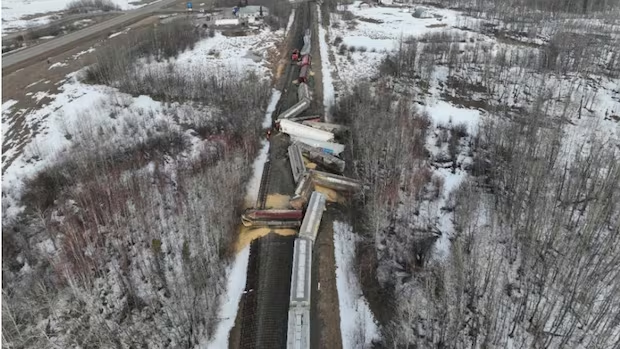
The 18-car derailment occurred on April 5, 2023 when a Canadian National Railway Company (CN) train was travelling down the company’s Wainwright Subdivision, a portion of track which runs through Saskatchewan and Alberta.
The TSB investigation report says a series of events led to the train’s conductor being told to stop the train and to do an inspection for a possibly defective wheel. Eighteen cars carrying grain derailed, however, no injuries were reported as a result.
The report notes that "despite compliance with existing wheel inspection requirements, including multiple visual inspections in the days preceding the derailment, no wheel condition issues were identified."
The TSB said investigators later determined the cause was a shattered rim failure on one of the wheels, causing a number of track fractures along the route, ultimately leading to the derailment.
“Having these wheels fail is not something that is uncommon,” Marier told CBC News. “I wouldn't say it's frequent, but it is something that we see in our line of work.”
Due to the commonality of wheel failures, railway tracks have a series of sensors called wheel impact load detectors (WILDs). The sensors measure strain and impact on wheels.
Marier said wheels are currently only flagged if they need to be immediately replaced at the next stop.
“The last sensor before the [April 2023] derailment identified that the wheel was creating a big impact on the side of the rail and it was flagged for removal,” he said.
“What the sensor did not identify is that all of the previous sensors also identified an increasing impact.”
After derailment, Repentigny, Que., asks Ottawa to reduce freight train speeds in urban areas
In its recommendation, the TSB said leading up to the 2023 derailment, the wheel was to be removed in Edmonton — the train’s next stop — but the wheel failed before arriving.
“Right now, the data from these sensors is collected, but it is not analyzed to identify trends between each sensor,” said Marier.
However, he said the data could be used to identify stressed wheels before imminent failure.
The TSB said its investigation of the 2023 derailment also revealed that the failed wheel was manufactured in 1991, several years before standardized steel practices were introduced in 2003, mandating the amount of imperfections and impurities in steel wheels.
Marier said the TSB has found these wheels have a greater risk of failure than wheels made after 2003.
The TSB said it estimates about one million of these wheels are still on trains across Canada and the United States today.
“Most of these wheels are probably fine, but they are at an increased risk of failure,” Marier said. “We haven't heard from the railways any sort of retirement strategy for these wheels.
“Considering their age, and considering the increased risk, it’s a bit puzzling to us.”
Marier said that while no policy violations or systemic deficiencies were found when investigating the derailment’s cause, the findings revealed an opportunity for the rail industry to improve safety by utilizing data it already has.
“We're essentially asking the industry to take a look at this, and for Transport Canada as the regulator to coach the industry in the right direction,” he said.
Transport Canada appoints minister's observer after train derailment in Repentigny, Que.
In a statement to CBC News, Transport Canada said it will provide a formal response to the TSB within the timeline mandated by the Canadian Transportation Accident Investigation and Safety Board Act.
“Transport Canada takes all TSB recommendations seriously and is committed to strengthen rail safety across the country,” the federal department’s statement reads. “To advance safety outcomes, Transport Canada works closely with partners, including railway companies, labour unions, provincial, territorial and municipal authorities.
“The safety and security of Canada’s transportation system will always remain a top priority for Transport Canada.”
Sara is a reporter and editor at CBC News in Edmonton. She is a graduate of NAIT's media communications and production program, and has been a reporter at Taproot Edmonton.
Related Stories
 Canada
Canada names Montreal Victoire's Kori Cheverie head coach of women's team
55 minutes ago
 Canada
‘Analyzing risk scenarios’ normal, defence minister says amid Carney’s U.S. invasion comments
56 minutes ago
 Canada
Carney's comments over possibility of U.S. invasion reveal how contingency plans are always in place
56 minutes ago
 Canada
Belleville synagogue shooting a ‘hate
1 hour ago
 Canada
‘I will not stay if Alberta leaves’: Students nervous about potential separation
1 hour ago
 Canada
Downtown Winnipeg gathering aims to bring Indigenous, newcomer communities together
1 hour ago
 Canada
Alberta separation group releases report touting affordable transition to independence
2 hours ago
 Canada
When will Quebec voters get bilingual mail voter cards?
2 hours ago