
Christa Pike 'angry and confused' after botched lethal injection, her lawyers say
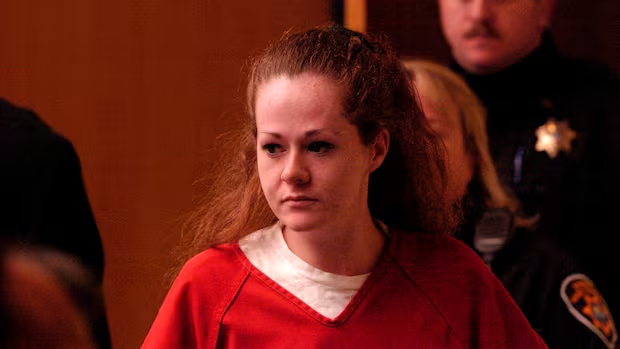
Christa Pike 'angry and confused' after botched lethal injection, her lawyers say
Christa Pike 'angry and confused' after botched execution: lawyer
Two of Christa Pike's lawyers, Luke Ihnen and Randy Spivey, gave an overview of the case they presented in court today, where their request to force the state of Tennessee to carefully preserve evidence surrounding the botched execution was granted.
They also provided some updates on Pike's condition, noting she woke up Tuesday morning after medical professionals had expected to have to take her off life support.
Her first words, as reported by hospital staff to Spivey, were: "Where am I and who are you?"
She has since asked about members of her legal and victim Colleen Slemmer's family.
Spivey also said Pike is "very aware" that the state tried to execute her and failed and that she is both "angry and confused."
Her recovery prognosis remains unclear, he added, noting her arms are "extremely swollen" to the point that one of her hands looks like a blown-up surgical glove. Pike's right arm and both her legs are still shackled to her hospital bed, Spivey said.
Ihnen and Spivey said today's hearing was the first of many of their attempts to gain answers and transparency from the state of Tennessee about what went wrong on Sept. 30 when Pike survived her lethal injection — as well as to have Pike's constitutional rights enforced.
Pike's attorneys are continuing to urge Tennessee Gov. Bill Lee to commute her death sentence to life in prison without the possibility of parole.
Lee halted further executions statewide following Pike's hospitalization and ordered a "comprehensive, third-party review to determine exactly what occurred."
Health-care professionals have also raised concerns about the drugs that are being used for executions. Pentobarbital, the drug used in Pike's failed execution, has not been clinically tested or approved for use in lethal injections in humans. In most jurisdictions, it is used almost exclusively for veterinary euthanasia.
Virtually all major pharmaceutical companies have taken public stances against the use of their drugs for capital punishment. Over the past decade most have worked to directly prohibit their use for this purpose, raising further legal complications.
This means that to acquire the pentobarbital used in lethal injections, states typically need to have it specially made. This relies on a compounding pharmacy — a specialized medical business that does not require certification, raising questions about quality control.
State investigations, including in Tennessee, have found their own protocols are routinely disregarded during executions by lethal injection. Under former president Joe Biden, the U.S. Department of Justice concluded that "the Department should err on the side of humane treatment and avoidance of unnecessary pain and suffering and cease the use of pentobarbital," unless new evidence arose.
Under Trump, the practice was resumed for federal executions earlier this year.
Arizona's botched execution of Joseph Wood
Arizona's botched execution of convicted murderer Joseph Wood in 2014
Pike is believed to be the first person to survive a lethal injection, but she is far from the first person to go through a botched execution attempt in the U.S.
Earlier this year, a doctor spent over an hour trying to establish an IV for the lethal injection of Tennessee death row inmate Tony Carruthers. According to his lawyers, they attempted to insert the needle more than a dozen times and even tried to establish a central line before giving up.
That same doctor, Mark Fowler, oversaw the failed execution of Pike last week.
According to the Death Penalty Information Center, a U.S.-based nonprofit, there have been at least 64 botched executions since 1982, with 51 of those being lethal injections.
For years, experts and human rights advocates have raised concerns about the ability of states to find competent individuals to carry out executions by lethal injection.
Some doctors have publicly argued that administering a lethal injection violates their oath to "do no harm." The American Medical Association's Code of Medical Ethics prohibits physicians from participating in capital punishment in any way, but the AMA is not a regulatory body.
However, anesthesiologists — the professionals most capable of effectively and responsibly administering the type of drug used in a lethal injection — are barred from doing so by the American Board of Anesthesiology, under penalty of losing their certification and, effectively, their ability to practice.
Ihnen reiterated that he and his colleagues had earlier raised the issue of vein access in Pike's case ahead of her planned execution, namely in a lawsuit in January, but that they had been "scoffed at" by the attorney general.
He said his team had also raised issues with the drug used in lethal injections, pentobarbital, as well as the "secrecy" surrounding the execution procedure itself.
Pike's team has previously said they were concerned that some of the state's supply of the drug may be expired. With that, the news conference has finished.
Spivey said he was not in the room when Pike regained consciousness Tuesday, but he was told that her first words after waking up were: "'Where am I,' and 'who are you?'"
He said "there's still a lot of cognitive confusion," but that she had asked about members of her legal team as well as members of the victim Colleen Slemmer's family.
Spivey said Pike is "angry and confused about everything right now."
Pike is aware the state tried to execute her, but Spivey said he did not want to say more about what his client remembers at this time "because it's evolving and I want to be very careful of that."
She's "very aware of what they did to her up to a point."
Myles's request for the state's preservation of evidence was quite lengthy. She also noted that it should "have no problem doing this because you all are already doing that," as Ayers earlier stated they were doing.
Myles said the state must preserve all drugs, syringes, IV lines, tubing, needles, catheters, medical supplies, restraints and gurneys that were in the execution room, as well as waste packaging, labels and manufacturer information.
"All photographs, video recordings, audio recordings, any surveillance footage of the execution will need to be maintained," Myles said. She also ordered the preservation of recordings or other evidence from witness and recording rooms on the night of Sept. 30.
The judge also called for the preservation of handwritten notes and logs, checklists, timelines, incident reports, witness accounts, emails, text messages and Signal communications related to the execution.
Myles said officials must preserve records concerning any "deviation from the protocol," as well as complications, delays, equipment problems and issues involving access to Pike's veins.
Pike's lawyers had warned ahead of the execution, when they attempted to prevent it from happening, that prison medical staff had previously struggled to access her veins, which are small.
She also ordered the state to preserve medical and monitoring records, time logs, documentation concerning Pike's psychological condition, and policies, protocols, training manuals and other internal guidance that may have been relevant to the execution.
The order will also cover communications surrounding the decision to call 911 and emergency medical services, the decision to stop the second execution attempt, and communications involving the Tennessee Department of Correction, state officials and the governor's office.
"I want you all to preserve all of that information," Myles said. She also instructed the state to take "special care" not to lose, misplace or accidentally delete any relevant evidence.
And if evidence has already been discarded, deleted or destroyed, the judge said she wants the state to take "an affirmative step to try to claw back that information."
Randy Spivey, another lawyer on Pike's legal team, said Pike was "brain dead" until Tuesday, a day after her lawyers had been warned she'd be taken off life support.
When she woke up, she had a ventilator in her mouth and very swollen arms and hands which she may not regain the use of, he said.
"Christa is a survivor," Spivey said, noting his client had survived several instances of rape and abuse as well as suicide attempts — and now, an execution attempt.
He said the botched execution was "foreseeable and foreseen" due to the medical issues he and his team had raised ahead of the attempt.
Pike's future as well as her mental health remain uncertain, Spivey said, adding that he and his team would do everything in their power to get answers about why it went so wrong.
"We have to ask: how much suffering is enough?" he said, adding it would be "unimaginable" for the state of Tennessee to try and execute her again.
Standing outside the courthouse, Ihnen said the hearing was an exercise in requesting more transparency from the state of Tennessee, whose "word" he said has so far been "shrouded in secrecy."
"Today was just a first step among many to preserve and enforce Christa's constitutional rights after this unprecedented botched execution," Ihnen said.
"I hope that you saw today some of the frustrations that we've had…. The goal posts keep moving."
Pike's lawyers are speaking to reporters outside the courthouse in Nashville.
Chancery Court Judge l'Ashea Myles has granted the defence's request for evidence to be preserved.
"Anything that was in the actual room needs to be preserved and maintained," Myles said.
Ayers had earlier listed some of the items in the evidence, including observation logs, medical waste and products and readouts of an EKG exam.
He said it's possible the state no longer has some of Pike's IV lines, which were cut. The defence had included IV lines in its request.
"We want all of it, that's the request," Ihnen said, noting he believes what happened to Pike is "prejudicial."
Myles acknowledged the "case is unique, to say the least."
Related Stories
 Business
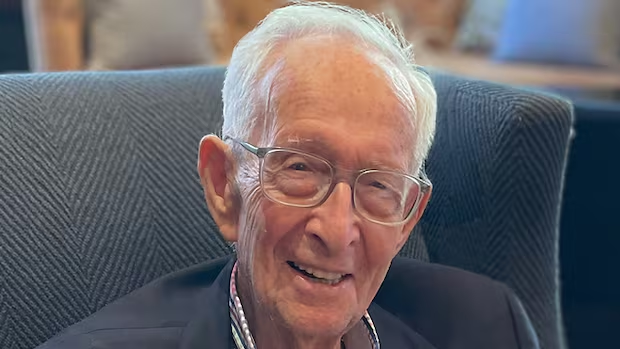
Canadian investor, philanthropist Stephen Jarislowsky dies at age 101
1 hour ago
 Business
After 27 years in Malaysia’s startup trenches, Sivapalan bets on profitability over hypergrowth with Cypress Drive Ventures
4 hours ago
 Business
Leonardo DiCaprio, yes that Leo, announces investment in Swedish EnergyTech startup Elvy
6 hours ago
 Business
Dialog Axiata launches IESL National Startup Challenge in Sri Lanka
7 hours ago
 Business
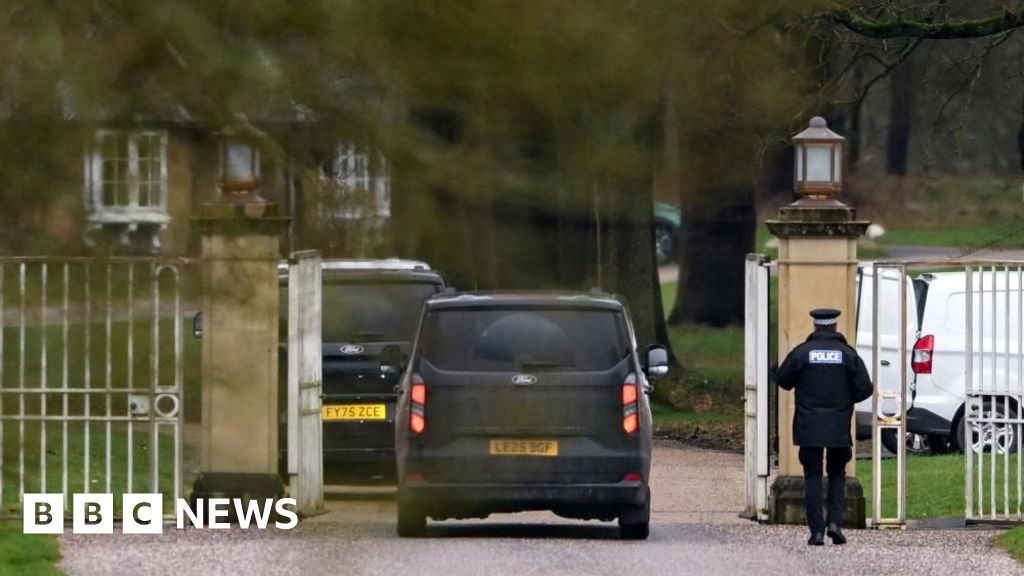
Police accept Andrew search warrants were unlawful, court hears
8 hours ago
 Business
After eight years advising startups, Irtus Consolidated now wants to fund them
9 hours ago
 Business
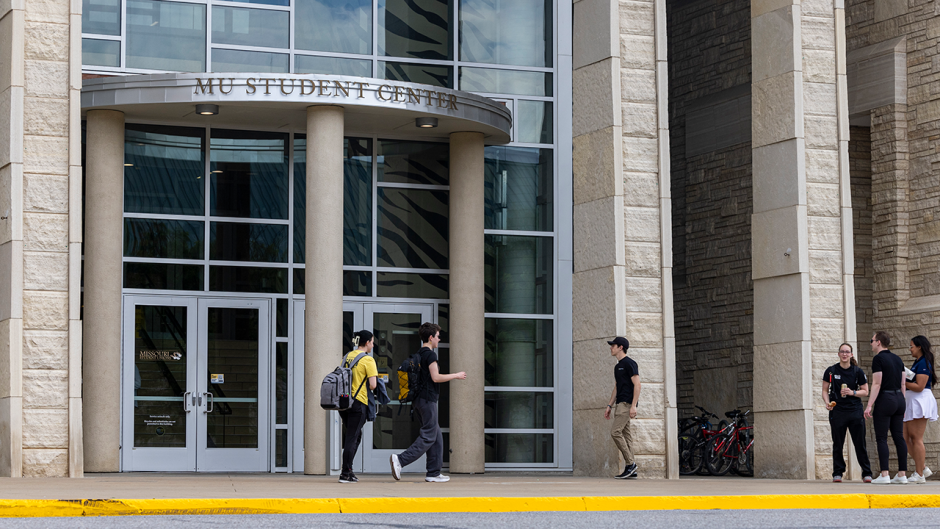
From storefronts to startups: Student entrepreneurs grow their businesses at Mizzou
10 hours ago
 Business
French, Japanese scientists share Nobel Prize in Chemistry
11 hours ago