
Could more food terminals make groceries more affordable? Ontario growers hope so
Could more food terminals make groceries more affordable? Ontario growers hope so
Federal government introduced Canada’s 1st-ever National Food Security Strategy in June
Why Canada is investing millions to expand the Ontario Food Terminal
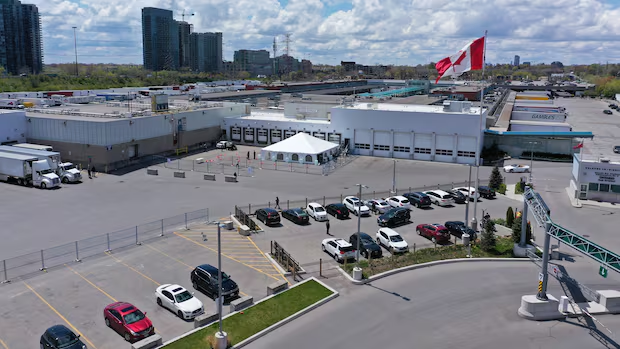
Hutch Morton crawls out of bed at 3 a.m. six times a week to bring his family’s wholesale business to the Ontario Food Terminal (OFT) in Etobicoke.
The nearly five-decade-old business, which specializes in berries and packaged salads, was first started by his father-in-law. Morton says the food terminal is the only place the company’s ever existed.
"It's the lifeblood of what our business does and I think the lifeblood of what a lot of businesses in the Toronto community depend on," he told CBC Toronto.
Food terminals are wholesale marketplaces where fresh produce is sold and bought in bulk. The OFT distributes nearly two billion pounds of fruits and vegetables annually across Canada.
Now, it’s getting an expansion. In June, the federal government launched Canada’s first-ever National Food Security Strategy. Prime Minister Mark Carney announced the government would spend more than $3 billion over the span of 10 years to produce more food in Canada and make it more affordable.
The strategy commits to investing $1 billion to create more choice and competition. The money will go into the new Food Link Fund to support food terminals and food hubs. The plan includes expanding the OFT by the end of the year, opening two new food terminals and establishing or expanding 10 smaller food hubs by the end of 2028.
'A rising tide lifts all boats': Ontario grower
Ontario farmers and growers say they are hopeful the country’s new food security strategy will lower grocery prices.
"Any investment in this place that helps connect growers with consumers … as a conduit to retail, to food service, is a benefit to all," Morton said. "A rising tide lifts all boats."
Getting more consumers to eat healthy local food is long overdue, he said.
"This truly is a national piece of critical infrastructure," Morton added. "This place is strategically located and it's really important where it's located to support all of the GTA."
Raymond Den Boer is the president of Den Boer Farms in Otterville, Ont., growing about 102 hectares of vegetables. He says he makes it to the OFT three times a week, but sometimes, due to overflow, has to set up outside, where the temperature can be too cold for consumers to stop by or too hot for the food to remain fresh.
An expansion would greatly impact the business, says Den Boer.
"Our product [would stay] colder, longer shelf life, nicer environment to work in for our customers to come to us," Den Boer said. "It's very important to support local."
“It will greatly affect us so that we have in place to be inside so our product stays colder, longer shelf life, nicer environment to work in for our customers to come to us,” Den Boer said. “It's very important to support local.”
But it's not just growers who think the strategy will benefit them. Little Harvest Market’s Vicky Lee said the store buys from farmers at the OFT five times a week.
"We try to go often to pick the freshest produce … We taste them, we smell them, we look at them and check the quality," she told CBC Toronto. "We know our farmers by name."
Little Harvest Market has been operating at The Well for two years. Lee says the store depends heavily on the wide selection of produce at OFT.
"We can buy locally sourced goods without having to [buy from] our competitors' supply chains because they will have more limited goods, they won't have as much variety," she said. "You'll get access to very interesting food that you normally don't see in other bigger stores."
Lee says expanding the terminal will allow for even more variety from new farmers at better prices.
"More suppliers coming in means more supply," she said. "That means that not just one person or one supplier has a monopoly on a certain product."
'Food inflation is a problem': food expert
But Sylvain Charlebois, director of Dalhousie University’s Agri‑Food Analytics Lab, says the national food strategy is more likely to stabilize prices and reduce price volatility — whereby prices go up or down drastically — than it is to make food more affordable altogether.
"To say beyond reasonable doubt that prices will drop is close to impossible," he said. "Food inflation is a problem."
Canada could add billions to its economy by processing more food. Here's what it's trying
Carney's new $3.2B strategy aims to boost access to local, affordable food
But that’s exactly why food hubs and terminals are so important, Charlebois says.
"The more you create these portals into the marketplace ... you basically increase chances for the marketplace to have access to more options," he said.
When competition goes up, food prices stabilize, Charlebois says.
"It will increase sales, it will increase the number of connections that the OFT generates between suppliers and buyers," he said. "You basically increase chances to enhance supply chain efficiencies, reduce waste."
Canada's got a grocery competition problem. Are local food hubs the answer?
Halifax Regional Food Hub aims to make it easier for local food to be bought and sold
More can be done though, says Charlebois.
"There seems to be no connection between supply and demand in terms of predicting over [the] next 5 to 10 years," he said. "How do we enhance production and processing in accordance to what Canadians are going to actually be eating?
"Food manufacturing is in decline in Canada. So what's the plan to actually increase it?"
Gabriela Silva Ponte has been with CBC Toronto since January 2025. Currently, she works as a web writer, but has previously taken on a variety of reporting roles in ethnic media newsrooms and at Toronto Metropolitan University. Gabriela graduated from TMU with a Bachelor of Journalism. You can reach her at gabriela.silva.ponte@cbc.ca.
Related Stories
 Lifestyle
Mimicking populists will not ease cost of living or boost productivity, Mathias Cormann warns
2 hours ago
 Lifestyle
Not cool: who hacked France’s supermarket fridges?
3 hours ago
 Lifestyle
A winter of hunger looms for residents trapped in Russian
6 hours ago
 Lifestyle
Clueso Raises $10M
1 day ago
 Lifestyle
Young father killed when motorcycle crashes into Edmonton bus shelter
1 day ago
 Lifestyle
Which countries waste the most food, and how to reduce waste at home
1 day ago
 Lifestyle
We know junk food isn't healthy, but scientists are trying to determine if it's also bad for our brains
1 day ago
 Lifestyle
Reprogrammed NK immune cells target cancer and autoimmune disorders
1 day ago