
Could the UK really rejoin the EU?
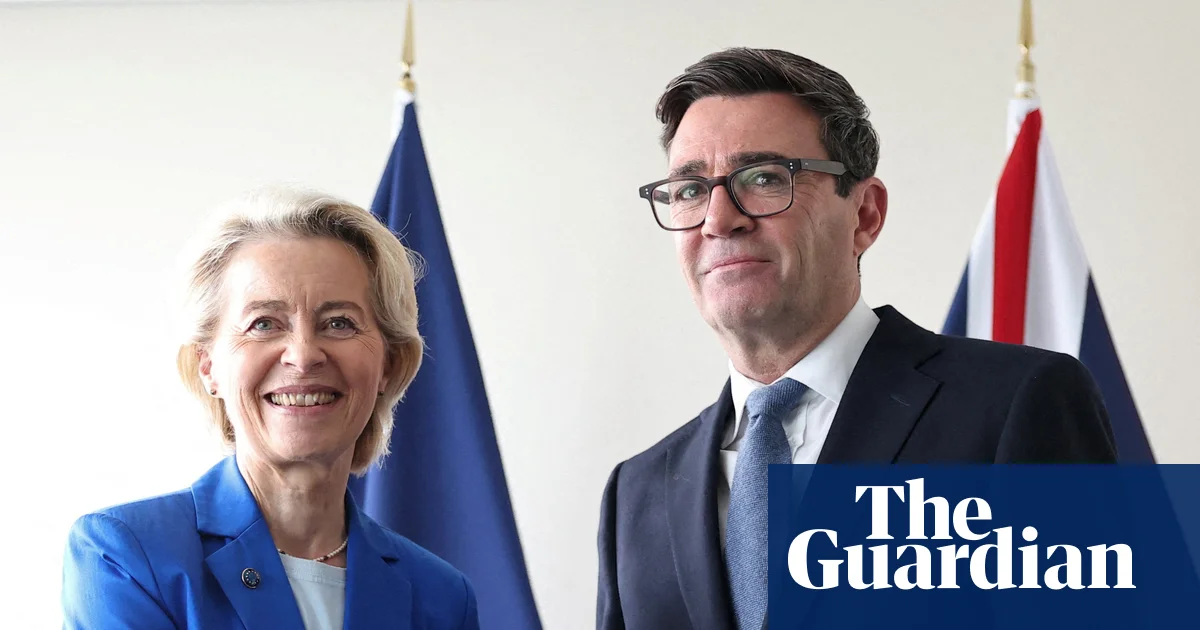
It was lobbed into the national conversation without fanfare or warning, almost a footnote in the UK prime minister’s first speech as leader to his governing Labour party’s annual conference. But Andy Burnham has kicked off a quiet U-turn on Brexit.
By stating bluntly that the decision to leave Europe’s core political community had done “more harm than good”, Burnham broke a taboo in his own party, in effect, discarding his predecessor’s paralysing ‘red lines’ on Europe, and signalling he will not be bound by these constraints after the next British election.
Over the coming six weeks Burnham will gauge public support before setting out future options for the UK’s long term relationship with the UK’s largest market. Rejoining the 27-nation bloc will be one of them, opening the door to Britain reversing Brexit.
The famous red lines, or non-negotiables, enshrined by Starmer in Labour’s 2024 election manifesto, were meant to reassure Brexit-supporting voters that under Labour there would be no return to a single market, customs union or the free movement of people. These pledges left Starmer with little room for manoeuvre with Europe beyond warm words.
The evidence that Brexit has stunted the British economy is not new. Estimates for the damage quitting the single market has already done range from 6% of 8% of GDP. What is new is a prime ministerial readiness to publicly acknowledge that harm and conclude that an ambitious new path is required.
“This is the first time that a UK politician in power has been willing to stand up and say that Brexit is a failure that we must address or redress in some fundamental way,” Joël Reland, an analyst with the UK In a Changing Europe thinktank, told me. “Keir Starmer’s public message was that we will be sticking with Boris Johnson’s [2019] Brexit deal, but we’re going to improve it to make Brexit work. Burnham is saying Brexit doesn’t work and that we need a different form of deal. That has never been said before.”
Burnham is not yet committing himself to fighting the next election on a particular course of action. Much will depend on the response he gets. But all options – Lisa O’Carroll details them here – are on the table, from a customs union to re-joining the single market and becoming, like Norway, a rule-taker, to “going all the way”.
But crucially, Burnham has already departed from the orthodoxy that makes questioning Brexit a heresy. Instead of shutting down the topic to limit his exposure to Eurosceptic attacks, the PM is meeting it head-on, Reland said. “And I don’t see why you would do that unless you wanted to take on the political argument”.
Why would Burnham choose this juncture and risk drawing down what Rafael Behr calls the Brexit curse?
The economic rationale is the obvious one. “Burnham’s ten year domestic agenda for the country promises radical reform of such things as the social care system, and somebody is going to have to pay for that,” argues Reland. “One of the ways you can get economic growth is by rejoining your largest and closest trading partner.”
The modest ‘re-set’ agenda launched by Starmer in May 2025 is stuck, bogged down in disputes, such as that over fees for EU students in the UK. A pencilled-in 20 November summit is still up in the air. Britain’s big impediment from outside the club is its lack of bargaining power. A cherrypicking attempt to coax the EU into a selective single market for goods only (without free movement of people) was firmly rebuffed by Brussels in May. And even if this reset were fully delivered, the government’s own figures estimate it would add at most 0.3% to GDP by 2040.
Labour meanwhile has lost votes to its left, particularly to the Greens, so a more progressive offer on Europe might be a gamble worth taking. New polling, as Pippa Crerar and Rowena Mason revealed at the weekend, shows that if Burnham’s preference is for rejoining the EU, almost half of the country already agrees.
Gaby Hinsliff noted that among Burnham’s opponents the only one to react to the surprise move with “unfettered glee” was Nigel Farage. Yet, she suggested, the Conservatives, also obsessed with economic growth, may not side with Farage given that most voters think Brexit has made them economically worse off. “It’s not in Tory long-term interests to strangle this at birth” wrote Hinsliff.
Events in Europe are also dictating the pace. “Welcome back!” was the French president Emmanuel Macron’s possibly tongue-in-cheek response to Burnham’s remarks. But it is a French-led project called “Made in Europe” that is both concentrating the PM’s mind and could ultimately undermine his ambition.
Made in Europe is a highly protectionist idea for remaking the EU as an industrial powerhouse, able to withstand competition from China. UK-made goods, if legally classified as non-European under the law, would be locked out, spelling trade devastation for the British car industry. France, facing its own domestic upheaval and crunch elections next April, is hardline about Britain’s exclusion: Macron’s ministers insist that if you’re not paying the costs of the internal market you don’t get to claim the benefits. Made in Europe is emerging as a symbol, Reland explained, of how geopolitics is driving the EU’s agenda, and widening its range of competencies to such areas as industrial policy, AI and tech sovereignty. “It is no longer just food and environment policy that is set at EU level but the big, strategic, hard security decisions too,” he said.
The more that EU countries strategically pool sovereignty to respond to shocks such as US antagonism or Russian hybrid warfare, and the more aggressively they protect that cooperation, the steeper the costs of being outside the club become. With Norway and Switzerland, both non-EU members with single market access, now also facing the Made in Europe battle, it’s no wonder Burnham is mulling the full rejoin option.
But, as Mujtaba Rahman’s prescient column advised, the coming debate will need to go beyond the question of whether Britain could contemplate rejoining, to an honest assessment of what Europe has become in the years since it left.
To receive the complete version of This Is Europe in your inbox every Wednesday, please subscribe here.
Related Stories
 Economy
‘Tipping recession’: Atlantic Canadian hospitality workers feeling the pinch
17 hours ago
 Economy
Iran’s oil minister resigns as country’s economic crisis worsens
20 hours ago
 Economy
Deloitte slashes 2027 economic outlook by 20% as trade tensions worsen
1 week ago
 Economy
Canada's economy stalls after three months of growth
1 week ago
 Economy
Deloitte Canada cuts GDP forecast by 20% as tariffs grip economy amid Trump's trade war
1 week ago
 Economy
Why gold and silver prices are on the decline as bond yields rise
1 week ago
 Economy
‘The weaker he gets, the more dangerous he gets’: Trump lashes out as his power wanes
1 week ago
 Economy
Where things stand after Iran's new pitch for a deal to open the Strait of Hormuz
1 week ago