
From ancient wisdom to artificial intelligence: India’s traditional health care ministry’s AI moment begins
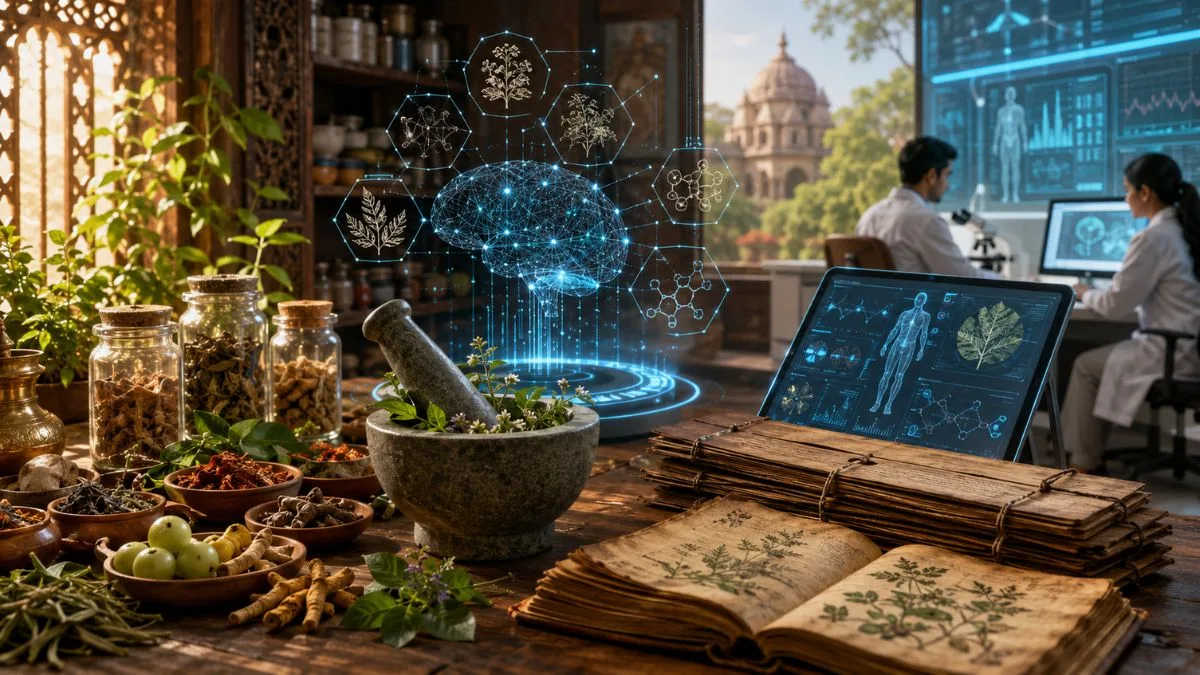
NEW DELHI – Ayurveda is thousands of years old. Artificial Intelligence is barely a decade into its mainstream journey. Yet, the two are now being brought together in what could become one of the most interesting experiments in India’s healthcare landscape.
In a move that signals how rapidly digital technologies are reshaping governance, the Ministry of Ayush has signed a Memorandum of Understanding with the IndiaAI Mission under the Ministry of Electronics and Information Technology.
The goal is simple in theory but ambitious in practice: use AI to make India’s traditional systems of medicine more evidence-driven, better researched and easier to access.
The agreement was signed by Dr Kavita Jain, Joint Secretary and Chief Vigilance Officer in the Ministry of Ayush, and Sudeep Srivastava, Chief Operating Officer of the IndiaAI Mission and Joint Secretary in MeitY.
For years, supporters of Ayush have argued that India’s traditional medical systems hold an enormous body of knowledge waiting to be explored.
Critics, however, have often pointed to the lack of structured research and accessible data.
AI has the potential to narrow that gap, not by replacing traditional wisdom, but by helping researchers organise, analyse and build upon it.
Under the partnership, the Ministry of Ayush will contribute research datasets, metadata, AI models, toolkits and other digital resources to AIKosh, India’s national AI repository.
The idea is to make this knowledge easier for researchers, startups and innovators to use while developing new healthcare applications.
The collaboration will also give Ayush researchers access to high-performance computing infrastructure under the IndiaAI Mission.
In practical terms, researchers working on areas ranging from medicinal plants to clinical studies will gain access to the computing power needed to run advanced AI models. Such infrastructure has often been expensive or difficult to obtain.
Speaking on the occasion, Dr Kavita Jain said Artificial Intelligence could open new possibilities for evidence-based research, better knowledge management and innovation across the Ayush ecosystem.
Sudeep Srivastava said the partnership seeks to bring together India’s traditional knowledge and modern technology.
By enriching AIKosh with traditional healthcare datasets, he said, researchers and practitioners would have better tools to generate new insights and applications.
The initiative also fits into the broader digital transformation being undertaken through Ayush Grid, which is developing AI-enabled platforms for the sector.
According to Naman Goyal, Officer on Special Duty at Ayush Grid, the collaboration is expected to accelerate those efforts.
Technology alone, however, cannot answer every question surrounding traditional medicine.
AI is only as useful as the quality of the data it learns from. Building reliable datasets, encouraging rigorous scientific research and ensuring the ethical use of AI will determine whether the initiative becomes genuinely transformative or remains another digital experiment.
Even so, the partnership reflects a changing approach.
Instead of seeing traditional medicine and modern technology as separate worlds, policymakers are beginning to view them as complementary.
If that vision succeeds, the future of India’s oldest healing traditions may be shaped not only by ancient texts, but also by algorithms, data and computing power.
Related Stories
 AI News
World's largest open library calls for volunteers to scan and preserve physical books as AI companies buy, scan, and destroy them
20 minutes ago
 AI News
After 27 years, it must have been hard for Jeff Dean to let go. Dean, who quit Google to build his own AI startup called DiscoveryLoop, briefly choked up while describing his decision to leave the search giant after more than a quarter
1 hour ago
 AI News
Royster Fellow will study how AI can be manipulated
2 hours ago
 AI News
Why Anthropic's AI watermark for Claude text goes further than rivals
3 hours ago
 AI News
MAHA activists criticize Trump’s push for coal
3 hours ago
 AI News
Neoclouds become AI’s new power brokers
3 hours ago
 AI News
AI Jobs Are Booming for Gen Z, Not Everyone
3 hours ago
 AI News
AI scammers may use vacation photos to determine travelers' locations, experts at McAfee warn
4 hours ago