
Gen Z Protest Politics: Laughter as Resistance in India

Since the upsurge of protesters from July 18, when Sonam Wangchuk was forcibly taken away for medical attention by the Delhi police, to the day of the “March to Parliament” on July 20, and till the protests ended on July 25, the Jantar Mantar protests saw an unprecedented use of foul language in the streets. It was an unmatched phenomenon, and a departure from past youth movements.
It stunned everyone. But it evoked laughter, not consternation. The expletives were uttered by young women and men in gay abandon and laughter. They were using slurs without fear or shame before the camera. What caused this sudden, vulgar burst of freedom? What does it convey in the context of a protest gathering? What is the political nature of this incredible phenomenon?
To begin with, public profanity is not an unusual practice in India. Conventionally, men across class effortlessly use foul language with crude regularity. There is something conventionally masculine about it too, with sexist, and even misogynist, overtones. But if expletives have an improperly recreational charm for the elite and middle class, they serve a different purpose in the lives of working-class men. Shankar Ramaswami writes in Souls in the Kalyug (2025), on the lives of factory workers in Okhla: “Mazak enabled workers to get into the work, distract themselves from tensions, keep boredom, fatigue, and drowsiness at bay, and complete one’s production.”
Elite denial and hypocrisy have long associated obscene language with the working class, or underclass. The argument was based on the lack of culture. Growing up in a middle-class railway colony, I picked up slang from male friends early in school. In retrospect, I don’t think there was anything deeply cultural about it. Slang was mostly used when we indulged in real, or mock, affront. It became part of an intimate language of annoyance and pleasure. Like other habits considered bad while growing up, such as smoking, drinking, premarital sex and porn, slang is a cultural surplus of the youth. It is taboo because it thrives in the pornography of language.
Since the awareness and sentiment of gender equality, most visible in coed institutions, contributed to the growth of confidence and sense of freedom among women in India, the desire for everything considered taboo began to interest women too. Behind the culture of formal equality, a more subversive form of equality also took root. Women could now abuse a man back in his own language, subverting the gender norms of (male-centric) slang.
What was striking at Jantar Mantar is that a large number of young women overtook the men in freely using expletives against political authority. The genteel found it a disturbing cultural spectacle. The new generation was hell-bent on introducing a radical fashion into the politics of protest. There is one more important thing to keep in mind. The youth at Jantar Mantar, barring some party activists, was largely composed of a heterogeneous group. It was not ideology, but a common political spirit, that brought them onto the political stage. The shared language of profane humour acted like glue.
Gen Z’s grammar of political expression deviated from the older nationalist language of politics and protest. Earlier, liberals, Gandhians, or communists maintained a certain veneer of seriousness (despite differences in their mode of articulation, which included persuasion, anger and satire) to criticise power and place their demands. It was not so much the nature of the regime (which in India has been mostly liberal) but a certain generational ethic, handed down by the anticolonial struggle, that laid down the language of politics.
Since 2014, it has been difficult to impress upon the regime using older forms of political language. The BJP regime created politico-moral binaries between national and antinational, Hindu and Muslim, citizen and infiltrator. Every political actor and demand was evaluated through a lens of othering. The language of secular faith or expectation ran into a fascist wall. Since older forms of political expression failed to impress the current regime, the youth decided to break conventions. Even as brokers of the regime on media and social media tried to malign the CJP as antinational and foreign-funded, Gen Z protesters who joined the movement reversed the game. They treated the political regime and its media agents with disdain and mockery. The regime tried to infantilise the youth with paternalistic advice, asking them to trust the system that had failed to assuage their fears. The protesters counter-infantilised the regime with obscenities as an act of rebellion.
It must be noted that the advent of social media, particularly Instagram, turned out to create public channels (or tunnels) that encouraged the flow of private language. As the digital world collapsed the moral and psychic distinctions between public and private spaces, it impacted a lot of binaries in the process, including the sacred and the profane. Everything from the body to personal relationships became part of visual culture and narrative. What was once considered private, hence sacred, was now up for public consumption and scrutiny. Many among Gen Z live their private life publicly.
This was bound to have a corresponding effect on language. Since the objective regard for binaries had collapsed into a subjective collapse of their boundaries, the new generation no longer distinguishes between private and public language. Some baited the police to hit them. Some asked them how they could hit them, if they had kids at home, and whether they were worried about their children’s future. They provoked interaction with expressions of delirium and intimacy that posed a challenge to the language of institutional power. The police either grimaced or turned away.
Kshipra, a political science student of the Gen Z generation living in Kota, said her generation grew up hearing right-wing leaders and television news anchors using crude and abrasive language as an intimidatory tool against dissenters, opposition leaders, and minorities. Since Gen Z is expert at dissolving narrative boundaries, it could see through the fake political binaries being recreated on an everyday basis for what they were.
Gen Z is also the most abandoned generation. It feels it belongs to nobody, and nobody could possibly belong to it, or understand its predicaments. It exists like a lost generation, neither fully grounded in the present, nor with a clear sight of the future. It is a generation that, while it destroys the language of the past, is looking for its own language. Like all generations, Gen Z is also confronted by the nature of the historical time it finds itself trapped within. This makes it carry and reflect a deep sense of the political and ecological imbalance the world is spiralling towards.
Perhaps because of all these objective and subjective reasons, Gen Z can be extremely sensitive to gestures of love, kindness and solidarity. When Abhijeet Dipke and the CJP declared their political support for the cause of students who had died by suicide due to institutional irregularities and apathy, it struck a chord. When Wangchuk declared his hunger strike, it endeared him to the youth. Some people out there cared for them, for their lives and future. It must have meant a lot. They decided to honour it with their presence and put their bodies on the line. This is politics beyond class and identity, a politics of dissolution. It is a generation finding its political moment, one it wanted to lift and crush at the same time. The obscene protest language deployed by Gen Z at Jantar Mantar was both an affirmation and a ridicule of the political.
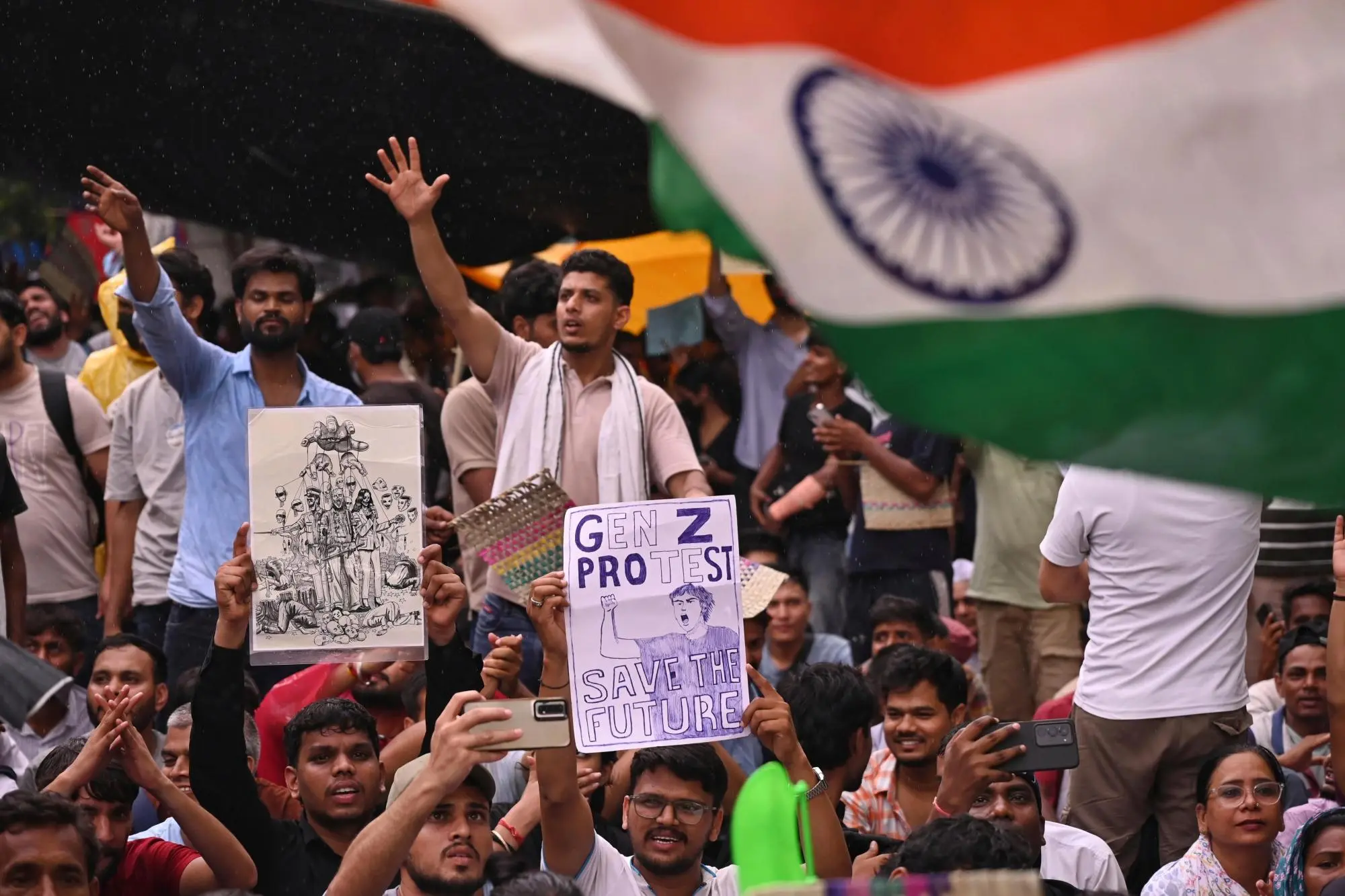
Protesters gather at Jantar Mantar in New Delhi on July 24, 2026, demanding the resignation of Union Education Minister Dharmendra Pradhan over alleged examination irregularities and the NEET paper leak. | Photo Credit: Vipin Kumar/ANI
The stamp of this paradoxical radicalism makes the Jantar Mantar protests unique. It can be read as a certain de-classification of social and cultural hierarchies. The taboo was lifted off language. The earlier denial and hypocrisy of elite versus working-class or underclass culture evaporated. Humour at Jantar Mantar was recreational and subversive cultural production. Gen Z is a genuine revolution in this sense.
“Gen Z is unhinged,” Kshipra said. An unhinged generation found itself hinged to a cause. They had had enough of governmental propaganda and inaction. They were frustrated, angry and ready to express themselves. Armed with mobile phones, they made the street their own. The presence of the police half irritated, half amused them. As I said before, they did not carry the defeatist common sense of Gramscian knowledge—that the state’s repressive apparatus will crush you. Everyone at the protest site used the word democracy like a piece of light. A placard at Jantar Mantar read: “Right to Education vs Dirty Politics and Dictatorship.” If politics was dirty—a problem Jean-Paul Sartre addressed in his 1948 play Les Mains sales (Dirty Hands)—Gen Z was going to play dirty too.
True to its uniqueness, however, Gen Z was not prepared to protest like its generational predecessors. This was a cathartic moment for them. If the digital world had intruded upon their private spaces and turned them public, they decided to turn the public private. If formal language had robbed them of their due and failed to impart justice, they would respond with the language of subversion. The language of surplus, or exception, was turned into a norm. That decision and gesture transformed the protests into a carnival of profanities.
Modern power is considered solemn. It doesn’t laugh, expresses itself in stern language, and demands obedience. Rulers have used it to evade responsibility and justify the excesses of authority. This aspect has inspired literary satire and critique from 20th-century writers such as Bulgakov, Márquez, Llosa, Saramago and Rushdie. Mandelstam’s grotesque poem on Stalin’s moustache cost him his life. Kundera’s satirical novel The Joke is about Ludvik Jahn, who is expelled from university and the Communist Party for writing to a girl: “Optimism is the opium of the people.” It took a little boy in a 19th-century story by Danish writer Hans Christian Andersen to say the emperor had no clothes. Laughter, satirical or not, is the most powerful human antidote to the solemn and ridiculous authority of power.
Filmmaker Anand Gandhi, who made Ship of Theseus (2012), wrote on X on July 25 that “Satyagraha is now haasyagraha.” The argument being that Gandhi’s idea of “truth-force” has now extended to humorous irreverence. In stories like the Jataka Tales, the Hitopadesha, and the Akbar-Birbal and Tenali Rama tales from India’s folk tradition, humour in social and political contexts that took digs at power and prejudice has entertained our cultural sensibilities. Closer to our time, Satyajit Ray’s epic musical satire Hirak Rajar Deshe (Kingdom of Diamonds, 1980) tells the story of two exiles who confront a tyrannical king. A song written by Ray and sung by Anup Ghoshal has the refrain: no machine am I, but a living being, and I know the Diamond King’s mischief well—fie on the king.
Truth and satire go hand in hand. If power grows absurd and ridiculous, rational arguments can contribute to understanding, not to challenging power. Songs and witticisms take over.
The writer is the author of Gandhi: The End of Nonviolence.
Also Read | What 12 years of Modi have done to India’s soul
Also Read | In defence of the self-criticising Hindu
Related Stories
 India
India
Rahul Gandhi INDIA bloc's 2029 PM candidate: Tamil Nadu minister P Viswanathan
56 minutes ago
 India
India
India releases names of 63 Indian nationals rescued from Trishuli
10 hours ago
 India
India
GlobalM and Lamhas Expand IP Broadcast Across India
11 hours ago
 India
India
How India’s Gen Z movement of ‘Cockroaches’ dented Modi’s political image
11 hours ago
 India
India
Cockroach revolution turns on India's leader
14 hours ago
 India
India
Kangana Ranaut opens up on politics, career and being ‘Hugely Desirable’: 'Had an identity for 20 years a
16 hours ago
 India
India
Will legacy brands handover online operations to start
18 hours ago
 India
India
Why India’s Gen Z Protests Matter to Young People Everywhere
19 hours ago