
Google Helps Accenture Embed AI Engineers With Customers

Google Helps Accenture Embed AI Engineers With Customers
Google has reportedly teamed with Accenture to help customers deploy Google Cloud’s agentic artificial intelligence platform.
That’s according to a report Tuesday (Sept. 8) from the Wall Street Journal (WSJ), which calls the collaboration the latest example of companies wagering that forward-deployed engineers are crucial to deriving business value from generative AI.
According to the report, the Accenture Gemini Enterprise Business Group is a new unit at the professional services firm, with Google Cloud on hand to train up to 1,000 Accenture forward deployed engineers, or FDEs, who will work with customers on-site to plan and develop AI applications on the Gemini Enterprise platform.
“There’s a need for experts who can go and do these [things] for customers,” Google Cloud Chief Executive Thomas Kurian told the WSJ.
As covered here in March, the role of the FDE reflects an obstacle companies face when adopting artificial intelligence.
We’d love to be your preferred source for news.
Please add us to your preferred sources list so our news, data and interviews show up in your feed. Thanks!
“Many organizations lack the data pipelines, system architecture or internal expertise needed to deploy AI tools on their own,” that report said. “Engineers embedded with customers help close that gap by translating models into production systems that companies can use within daily operations.”
The WSJ report says this is the latest in a series of bets by AI companies that placing their technologists within customers’ offices is the best way for enterprises to see meaningful returns on their AI investments.
“Clients want clear value and they’re stuck,” said Accenture CEO Julie Sweet, adding that companies are seeking growth, investment capacity and real impact on their bottom line.
“We promised AI can do that. And they’re like, ‘We get it, except it’s not happening, help us make it happen,’” she added.
Beyond that, said Kurian, companies have trouble understanding how artificial intelligence can reconfigure their business processes, and struggle with grasping how to make organizational and labor changes that come from that redesign.
PYMNTS reported in July that businesses have begun scrutinizing their spending on AI in the wake of two years of unchecked growth in expenditures as companies pushed workers toward “the biggest AI models and the heaviest usage as if consumption were a sign of progress.”
A PYMNTS Intelligence report, “The Enterprise AI Payback Curve: Adoption Accelerates as Returns Take Shape,” found that among financial services, healthcare and media companies, nearly all respondents say AI is functioning well in the purposes for which it had been deployed and that their return on investment over the prior 12 months has been positive.
Still, most firms say the real payback on their AI investments will happen on a five or six-year timeline, the report added.
Related Stories
 AI News
Guardio Raises $40M at a $1.1B Valuation
1 hour ago
 AI News
Artificial Intelligence in Italy: Compliance Roadmap after the Digital Omnibus
1 hour ago
 AI News
AI Stocks: OpenAI Declares The 'AGI Era' Is Here Amid IPO Fervor
1 hour ago
 AI News
Senegalese space expert Maram Kaire appointed Associate Editor of Deep Space Exploration Journal
2 hours ago
 AI News
The Pentagon Asked OpenAI for Artificial Intelligence Designed to Rarely Say No
3 hours ago
 AI News
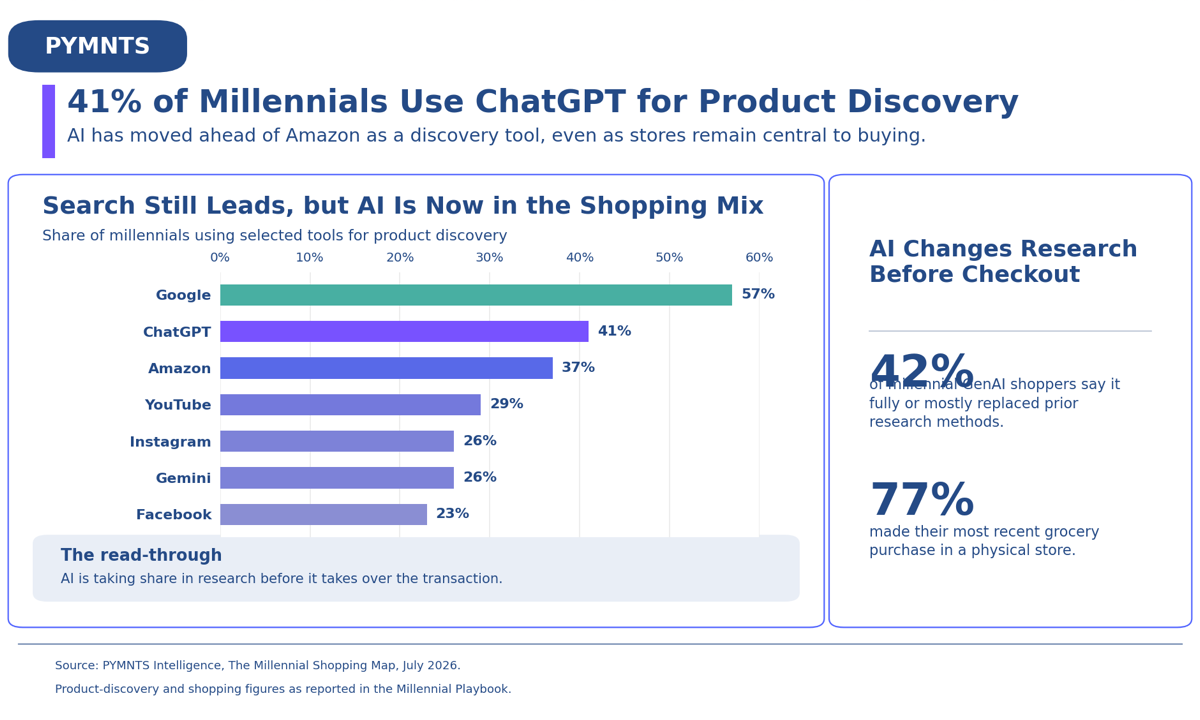
41% of Millennials Use ChatGPT for Product Discovery
4 hours ago
 AI News
Mistral AI raises €3 billion in response to doubts over its strategic direction
4 hours ago
 AI News
Making sovereign, open
5 hours ago