
Heart disease found in 5 of 7 open
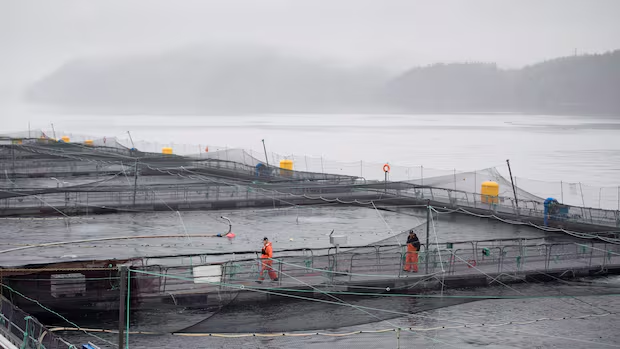
Heart disease found in 5 of 7 open-net salmon farms: study
Pacific Salmon Foundation study found viral heart disease is more widespread than previously reported
Viral heart disease is more widespread in open-net salmon farms in B.C. than previously reported, according to a new peer-reviewed study from the Pacific Salmon Foundation published in the journal Aquaculture.
The study found the disease, heart and skeletal muscle inflammation (HSMI), in five of seven open-net pen salmon farms in the Broughton Archipelago, a group of islands east of Port McNeill on Vancouver Island.
And researchers say the disease-causing virus, piscine orthoreovirus (PRV), can spread into the surrounding waters and infect wild fish.
“We found the occurrence of the disease is much higher than what was thought previously,” said lead author Emiliano Di Cicco.
Open-net fish farms off B.C.’s coast have long been the subject of debate, including the risk of disease transfer from farmed fish in the pens to wild salmon swimming past.
Di Cicco and colleagues published research in 2017 that found the disease in one out of four farms studied at the time. But Di Cicco said they knew it was not just a single occurrence.
“Now we have evidence that that was really not the case,” he said.
Hundreds of thousands of Atlantic salmon school together in a tank at Mowi's Big Tree Creek salmon hatchery near Campbell River. (Kieran Oudshoorn/CBC)
Nearly seven per cent of the 749 salmon that were examined by three independent pathologists across the farms in the study showed signs of HSMI.
As recently as 10 years ago, the role of PRV in causing the disease HSMI was uncertain, in part because fish can carry the virus and be healthy. But in 2017, experiments by Norwegian researchers established the link, Di Cicco said.
According to the researchers, Pacific salmon can suffer from anemia, inflamed hearts, damaged livers and kidneys, and jaundice when infected by PRV.
However, Di Cicco said this virus is currently classified by the Department of Fisheries and Oceans (DFO) in B.C. as non-pathogenic, or not disease-causing. He is calling on the federal government to reclassify the virus as pathogenic.
He also wants the criteria for diagnosing the disease to align with other countries. He says DFO uses different standards for diagnosing HSMI, looking at observable symptoms or large mortality spikes in a population.
But globally, he says the disease is known as a chronic, low-level condition.
“If you expect to diagnose the disease only if all these criteria occur, most likely you are going to miss it,” said Di Cicco.
Federal Court of Appeal upholds decision to keep salmon farms out of B.C.’s Discovery Islands
New study shows increased pathogens near B.C. open-net salmon farms
DFO said in a statement it will review the study and consider its findings in future work.
“Detecting a virus or disease in farmed fish does not, on its own, demonstrate impacts on or decrease of wild salmon populations,” it said.
It said DFO’s diagnostic criteria for HSMI were established in collaboration with leading scientific experts.
“In January 2020, Canadian and international veterinarians and pathologists generated the current case definition of HSMI to ensure it is scientifically rigorous and aligns with the highest global standards.”
Feds delay closure of B.C.'s open-net salmon farms until 2029
The B.C. Salmon Farmers Association did not immediately respond to a request for comment. The industry group has previously called concerns about PRV "fearmongering" and said the virus is "a common, relatively benign, and widely distributed marine virus."
Industry groups have said salmon farming in B.C. provides highly paid and skilled jobs, and makes up 95 per cent of Canada’s salmon production.
Protesters hold a demonstration in front of the Department of Fisheries and Oceans office calling for an end to fish farms in B.C in downtown Vancouver in September 2020. (Ben Nelms/CBC)
Collaboration with First Nations
The recent paper was conducted in partnership with the Mamalilikulla, ʼNa̱mǥis, and Ḵwiḵwa̱sut’inux̱w Ha̱xwa’mis First Nations.
Rick Johnson, the Kwikwasut’inuxw Haxwa’mis First Nation Chief, said salmon have always supported the coastal Indigenous people in B.C.—and now, people need to support salmon.
“We always knew there was a problem,” he said.
“It’s just a great blessing to have science prove what we thought.”
Don Svanik, the elected chief councillor of the Namgis First Nation said he has been fighting to have open-net pen salmon farms closed for years.
“We’re salmon people. . . it’s intrinsic to who we are,” he said.
“Certainly our ancestors knew how important it was, how vital it was for the ecosystem and environment. I think human beings, we kind of let that slip a bit.”
Michelle Gomez is a writer and reporter at CBC Vancouver. You can contact her at michelle.gomez@cbc.ca.
Related Stories
 Canada
Disruption until 2028 as new water pipes installed
8 minutes ago
 Canada
Trump announces Russia
1 hour ago
 Canada
Top stories of the week: Remembering Harrison Yoshy, Canada’s grocery rebate, and Stratford mother found
1 hour ago
 Canada
What Albertans can expect when they go to vote
2 hours ago
 Canada
Family hubs set to launch across borough
2 hours ago
 Canada
Zelenskyy comments on proposed energy truce
2 hours ago
 Canada
'Book brigade' moves 7,400 books by hand to Hintonburg store's new space
3 hours ago
 Canada
Canada Life launches more flexible workplace savings options for Gen Z employees
3 hours ago