
How has tornado forecasting technology changed over time?
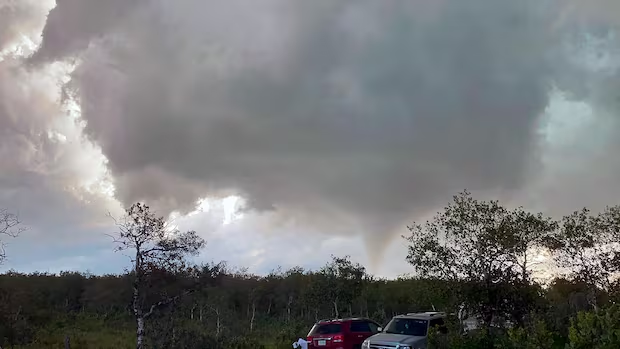
How has tornado forecasting technology changed over time?
Social media has changed prediction landscape, weather expert says
Tom Taylor says he used to occasionally phone into Edmonton’s local weather office to report conditions and ask questions, but his call one summer day in 1987 was anything but usual.
“I felt comfortable saying, ‘Well, is there a tornado in the area?’ And they immediately said, ‘Why? Have you seen the funnel?’” he told CBC News on Monday as he recounted a day that has become known as Black Friday.
“I said, ‘Yes, and it touched the ground.’ Then they asked me a few more questions and said, ‘We have to put out a tornado warning.’”
After witnessing a twister barrelling towards Edmonton, the Leduc man was among the first to report what became one of the deadliest tornadoes in Canadian history.
Thirty years after deadly Edmonton tornado, storms remain difficult to track
On July 31, 1987, an EF-4 tornado on the enhanced Fujita scale passed through Alberta’s capital, killing 27 people and injuring at least 300 others. The tornado racked up over $600 million in damages, adjusted for inflation.
Black Friday was a “wake-up call” for many Canadians when it comes to emergency preparedness and tornado forecasting, says Dave Sills, the director of the Northern Tornadoes Project, a research group based out of Western University in London, Ont.
But the 1987 tornado isn’t the only destructive tornado in Alberta’s history. A tornado in Pine Lake, Alta., in July 2000 resulted in 12 deaths, and this year’s tornado season in the province has seen double the number of twisters than the year prior.
Nowadays, meteorologists rely on computer modelling and Doppler radars to track and forecast storms, Sills told CBC News on Monday. But in the 1980s, technology was not nearly as advanced as it is now, according to Terri Lang, a meteorologist with Environment and Climate Change Canada.
At the time, meteorologists relied on tools similar to today’s — like data on weather patterns and weather radars — but this technology was “very, very slow,” Lang said Tuesday.
Reflecting on Pine Lake's deadly tornado 25 years later
“You were relying mostly on people phoning in, weather spotters [and] that type of thing as opposed to — now it’s seemingly instantaneous on social media.”
Lang said meteorologists “would have struggled a lot back then.”
“They missed a lot back then, but by no fault of their own,” she said. “They can only go on what information that you have.”
The destruction on Black Friday prompted Canada to adopt a widespread Doppler radar system. These radars are one of the primary tools forecasters use to predict and alert the public when it comes to tornadoes and other extreme weather events, said Sills.
“[It] lets you actually see inside of the storm, … see wind motions within the storm,” said Sills, who noted this feature is particularly important for forecasting supercell thunderstorms — storms that can create tornadoes — since the storms can create specific environments around them.
Vicious storm in central Alberta results in 2 tornadoes, sends 3 people to hospital
Though storms can still be difficult to predict, technology is constantly advancing, said Sills, adding that artificial intelligence and increasingly refined tools allow for warnings to be issued sooner rather than later.
But that doesn’t mean prediction technologies don’t have flaws. Sills said work needs to be done by authorities to ensure radar works better, such as by enhancing images and scope and expanding coverage areas.
“As the science progresses, we're getting better and better at being able to predict these things. But certainly there's going to be times when things occur that we just can't detect in real time, can't warn for,” he said.
But where gaps exist, civilians are stepping in.
Citizen science and crowdsourcing on social media has allowed for environmental and weather agencies to know more about what’s happening on the ground, said Sills.
“A lot of times you can see something on radar and know what's happening with the storm, but you don't know what's happening under the storm,” he said. “So it's someone reporting something happening under that storm … that can lead to the issuance of a warning.”
Several structures damaged after tornado passes through part of central Alberta hamlet
Social media has also changed the way Environment and Climate Change Canada forecasters analyze tornadoes and issue safety alerts, Lang said.
“Before, a couple decades ago, they would have that little trailer that came across your TV that was really, really slow coming across,” said Lang, noting social media posts can provide important eyewitness information about severe weather events.
“But now we can instantly push tornado warnings out to people as well as severe thunderstorm warnings.”
Weather watches, warnings and alerts are useful to keep people informed and safe, said Lang, and a lot of verification goes into releasing the notifications.
“There's no forecaster that would ever flippantly put out watches or warnings,” she said. “If a forecaster sees that the storm itself is starting to rotate, they will put out a tornado warning on it because the probability that it could produce a tornado is there.
“For the safety and security of all Canadians, you're not going to sit on it and wait.”
What's behind all the wild weather in Canada this summer?
Sills agreed with Lang and noted these alerts were once thought to elicit mass panic and chaos in communities.
“It took a while for the science to come to a place where the people in charge were convinced that this is going to work,” Sills said. “We can issue tornado warnings and the public is going to be educated enough to know that this is not something that causes mass panic.
“It's going to save lives.”
Iman Janmohamed is a reporter with CBC Edmonton. She previously worked as a digital editor for The Globe and Mail in Toronto and Vancouver. She is a member of the Canadian Association of Journalists and Investigative Reporters and Editors. You can reach her at Iman.Janmohamed@cbc.ca.
Related Stories
 Technology
Oxfordshire sensor technology powers hybrid
1 hour ago
 Technology
James Franklin questions 'un-American' Virginia Tech penalty for high
2 hours ago
 Technology
What Utah Tech coach Lance Anderson said after losing to BYU
3 hours ago
 Technology
Jitendra Singh calls for greater support for non
4 hours ago
 Technology
NET opens registration for new vocational, tech programs
4 hours ago
 Technology
Marvell Technology stock gains on AI momentum and strong guidance
6 hours ago
 Technology
Artificial General Intelligence: The Milestone That Disappears as We Approach It
6 hours ago
 Technology
German company launches rocket as Europe enters satellite race
8 hours ago