
How Political Symbols Shape Power and Resistance in India
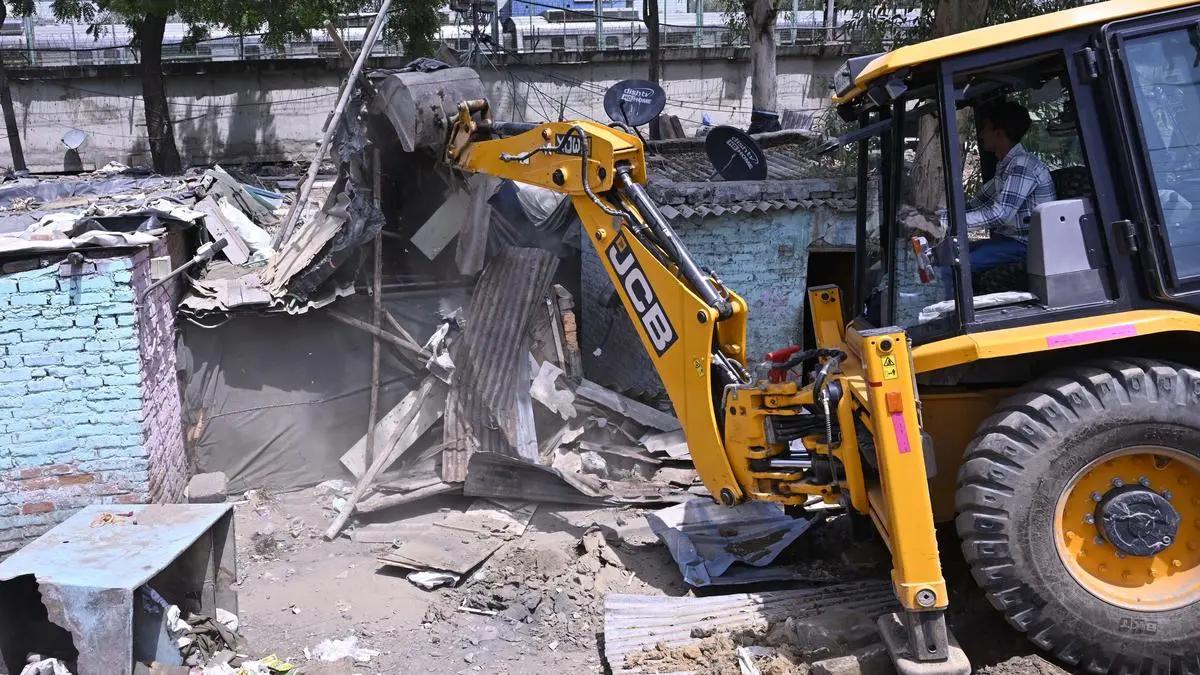
Authoritarian symbols have an ungovernable stubbornness. Devoid of agency, yet uncaring of their own origins, such symbols eventually slip from the grasp of their authors and acquire a life of their own. As they spread, detached from their original context and reassembled by those who encounter them, their meanings continue to change. Though their journey may begin as vehicles of a dominant political imagination, these ordinary symbols become transformative agents. Ultimately, they reframe the gaze directed at the “other” and, by extension, the perception of the self.
Where democratic backsliding is underway, authoritarianism relies on a two-part strategy: material violence and the political rhetoric that clears the path for it. This work spans state institutions and unfolds through a calculated sequence of events that advances a political agenda. It is one of the ways power accumulates, tensing around pressure points until it finds a way out. Once free, that power flows into the hands of people who each decide where it rests, what form it takes, and what patterns it reproduces.
Also Read | Student protests and the politics of laughter and profanities
For a country as linguistically divided as India, symbolism provides a powerful means of political unification. Political parties turn everyday objects, colours, flowers, and words into shorthand for political identity—the more mundane and identifiable the object, the more effective it becomes. Hindi-heartland politicians, despite their zeal to impose Hindi on everyone, have borrowed terms from non-Hindi languages—such as shor (noise) and shorba (gravy) in Urdu—and deployed them as anti-Muslim dog whistles. During the protests against the Citizenship (Amendment) Act in 2019, Prime Minister Narendra Modi similarly suggested that people involved in arson and violence during protests could be identified by the clothes they wear. This machinery of othering—built through objects, words, and their circulation—shows the work that symbolism performs. It is no accident, then, that once attached to a political cause, symbols begin to shape public behaviour.
India’s political history has many examples of ordinary objects escaping their origins to structure public life. Mahatma Gandhi’s engagements with the charkha (spinning wheel) and khadi (hand-spun, hand-woven cloth) offered a path towards colonial emancipation. In recent decades, conspiracy theories such as “love jihad” and “land jihad” have turned intimacy and property into sites of suspicion and exclusion. The JCB bulldozer—no more than a yellow earthmover with a large digging arm in the front—has become the primary instrument of what scholars call domicide, the deliberate destruction of home. More recently, zoological metaphors such as “termite” or “cockroach” have reduced entire social groups to infestations. In each case, weaponised language and naturalised symbols spread with the ease of a contagion, allowing political change to become easily reproducible.
Relatability gives political symbols reach as people embrace and use the vocabulary, allowing it to normalise as innocuous, shareable content in the public imagination. In the digital age, memes, reels, and algorithmic trends accelerate this circulation. Such symbolism works so pervasively because it requires little active thought. Yet while symbols carry intent, they lack a predetermined political path. Once they escape their proving grounds, the public can turn them against the powers that produced them, or use them to reproduce power. This duality defines the present moment: at times, the state’s intention and symbolism are normalised, as with the ubiquity of the JCB bulldozer; at others, it backfires spectacularly into resistance, as with the Cockroach Janta Party (CJP).
In the case of the CJP, the cockroach changed from a dehumanising metaphor into a tool of defiant self-assertion. After Chief Justice of India Surya Kant’s remark in May 2026 comparing certain unemployed youth to cockroaches, Abhijeet Dipke harnessed the ensuing outrage to found the CJP. In digital spaces, a single cockroach emoji in a user’s bio became a signal of belonging. That shared identity sparked collective mobilisation, carrying the satire from social media feeds onto the streets. As it became more popular, the movement grew into a multi-site resistance, with protests in States across the country. The cockroach had acquired a second life, evolving from an institutional slur into an active site of identity, protest, and public culture.
Through the CJP, the cockroach changed from a dehumanising metaphor into a tool of defiant self-assertion. | Photo Credit: Dibyangshu Sarkar/AFP
The CJP gives us an example of what the philosopher Michel Foucault called reverse discourse: when marginalised groups spin the symbols and vocabulary used against them, in their favour. Meanwhile, symbols can also travel in another direction: rather than being turned against the power that produced them, they can be absorbed into public culture and end up reproducing that power. In today’s India, the bulldozer follows this exact path. The state has weaponised the machine, and the violence carried out has acquired its own vocabulary. Such demolitions are often extrajudicial, later justified as “a response to illegalities in civil law”. The press has taken to calling these actions “bulldozer politics” or “bulldozer raj”, while the right wing celebrates it as “bulldozer justice”. The use of this symbolism shows the growing fascination with spectacular violence in India’s majoritarian politics.
The JCB also carries a British legacy into contemporary India. The acronym does not belong to Indian politics; it belongs to J.C. Bamford Excavators Ltd, a British firm founded in 1945. The company’s commercial presence points to how colonial language and machinery remain embedded in the country even as their political meanings change. As one of the most recognisable manufacturers of backhoe loaders and excavators in India, JCB has acquired a political meaning far removed from its industrial origins. Its excavators now act as a prop in political roadshows, a gift handed to politicians by children as a “symbol of trust”, a patronage token for allies, and a spectacle of state power. It functions as both infrastructure and political theatre, its material force inseparable from the meanings attached to it. This symbolism strips the targeted groups of their humanity, increases the public’s tolerance of persecution, and creates desensitisation to violence—a helplessness that majoritarian forces then treat as a foregone conclusion.
The JCB no longer needs to physically demolish a structure to project power—the acronym is now enough. The rats of Raipur are not merely a sanitation problem. Their behaviour has left residents and officials alike feeling helpless and resentful. The crisis is most acute in Ward 19 of Raipur, Chhattisgarh—a dense, 0.65 sq km area officially designated the Dr A.P.J. Abdul Kalam Ward, where nearly 20,000 residents live along narrow lanes bounded by railway tracks and peripheral nallahs (drainage channels). A severe rodent infestation has taken hold here, with rats hollowing out the earth below the settlement. The scale of the crisis has even prompted some office-bearers to suggest they “arrange cats for the treatment of rats”. The more revealing response, though, has been linguistic. Rather than reach for technical or sanitary vocabulary, officials refer to the rats as Chhota JCB—small but mighty JCB. The moniker prompts immediate, dark laughter from a public that needs no explanation for a joke already built into the image of the machine.
Language, the anthropologist Veena Das has argued, does not merely describe life but constitutes it. The moniker chhota (small) operates on precisely this kind of duality. While it literally denotes the animal’s size, it simultaneously evokes the vernacular underworld of the petty gangster, as in “Chhota Rajan”, and the mechanical muscle of the Chhota Hathi (small elephant) pickup truck. By turning a crushing crisis into a joke, the nickname makes it survivable.
The rodent crisis in Ward 19 is a consequence of an urban landscape that traps its most vulnerable residents in conditions of persistent neglect. Dawn in Raipur is heralded by the Mor Raipur anthem, a waste-collection jingle blaring from loudspeakers atop municipal trucks. While mainstream headlines celebrate Raipur as a “five-star, garbage-free city”, the city’s garbage-collection timetable operates with little regard for the lives of the people it is meant to serve. The ward’s working population—labourers, domestic workers, and nurses—collects waste across the city’s wealthier enclaves, entering, naturally, through the “service doors”. But back home in Ward 19, waste disposal does not follow a neutral timetable. Caste-coded practices around purity, pollution, and physical contact with waste dictate when and how it can be handled, and only after a morning bath. Because the kachra gaadi (garbage truck) makes its rounds after these morning rituals conclude, the handover fails. Waste piles up at property edges and in stormwater drains, choking the drainage and creating the porous thresholds through which rats hollow out the soil below.
Also Read | The militarisation of political language
Predictably, residents say they are blamed for this “localised sanitation issue”. The mainstream narrative isolates wards such as this one, casting residents as a non-compliant population that deserves to live amid filth because they have failed to be “dutiful citizens”. Outside observers reach for labels such as “dirty”, “ugly”, and “unsafe”, turning a material condition into a judgement on the people who live with it. Here, symbolism completes its vicious circuit: instead of merely masking a crisis, it dictates how structural neglect is justified and who bears the blame. It then shapes how people treat one another, turning everyday interactions into those with suspicion, hostility, and name-calling.
As in any jurisdiction, Ward 19 receives regular visits from municipal officials, consultants, and local politicians. Over the years, these visits have produced a carousel of reports, slide decks, and, more recently, a “Ward Action Plan” that flagged the rodent-driven sunken land. Yet the plan remains on hold, caught up in staff transfers and unpaid labour. Critics say technical interventions are routinely dismissed as “too complex” or “too expensive”, while city officials wave off the rodent infestation as an unchangeable fixture of the landscape.
Left to bear the brunt of what residents call Chhota JCB’s reign of terror, Raipur’s frontline garbage collectors launched a wave of strikes in May 2026. The municipality, for its part, says its own enforcement is undermined from within, by collection drivers who disable GPS tracking or illegally burn and sell waste rather than haul it to designated facilities. As institutional responsibility fragments, the “Chhota JCB” tag gives residents a vocabulary for their material reality. JCB imagery, deeply embedded in the public imagination, gives form to what is otherwise an unmanageable lived experience: one of helplessness and resentment.
Rats in Raipur’s Ward 19 are called Chhota JCB for the destruction they have caused in the locality by burrowing under buildings. This image is representational. | Photo Credit: Sanjay Kanojia/AFP
Residents, officials, and politicians all acknowledge the crisis, but not always with urgency. Last summer, as rats scrambled through a lane, a team of visiting officials and consultants met residents’ frustration with amused resignation. Some laughed off the crisis, casually discarding paan masala packets on the street as they did. “Sangathit hain” (they are organised), one official remarked, jokingly casting the rodents as an efficient political constituency rather than a symptom of civic failure. In that moment, the crisis dissolved into laughter, and the case for structural intervention dissolved along with it.
Yet the joke cannot erase the deeper conflict over who belongs and who has the right to occupy space. In a familiar pattern of urban governance in India, the state routinely brands marginalised communities such as Ward 19 as “encroachers” to justify its own neglect. During another visit, an exchange took place between two neighbours. One muttered that the rodents were merely “bahari jaanwar”—outsiders crowding the inside. The other responded plainly: “Nahi, hum unki zameen par aa base. Ulta hai” (No, we have come to settle on their land. It is the other way around). The brief exchange upended the conventional framing. By turning that weaponised vocabulary on themselves, the residents point to a reality in which structural abandonment forces citizens to manage survival on the same terms as the pests below—where the humans are no longer innocent victims and the rats are no longer simply invaders.
The Chhota JCB joke gives one more glimpse of how far the bulldozer’s symbolism has reached. The name stuck because the burrowing rat and the yellow excavator undertake an eerily similar labour: both destroy the foundations of a home from within, and both have the arbitrary power to bring about its fall. What is clear is that symbols do not always move in the same direction. Sometimes subverted language turns an insult back against its source, reclaiming its meaning and the power attached to it. At other times, symbolism is absorbed into public culture, reproduced through jokes, labels, and apathy. Once symbols escape their makers’ control, they carry the volatile possibility of reproducing power, distorting it, resisting it, or turning into something their makers never intended. The true power of a symbol, in the end, lies in its refusal to mean only what power intended.
Isha Riza Khan is an urban specialist, trained at the University of Southern California, Los Angeles, and the University of California, Berkeley. Her work focusses on urban and social transformations.
Related Stories
 India
India
Kangana Ranaut opens up on politics, career and being ‘Hugely Desirable’: 'Had an identity for 20 years a
5 minutes ago
 India
India
Will legacy brands handover online operations to start
2 hours ago
 India
India
Why India’s Gen Z Protests Matter to Young People Everywhere
3 hours ago
 India
India
Rahul Gandhi Ushers a New Style of Youth-Centric Politics in India - The Diplomat
7 hours ago
 India
India
130+ Indians, 37 NRIs out of reach as Nepal floods toll mounts, Bihar, UP on alert: What is happening? | India News
7 hours ago
 India
India
Why India is sharing missile secrets with its private sector
7 hours ago
 India
India
Ukraine’s drone attacks have left Russia desperately scrambling for oil imports
9 hours ago
 India
India
Piyush Goyal proposes India
11 hours ago