
'It’s awkward': Why Alberta's separation debate tends to live mostly online
'It’s awkward': Why Alberta's separation debate tends to live mostly online
We were curious how the separatism debate is affecting small communities. So, we visited one
Natalie Lum is proud of a rare and “awkward” conversation she had recently.
It was on separatism — a subject people here in Drumheller, Alta., said they normally don’t bring up in what some refer to as polite society.
Online, well, that’s another matter altogether.
During a recent CBC public event in Drumheller, we had a chance to chat with a lot of people around town. Separatism only came up when we asked about it, and then people said it’s been divisive. Community Facebook groups have been full of angry banter, especially from a couple of hot-heads, and some local online groups have actually been ruined by animosity.
At the same time, most people aren’t talking about separatism face-to-face, they said, not unless each is fairly certain the other person agrees with them.
Lum had some time to kill with her brother-in-law as they waited for her partner to finish running errands. And when the topic came up, they both approached it carefully.
“It was awkward. You gotta feel OK and sit in some awkwardness, right?” said Lum, an entrepreneur who is against separatism.
“I think we all have a hard time with that — with silence and awkwardness. … But I appreciate that the space was held on both sides to be, like, OK, I'm going to fully listen to what you have to say and not jump in right away to disagree.
“At the end of the day, we both were like: I know my brother better. I know my sister better, and we're better off for it.”
Earlier this year, pro-independence volunteers in Alberta collected signatures to force a vote on separation. The government decided to hold a referendum in October to see what Albertans think about that, among other issues. The ballot will ask whether voters want to remain a part of Canada or explore holding a binding referendum on separation.
The need for listening and conversation
CBC News was at the Drumheller Public Library for a live show, Daybreak at Night, and set up a tack board to ask people to share how the debate on separatism is affecting their community.
That’s not because we thought Drumheller was a hotbed of anything. From our conversations, it sounds like a community that supports each other, where people with different perspectives live together with a degree of harmony.
But with the referendum looming, they face similar challenges to many communities.
People said separatism has been divisive online, with a group of people on each side quick to attack the other. Others said they wished they could talk about it more in person, but weren’t sure how to have that conversation, and still others said even the idea of separation is spreading fear among some residents.
“In our community, you'll see people are great face-to-face,” said Lum. “I think that's the hard part. What you're hearing and reading is just so drastically different. The internet is a beast, and it's allowed for a lot of beastly things.”
Drumheller is an old coal and farming town, now more famous for paleontology and the Royal Tyrrell Museum. It’s 100 kilometres northeast of Calgary, in a federal Conservative stronghold. The local MP is Opposition Leader Pierre Poilievre.
As in most Alberta towns, political support runs a wide spectrum. And there are loud voices but also many quiet ones. That makes it dangerous to try to gauge the level of pro-Canada or pro-independence support just from what you hear.
Wondering about the silent separatists
That’s the point Jim Millius made when he stopped at the CBC table to talk. He works in IT for an agriculture company and moved to Drumheller five years ago. He said he’s never spoken publicly about his support for separatism.
“I don't think that it comes up in polite conversation, so to speak,” he said. “But I do believe that there's a lot more people accepting of the separation thing than people think there are.”
Online, people are quick to insult, he said, and from what he’s seen on the Drumheller Chat Facebook page, some pro-Canada supporters are the most vitriolic.
“People are afraid that they're going to be called racists and Nazis as soon as somebody knows that you think separation is a good idea for the province. I think that’s a huge reason why people don’t express themselves,” he said.
Those are inflammatory words, but they illustrate how feelings can run high when this topic comes up.
As for why he supports separatism, Millius said it’s because he’s libertarian and believes smaller governments are better — and that’s more likely if Alberta is operating on its own.
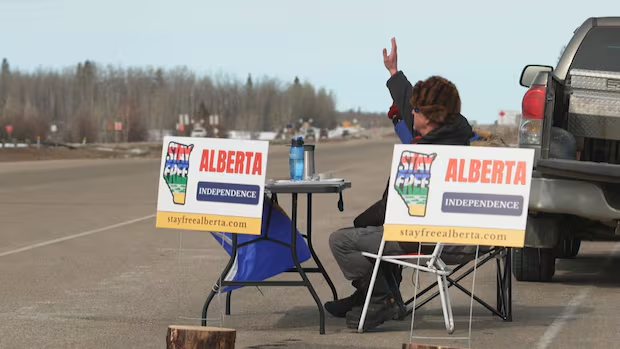
Over at the back of the room, James Crankin agrees there are many quiet separatists in town. He saw that when volunteers were collecting petition signatures this spring.
“One of my good friends, he was gathering the signatures. So I was hearing what was happening and day-to-day counts. So it was interesting to see which people were wanting to sign and which weren't,” he said.
“People that you wouldn't have imagined would sign it, [they] signed it and said, 'Don't tell anybody.'”
Crankin is careful what he says as well. He signed the petition because he wants to send a message of discontent to Ottawa. But when asked if he would actually vote in a referendum to leave, he said he’d rather not say.
The event in Drumheller was part of a CBC effort to spend more time listening and reporting in rural Alberta. We held a roundtable discussion with community leaders, then hosted a live show of interviews and music highlighting the town.
Pro-Canada lawn sign makes a statement
In the crowd, there were also residents happy to share why they’re against separatism.
Lum, the entrepreneur, said she’s opposed because it’s such an all-or-nothing solution to Alberta’s problems, and the consequences could be severe if it’s not handled well.
“Governments at all levels have a hard time implementing things. Change is hard,” she said. “I don't feel like it's a fully thought out idea.”
Sharon Clark, a retired lawyer, also opposes separatism. She believes Alberta is getting a fair deal from Canada: the province sends a lot of money to Ottawa, she said, but gets a lot of support back as well. She recently put up a lawn sign to make her views clear.
“I keep looking to see if it's been vandalized. It hasn't. And I don't expect that it will be, but I'm making my position very clear,” she said.
“My gut feeling is there's a lot of people that are very, very opposed to separation,” she said, adding she’d love to see a town hall or other event where people would feel comfortable sharing their views, as long as they're “reasonable.”
Elsewhere in Alberta, there are reports of both pro-Canada and pro-independence signs vandalized.
A face-to-face conversation draws anger
On CBC's tack board at the Daybreak Alberta event, attendees shared their thoughts through Post-It notes. One person wrote about “online cowboys on both sides of the debate." Another said it’s creating “unnecessary division.”
One resident wrote “fear of losing social benefits” and explained that even the threat of separatism has many seniors feeling scared.
Melody Polych, the local library director, said it’s been rare to see conflict in public. She only noticed one example, after a local thrift store let independence organizers set up a signing station in front. The business later issued an apology on Facebook.
Reached later by phone, Kerys Robinson-Taylor from Badland Bargains confirmed what happened. He said he’s personally undecided whether independence is the right answer, but said he welcomed the canvassers this spring because supporting community and conversations is part of the store’s mission.
The canvassers were polite and waited for people to approach them with questions, he said, but still the blowback came online.
“We got a lot of negative reviews, a lot of negative feedback towards them being there. And it's just as simple as that — just [canvassers] being there was enough to get people upset to the point where we were threatened to be banned from going to the Remembrance Day ceremony," Robinson-Taylor said.
“Nowadays, social media can kill a business in no time at all. So it's really tough to have to put your beliefs and your own mission aside because people will attack you for it.”
He asked the canvassers to leave and apologize, because the anger and bad Google reviews were affecting his business. Then the blowback came from the other side.
Robinson-Taylor said he’s on the fence on separatism because he wants to see Alberta have more freedom to develop its natural resources without federal interference, but loves Canada and isn’t sure full independence is the right way to go.
He wishes people would actually feel safe talking through the issue.
“Just listen to each other,” he said. “Nobody should ever feel put down by voicing their opinion. Nobody should ever feel like they're being attacked. We live in Canada. We're a great country, and I think in the long run, people need to have that conversation with people whether it's tough or not.
“I mean, at the end of the day, if we don't communicate together, then we're already separated.”
Elise Stolte runs project-based engagement efforts for the CBC Calgary newsroom. She has 20 years of experience telling the stories of her community and has been recognized for feature writing, social impact and community-based journalism. You can reach her at elise.stolte@cbc.ca.
Related Stories
 Canada
Canada's tariffs target certain U.S. states. See which regions are most vulnerable.
33 minutes ago
 Canada
Looking to the past to understand Canada’s security future
33 minutes ago
 Canada
'Elbows up': Why Canadian Prime Minister Mark Carney may be the right leader for this moment: ANALYSIS
33 minutes ago
 Canada
Police investigating suspected arson after car at Liberal MP's home torched
33 minutes ago
 Canada
Ratko Mladic, ex
1 hour ago
 Canada
2 Air Canada employees arrested by RCMP in connection with alleged drug trafficking
1 hour ago
 Canada
U.S. confirms language, culture protections won’t be subject to trade actions: LeBlanc
1 hour ago
 Canada
Blockbuster Sale: Save big on select digital games!
1 hour ago