
Judge to rule on constitutional challenge by B.C. compassion club founders convicted of drug trafficking
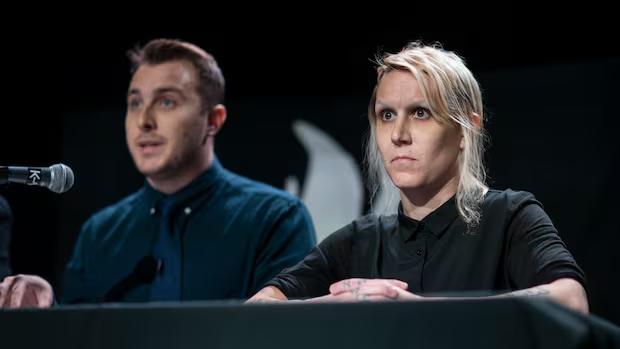
Judge tosses drug trafficking convictions for B.C. compassion club founders after constitutional challenge
Judge says DULF founders 'selflessly' put their lives on hold during public health emergency
A British Columbia Supreme Court judge has ruled in favour of two harm-reduction activists convicted of drug trafficking who argued they were doing it to reduce the harms caused by toxic drugs.
Justice Catherine Murray found parts of Canada's Controlled Drugs and Substances Act unconstitutional and stayed the convictions against Jeremy Kalicum and Eris Nyx.
Murray said Kalicum and Nyx's compassion club, the Drug User Liberation Front (DULF), reduced the harms associated with the toxic drug crisis and did not negatively impact the community or public safety.
Kalicum and Nyx were found guilty last year of drug trafficking after Vancouver police raided the club in 2023.
Murray said in court on Tuesday that the pair "selflessly" put themselves to the side for the cause.
"Mr. Kalicum and Ms. Nyx have borne the burden of bringing a successful constitutional challenge, thereby doing the public interest a service at considerable personal cost," Murray said.
She noted thousands of people have died due to toxic drugs since the public health emergency was declared in B.C. in 2016.
Drug User Liberation Front founders found guilty of drug trafficking
More stories from Vancouver-South Coast
Murray put Kalicum and Nyx's convictions on hold last year to hear the constitutional challenge, where their lawyers argued that forcing drug users to rely on unregulated street drugs violates the Charter of Rights.
Murray said in her ruling then that Nyx and Kalicum's intentions were good as they tried to save lives, but that buying pure drugs on the dark web and selling them to members was not covered by an exemption that allowed for drug storage and testing.
She said the two were "agitators" who wanted to make change and were aware that they ran the risk of a trafficking prosecution.
Kalicum and Nyx's lawyers had argued that closing the club violated the rights of those who are disabled by addiction and raised their risk of death from an unregulated, illicit drug supply.
Related Stories
 Startups
How Liverpool’s Digital and Creative Startups Are Attracting Investment
3 hours ago
 Startups
Proven Ventures seeks to invest the remaining capital of its $10 million fund in Nebraska startups
5 hours ago
 Startups
Africa strengthens venture capital fund management capacity with €129m initiative
9 hours ago
 Startups
UK venture capital matches US long-term returns as newer funds pull ahead
9 hours ago
 Startups
Omnivore
13 hours ago
 Startups
Peak XV’s Surge programme selects 18 startups for 12th cohort after revamp
14 hours ago
 Startups
TiE Mangaluru picks 8 startups for K
1 day ago
 Startups
Noa Argamani joins venture capital fund: ‘I want to make an impact’
1 day ago