
Noa Argamani joins venture capital fund: ‘I want to make an impact’
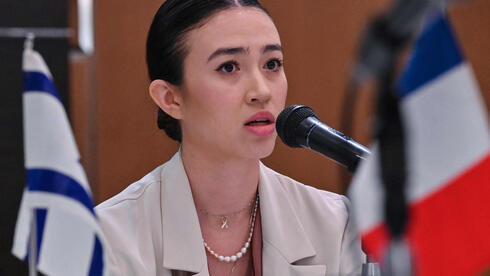
Noa Argamani began working this month at venture capital fund Vine Ventures, which invests in early-stage startups, primarily in artificial intelligence, cybersecurity and defense technology. In an interview with Business Insider, she spoke about the new chapter in her life as well as her time in captivity.“At this point, if I want to learn and make an impact, venture capital is the right place for me,” she said of her new job. “I want to be surrounded by people who dream big.” Argamani works with Israeli founders and companies seeking to expand their operations in the United States.GalleryNoa Argamani (Photo: Richard A. Brooks / AFP)“My mission is to help Israeli startups enter the market and really break through that barrier,” she added. According to Argamani, the challenge for Israeli founders is the United States, the market that can determine whether a promising startup becomes merely successful or grows into a true giant. She sees herself as a bridge between the two countries.In the months after she was rescued from captivity, Argamani became a prominent advocate for the hostages who remained in Gaza. She later returned to her studies at Ben-Gurion University and found that while she had been in captivity, artificial intelligence had transformed software engineering. Models were writing better code, and digital workers, or “agents,” had begun performing tasks once reserved for humans.Argamani threw herself into the field. She and her friends used large language models to scan news articles and identify patterns of antisemitic rhetoric, mapping the countries where it originated. They built a website allowing users to select a date and see where such rhetoric appeared most intensely. As part of an entrepreneurship program, she also designed a startup aimed at helping children with autism.‘There’s the person you were before October 7 and the person you are after’But the life waiting for her outside university had changed.“There’s the person you were before October 7, and the person you are after,” she said in the interview.Job offers quickly followed. She could join a company, help build one, or pursue a career in public speaking or modeling. She had access and public attention, and sitting in front of a screen suddenly seemed like a poor use of both.“I felt that going back to coding would be a waste,” she said. “I want to do something with more impact, to make a change in the world.”Through her advocacy for the hostages, Argamani met Eric Reiner, founder of Vine Ventures. Reiner has spent his career working between Israeli startups and American capital, first at Insight Partners and later at Dynamic Yield, an Israeli startup that used algorithms to personalize advertisements and websites before being sold to McDonald’s in 2019.Reiner founded Vine to invest in companies on both sides of the Atlantic, but the fund’s advantage lies in Israel, where its team identifies founders and helps them enter new markets. The fund manages about $500 million and has invested in Israeli companies including Wonderful, Kodo and Eon.In April, Reiner invited Argamani to intern at the fund. In venture capital, she said, she can help more than one company at a time and use the network she has built to open doors for founders.At Vine, which has a presence from San Francisco through Boston and New York to Tel Aviv, she can help Israeli startups make the crucial leap into the U.S. market.Argamani speaking at the United Nations (Photo: UN Web TV)Over the past five months, she has been learning the profession, including how to assess market size and evaluate a young company. She also helps founders understand what lies behind another investor’s “no.”Israeli investors, she said, may interrupt a founder in the middle of a pitch to explain what is wrong, while Americans tend to be more polite.“They can smile through the entire pitch, then reject you at the end and never tell you why,” she said.In September, she began working full time and will divide her time between San Francisco and Tel Aviv.Another way she hopes to help is through mentorship. Captivity taught her that a person can do everything required of them and still have no control over what comes next, a reality she also sees in the startup world.“Sometimes, no matter how hard you work, things won’t turn out well,” she said.She wants to help founders navigate periods of uncertainty and understand what they can learn from them.Argamani insists she has always been optimistic, even, as she jokes, “naively optimistic.” That instinct, she said, helped her recognize the miracles that carried her through the darkest period of her life. But she also saw how much could be taken away.She saw friends murdered. Others remained in captivity after they were killed, and their bodies were returned months later in hostage deals. She went from funeral to funeral.“I lost a lot of people. I saw hell with my own eyes, when I was in the tunnels and looked into the eyes of Hamas,” she said. “But every day I choose to continue with another part of my life, to look forward, go to work and not let grief become my identity.”
Related Stories
 Startups
Why Noa Argamani chose venture capital after 246 days in Hamas captivity
48 minutes ago
 Startups
Startups: Vai-Thee
14 hours ago
 Startups
New BlueTech Accelerator Drives Startups to Freshwater Research Center
1 day ago
 Startups
Seven Italian startups pitch to US investors and leading Italian venture capital firms in Rome
3 days ago
Why Osaka Is Emerging As A Launchpad For International Startups Entering Japan
3 days ago
 Startups
Nykaa partners with L’Oréal’s BOLD to invest in Indian beauty startups, shares flat
3 days ago
 Startups
"Definitely losing talent": Startup leaders fear tax settings pushing Aussie founders overseas
3 days ago
ASTAR expands AStartCentral to 18,000 square feet with larger labs and engineering facilities
3 days ago