
Live updates: Iran condemns Trump’s threat of ‘economic D
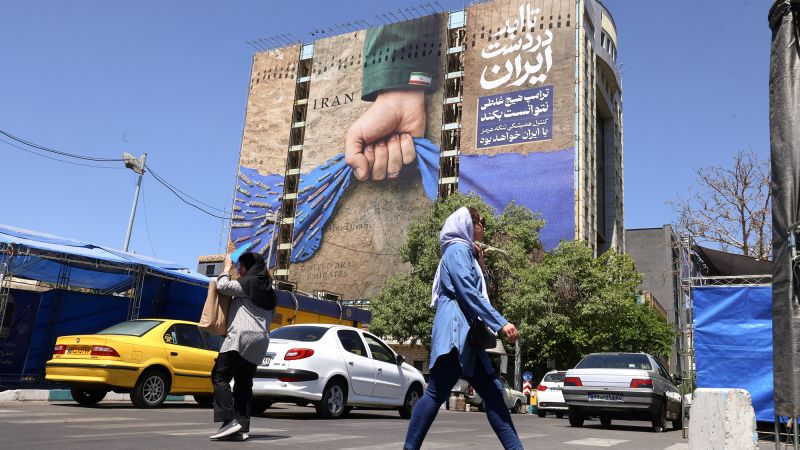
• Economic pressure: Iran has condemned US President Donald Trump’s threat of an “economic D-Day” against the country. The Iranian Foreign Ministry warned that those who order or implement the levies “are liable to prosecution and punishment.” The Trump administration also imposed new sanctions on Hezbollah and redesignated the group as an Iranian proxy.
• Trump’s threat: The US president vowed “tremendous economic consequences” against countries that continue to do business with Tehran. Treasury Secretary Scott Bessent urged China, a major trading partner with Iran, to “get with the program.” But the US has little leverage to force Beijing’s hand. China believes that “sanctions and pressure tactics are not the solution,” a foreign ministry official said.
• US carriers: The troubled USS Abraham Lincoln is on its way home, according to a source, after the USS George Washington arrived in the Middle East to relieve the carrier. The journey to San Diego will take about a month.
Iran’s President Masoud Pezeshkian said it would be “better” if the war ends now, while Tehran is in a position of strength, the country’s state-run media reported on Friday.
The president’s comments about wanting the conflict to end came as Iran’s armed forces chief of staff warned that any “new threats” would be met with a “crushing” response, Iran’s semi-official Mehr News Agency reported.
Iran’s Islamic Revolutionary Guard Corps said Thursday it could deploy more “destructive” weapons if the war restarts, according to Iranian semi-official media, after US President Donald Trump said he had paused talks with Tehran.
China responded today to US President Donald Trump’s threat of an “economic D-Day” against Iran, saying that sanctions do not “fit the interest of any party.”
On Wednesday, Trump vowed to impose “tremendous economic consequences” against countries that continue to do business with Tehran, with Treasury Secretary Scott Bessent later urging Beijing to “get with the program.”
China believes that “sanctions and pressure tactics are not the solution,” Lin Jian, China’s foreign ministry spokesperson, said in a news briefing on Friday. Jian urged the relevant parties to solve the dispute through negotiation and dialogue, and come to a political settlement.
Beijing is a source of crucial economic support for Iran but has walked a cautious diplomatic line amid the US-Iran war, keeping communications open with players on both sides. As for the leverage the US could wield over China however, Trump has increasingly limited options.
Alongside China, Iran has also condemned what it called Trump’s “unlawful” threat of an elevated economic campaign against Tehran.
Mohammad Bagher Ghalibaf, the country’s parliament speaker, said today that Tehran is prepared to “sacrifice our wealth” to defend the country’s “dignity and honor,” according to Iran’s semi-official Tasnim news agency. He added that “we must plan for unjust sanctions so that we can overcome them.”
Deploying the Japan-based USS George Washington signals that its mission is “something incredibly important,” a retired US Navy rear admiral told CNN on Friday after the carrier arrived in the Middle East to replace the USS Abraham Lincoln.
“That’s a very, very deliberate signal to send. It’s got to be for something incredibly important.”
The George Washington’s rotation to the Middle East leaves the US without an aircraft carrier in the Pacific.
The Lincoln is beginning its journey home after an extended deployment at sea during the Iran war, according to a source familiar. Families of service members on board had reportedly raised concerns about the crew’s mental health and conditions on the carrier. A US official told CNN last week the swap had been previously planned.
For the crew of the USS Abraham Lincoln, the announcement they would be returning home brings “a huge sense of relief” after the emotional ups and downs of their extended mission.
“So prior to this they’ve been told… ‘you’re going to return at this date’ and then that date gets extended by a couple of weeks, or maybe a month and each increment… is a kind of an up-and-down ride for the crew emotionally when they figure out when they’re going to actually go home to their families,” retired rear admiral for the US Navy Andrew Loiselle told CNN on Friday.
The Lincoln has begun its journey home, according to a source. Its 13,000-mile journey to San Diego will take around one month, Loiselle said.
But this transit leg of the deployment “will be a welcome break” for the service members as they prepare the ship and get aircraft ready to fly, he added.
During their nearly nine months at sea, the crew likely relied on deliveries from Diego Garcia — a tiny Indian Ocean island over 2,000 miles off the Iranian coast — rather than the United States’ typical base in Bahrain due to conflict in the Strait of Hormuz, Loiselle said.
“That ends up being a longer interval in between replenishments, a longer time in between mail and Amazon boxes, and all the things that keep the morale up for the crew,” he added. “They’ll hopefully get some more regular mail hits, and that will raise morale on the way home as well.”
A crew member serving on the Lincoln described morale on the ship as very low, as well as regular strains on essential amenities — like toilets and water fountains around the ship being frequently closed and hot water often unavailable. Other sailors described to CNN conditions unlike their previous deployments, largely because of the war, which stopped the ship from making stops at friendly ports.
US President Donald Trump’s threat of an “economic D-Day” against Iran is unlikely to bend the country to his will without China joining in. But Trump has little leverage over China to make that happen.
On Wednesday, the American president vowed “tremendous economic consequences” against countries that continue to do business with Tehran. Treasury Secretary Scott Bessent has since doubled down on Trump’s warnings, urging Beijing to “get with the program” in a Thursday interview with CNBC.
Beijing has been Tehran’s lifeline, buying 90% of Iranian crude exports, according to data from Vortexa Analytics in a Reuters report. China doesn’t acknowledge importing Iranian crude in its customs data.
That is unlikely going to change now, especially as China sees how unpopular the ongoing conflict has been within the US and abroad, and as Chinese leader Xi Jinping is set to visit the United States next month.
After a tumultuous year of US-China relations triggered by his renewed tariff offensive, Trump has every reason to prevent tensions between the world’s two largest economies from flaring up again. His May visit to Beijing has so far calmed the waters.
In response to Washington’s economic pressure campaign against Iran, Lin Jian, China’s foreign ministry spokesperson, said that “sanctions and pressure tactics are not the solution.”
“China calls on parties to act responsibly and stick to the political and diplomatic approach,” he said on Thursday.
Trump also possesses increasingly limited economic options he could leverage against China. While the US Treasury Department sanctioned independent Chinese refineries that have been importing Iranian crude, Beijing ordered its companies to ignore those restrictions.
Any major US moves against China could also risk provoking countermeasures from Beijing. China holds a trump card in rare earths — critical minerals necessary for making many items, from smartphones to electric vehicles and fighter jets. With China processing about 90% of the world’s supply, Trump must tread carefully while Western nations attempt to build alternative supply chains.
“Don’t forget me.” This is the desperate plea of Iranian photojournalist Yalda Moaiery, who has spent more than two decades documenting life under the Iranian regime, including most recently the bloody crackdown on protests in January, the war with the United States, and a new campaign of repression currently underway.
Moaiery, whose stories and photographs have appeared around the world, has now herself become a target and was sentenced to 15 years in prison earlier this month by an Iranian court with “activities in furtherance of the interest of the Zionist regime against national security.” She hopes to appeal the decision.
Even as she prepares for the alarming prospect of years inside Iran’s notorious prison system, Moaiery told CNN she will continue to bear witness as long as she can. “I’m not willing to work as a person in that framework of propaganda,” she said. “This is the main problem, but all of my interviews, all of my photos…all, all the things that I did as a photojournalist…is like crime for them, and these are all of my charges, including talking with you.”
President Donald Trump has threatened heightened sanctions on Iran as Tehran warns it could deploy more “destructive” weapons if the war restarts.
It comes at a time when the US president has publicly stepped back from efforts to make diplomatic progress with Iran, facing deadlocked attempts to reopen the Strait of Hormuz and intensifying questions about the toll an unpopular war has taken on the US military.
CNN’s Aida Karimi, Sana Noor Haq, Pamela Brown, Davis Winkie, Jennifer Hansler, Kit Maher and Laura Sharman contributed reporting to this post.
The Trump administration on Thursday imposed new sanctions on Hezbollah and redesignated the group as an Iranian proxy.
The US Treasury Department imposed sanctions on 10 individuals alleged to be “part of a network responsible for transferring cash” to Hezbollah.
The redesignation, meanwhile, is meant to show that Hezbollah is acting on behalf of Iran’s Islamic Revolutionary Guard Corps-Qods Force (IRGC-QF) and that it is “not a stand-alone operation,” a State Department official said. Both Hezbollah and the IRGC-QF have long been categorized as specially designated global terrorists.
Hezbollah is both a political party and an armed group in Lebanon. The redesignation comes as the administration worked to broker peace talks between Israel and Lebanon.
The USS Abraham Lincoln is beginning its journey home, per a source familiar. It comes after another ship, the USS George Washington, arrived in the Middle East to relieve the strain on the beleaguered Lincoln.
The Lincoln, however, is still in the 5th Fleet area of operations, meaning it has not yet left US Central Command’s area of responsibility, a US official told CNN. USS George Washington arrived on Wednesday as it prepares to relieve the Lincoln, the US military confirmed on Thursday.
The Lincoln has been at sea for an extended deployment during the Iran war, which sparked concerns among lawmakers and military families after reports of the crew’s worsening mental health and conditions aboard.
CNN previously reported two sailors assigned to the Lincoln strike group had jumped overboard in recent months. Both were rescued alive, US officials said.
The father of a service member deployed on the USS Abraham Lincoln speaks to CNN’s Pamela Brown about a sailor jumping overboard and reports of mental health issues during the ship’s eight-month deployment supporting US operations during the Iran war.
Others were prevented from jumping, according to reports from the Navy Times and Stars and Stripes.
US President Donald Trump dismissed concerns, saying that the ship’s almost nine month-long deployment hadn’t been long enough, and Secretary of Defense Pete Hegseth said the ship’s conditions had been “completely misrepresented.” The US Navy recommends aircraft carrier groups be deployed for seven months.
That reaction contrasted with that of some Democratic lawmakers, like Sen. Richard Blumenthal, who demanded answers following concerns raised by families.
The Navy told CNN in a statement that it has “not observed an increase in suicidal ideations or attempts aboard the ship.”
The Iranian Foreign Ministry condemned US President Donald Trump’s “unlawful” threat of an elevated economic campaign against Tehran on Thursday.
Trump’s threat of heightened sanctions is “the other side of the coin of war and military aggression,” the ministry said in a statement, according to state broadcaster IRIB.
The statement warned that those who order or implement the levies “are liable to prosecution and punishment.”
“Responsibility for the consequences and repercussions of this unlawful act will rest with the US government and the perpetrators of this policy,” the statement said.
Some context: The US president signaled his willingness to wage an economic war of attrition with Iran on Wednesday, threatening “the MOST CRUSHING ECONOMIC OPERATION” in a social media post.
Several analysts told CNN they were skeptical that Trump’s claims would have the desired impact on an Iranian regime that has withstood oppressive economic sanctions from major world powers.
Trump has publicly stepped back from efforts to make diplomatic progress with Iran, facing deadlocked attempts to reopen the Strait of Hormuz and intensifying questions about the toll an unpopular war has taken on the US military.
US President Donald Trump has declared economic warfare against Iran, vowing to isolate the regime in a move he hopes will bring about what military force has so far failed to achieve: capitulation.
The United States is already targeting Iran’s oil sales, enforcing a blockade that is allowing much less Iranian oil to be exported to international buyers, including China. But sanctioning Chinese buyers or banks seems an unlikely move ahead of President Xi Jinping’s state visit to the United States in September.
Kpler, which tracks ship movements, estimates that Tehran may have enough oil already outside the blockade to provide it with about four months’ worth of export revenues, but said oil income could drop to zero beyond that if Tehran’s exports are strangled.
Iran’s economy has already taken a major hit from the war and is grappling with rampant inflation, but it could take many months to destroy the economy completely. Following decades of US sanctions, Iran has developed a “survival economy, which allows them to sustain more economic pain over time,” said Jorge Leon, head of geopolitical analysis at Rystad, a consultancy.
To really tighten the screws, Trump will need to tackle the clandestine trade and banking networks that enable Iran to evade sanctions and procure weapons. Doing so will require a crackdown on networks that operate most prominently through the United Arab Emirates, Hong Kong, and Singapore, according to the US Treasury.
In a significant blow to the Iranian regime, the UAE announced this week that it had suspended all trade and financial transactions with Iran. Still, restricting all illicit activity – including, Trump said, “oil smuggling, swap limes, cash transfers, exchange houses, ship registries (and) front companies” – will require considerable coordination across multiple countries and won’t happen overnight.
CNN’s Stephen Collinson contributed to this report.
Countries that continue to do business with Tehran will face “TREMENDOUS Economic Consequences,” according to US President Donald Trump, who urged allies to “stand with the United States” to defeat Iran.
His threat could put China, India and even Germany in the firing line.
Iran exported to 147 countries in 2022, according to the most recent data from the World Bank. It imported goods from 114 countries that year.
China is by far Iran’s biggest trading partner, accounting for the bulk of Iran’s oil and non-oil exports. Iranian exports to China amounted to $22.4 billion in 2022, according to the World Bank. Imports from China stood at $15.6 billion.
Other Asian countries, Iraq and the United Arab Emirates are also significant export destinations for Iran. The country’s imports come mostly from the United Arab Emirates, China, Turkey, India and Germany, a 2024 World Bank report shows.
Last year, Germany exported goods worth €962 million ($1.1 billion) to Iran and imported goods worth €235 million ($275 million), according to the country’s statistics office. Imports increased marginally on the prior year, but both exports and imports have plummeted by around half or more since 2018, when the United States reinstated extensive sanctions on Iran.
Bilateral trade between India and Iran amounted to $1.1 billion between April and December 2025, according to India’s commerce ministry. Major Indian exports to Iran include basmati rice, tea, sugar, fresh fruits and pharmaceutical drugs.
Piles of fruit and vegetables are sitting unsold in some Iranian markets as rampant inflation has made them too expensive for many people to buy.
Videos posted on social media show sellers at Tehran and Karaj wholesale markets sitting beside their fresh produce, waiting to sell goods like melons, watermelons, pears, bananas and grapes, but with no one arriving to buy it.
The war has dealt another major blow to Iran’s economy, deepening the state of economic crisis the country was already in. The price of food has more than doubled since July last year, and basic food items like eggs, rice, meat and bread have effectively become “luxury goods” for many, the state-affiliated Iranian Labour News Agency said Monday, citing the Statistical Center of Iran.
Another seller speaking at Tehran’s Central Fruit and Vegetable Market on Tuesday morning described a steep drop in people coming to the market due to skyrocketing prices. In an Instagram video, he pans across a near-empty parking lot, comparing it to last year when vehicles were packed “lip to lip,” and vendors lined both sides of the road.
Other markets are affected by the dire economic situation too. In another video, a vendor who sells power and construction tools outlines the near-impossible nature of trying to import cargo into Iran, detailing a complicated supply chain that passes through several countries.
Related Stories
 Business
Economy Ministry Launches Startup Investment Package Program Cohort 2
39 minutes ago
 Business
YBI Shark Tank returns to Boardman this fall with six celebrity sharks
1 hour ago
 Business
S.Korean fintech startup Afinit seeks Kosdaq IPO as True Balance fuels Indian lending business
1 hour ago
 Business
Angel
1 hour ago
 Business
Indian startups raised over $242 million from August 10 to August 15, 2026; Yulu tops the list
2 hours ago
 Business
Dubai’s competitive advantage for digital business
2 hours ago
 Business
Panama Canal will cap daily transits as El Nino set to reduce water levels
3 hours ago
 Business
Embraer’s Eve says cash covers ‘flying car’ certification
3 hours ago