
Mark Carney Spills Dramatic Military Plan for Trump Invasion
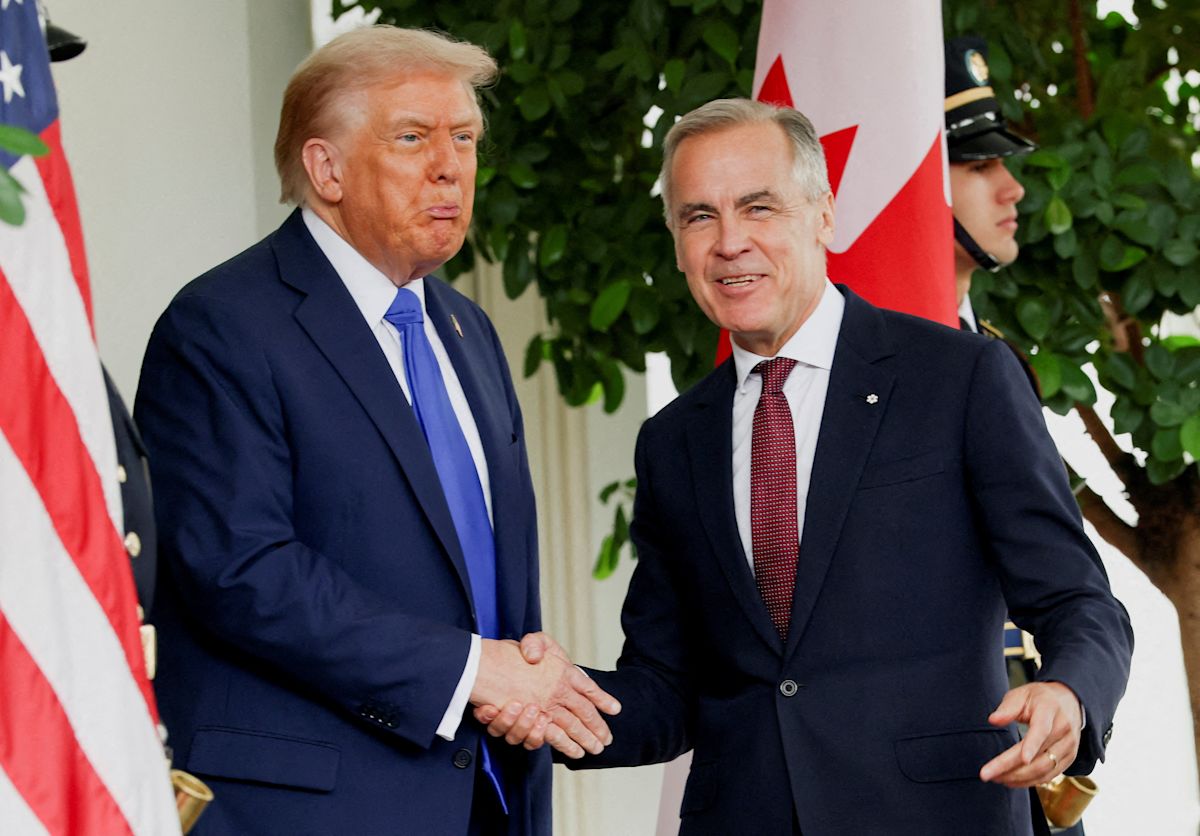
Canada quietly prepared for the possibility that Donald Trump could order military action against the country, Prime Minister Mark Carney has revealed.
Canada and the U.S., two close allies, have been embroiled in a row since Trump threatened to make Canada the 51st U.S. state.
Trump has repeatedly questioned the permanence of the Canada-U.S. border, arguing that the centuries-old boundary was an artificial line that could be redrawn through force and persuasion.
"Somebody drew that line many years ago with, like, a ruler – just a straight line right across the top of the country," Trump told Carney last year.
He later posted an altered image showing the U.S. flag covering Canada, Greenland and Venezuela.
The rhetoric unsettled Canadians: a 2025 poll found 43 percent believed a U.S. military attack on Canada within five years was at least somewhat likely, including 10 percent who considered it highly likely or certain.
Trump ruled out using military force to annex Canada in 2025, saying he would instead use "economic force" to pursue his vision of Canada becoming part of the United States.
But his repeated comments have nonetheless prompted Ottawa to consider how it would respond to more extreme scenarios.
Carney told the New York Times he spent the past year planning for what he called the "extreme tail risk" of a U.S. attack against Canada.
"I think you have a responsibility in these roles to look at extreme tail risk," Carney said.
"That's just risk management. That's not a base case, but it would be irresponsible not to" prepare, he added.
But while Ottawa was quietly preparing for the extreme possibility of a military confrontation, the conflict between the two neighbors has largely played out on economic turf.
Trump's threats against Canada were followed by a sweeping tariff fight, with Trump imposing a 50 percent tariff on approximately $20 billion worth of Canadian products under a previously unused provision of the Tariff Act of 1930 after trade talks between the two countries broke down.
Trump also invented a bogus new name for Lake Ontario—"Lake America."
Carney responded by increasing counter-tariffs on American steel and aluminum and introducing new duties on other U.S. goods, set to go into effect on September 29.
But Trump's trade war has pushed Canada to deepen its ties with the European Union rather than move closer to his vision of Canada as the 51st U.S. state.
Carney has been calling for a "unique alliance" between Canada and the EU as relations deteriorate with the U.S.
European Commission President Ursula von der Leyen embraced the idea during her annual State of the European Union address last week, with Carney watching from the front row of the European Parliament.
"I would like to work with you on opening the door for Canada to be the first associate member of the EU," von der Leyen said. She argued that, amid a "fracture in the international rules-based system," Europe and Canada should strengthen their partnership.
Trump responded furiously, suggesting the closer relationship could trigger retaliation from Washington.
"Canada's been a terrible trade partner," he told reporters. "No, I don't see that. If they do that, if I think it's at all a hostile act, I will put very serious tariffs or stop trading with Europe on many things. So, if they do that, if Europe does that, with a bad intention — if it's a good intention, that's fine — if it's a bad intention we'll put very heavy tariffs on Europe, which is a possibility."
The comments drew a rebuke from France's Europe minister, Benjamin Haddad, who said Washington had no authority to determine the EU's foreign policy.
"It is not up to the United States, or anyone else, to choose the political and geopolitical direction of the Europeans. Once again, we have a relationship with Canada, and we are fully entitled to seek to deepen it," Haddad told the Public Sénat TV channel.
But even if Canada does not join the EU, Carney told the New York Times he is focused on reducing his country's economic dependence on the U.S.
"Starlink, we will diversify away from, no question," he said, referring to Elon Musk's satellite company.
"We will be a better partner for the U.S. because of what we are doing," he added.
But despite the friction between Canada and the U.S., Carney said he still has a good relationship with Trump and that he remains in frequent contact with the U.S. president, with the two leaders speaking several times since negotiations collapsed last month.
"From my perspective, we have a good relationship in the sense of we can pick up the phone and talk to each other about issues," he said. "He's direct. I'm direct in terms of where positions are. It's much more efficient that way, and so you know that exists and that will continue to exist."
Related Stories
 Canada
Judge orders White House to restore access to CNN, MS NOW and Politico. Reporters still blocked
5 minutes ago
Toronto's Weekend Forecast
6 minutes ago
 Canada
Starbucks to close 250 more stores in Canada and the U.S.
6 minutes ago
 Canada
Judge blocks Trump's ban and says CNN, MS NOW and Politico must have White House access restored
1 hour ago
 Canada
Girl Guides celebrate 100 years of Quebec camp
1 hour ago
 Canada
Canadian producers, retailers feel impacts of protein boom as dairy tariffs hit
1 hour ago
 Canada
So Delicious Dairy Free dessert product recalled after small hard objects found
1 hour ago
 Canada
Discovering Canada's Hidden Stock Gems September 2026
2 hours ago