
Canadian producers, retailers feel impacts of protein boom as dairy tariffs hit
An international surge in protein consumption, combined with pricey new tariffs on American dairy, means Canadian whey retailers are being hit with a worldwide product shortage — just as prices soar.
Some Canadian dairy farmers are already working to produce milk with higher protein content, but economists say large-scale investments in whey processing are also needed to keep up with the surging demand.
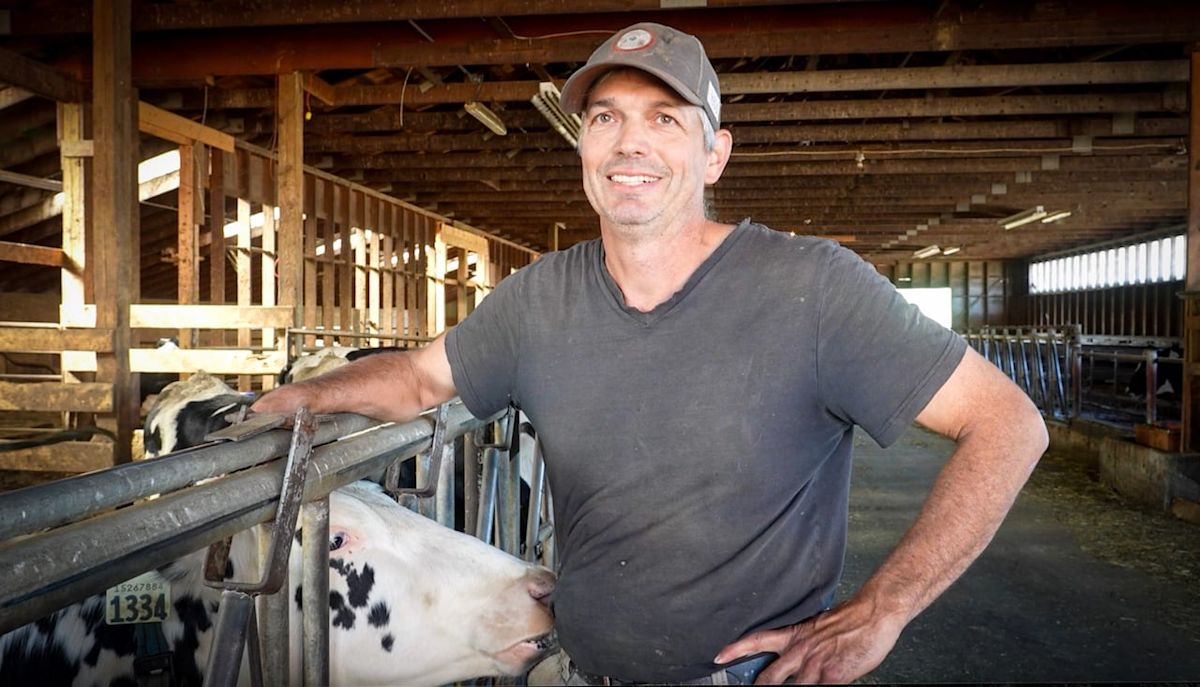
"We have already changed our breeding selection," said Kevin de Vos, the owner of Foxtrot Dairy near Salmon Arm, B.C. Those breeding changes will increase the concentration of protein in milk his future cows produce.
Kevin de Vos, is a co-owner of Foxtrot Dairy near Salmon Arm, B.C. (Jacqueline Gelineau/CBC)
He said within the last year, the pricing formula for milk changed, to recognize Canada's increased desire for more protein in milk.
"We have made some slight changes to our feeding program too, to provide that higher protein-to-butterfat milk ratio."
However, de Vos said it will take more than three years of careful breeding to see the protein content of milk increase, after previously spending years selecting for high-fat producing cows.
Cows at Foxtrot Dairy near Salmon Arm, B.C., are being bred to have calves with genes that produce protein-rich milk. (Jacqueline Gelineau/ CBC)
"We're at an inflection point here," said Graeme Crosbie, a Farm Credit Canada senior economist. He said until recently, there was always more demand for the butterfat in Canadian milk — which is used in butter and cheese — than there was for the protein.
"That's kind of inverted," said Crosbie.
He said whey used to be considered not much more than a liquid byproduct of the cheesemaking process.
Now, as prices for refined whey skyrocket, cheese producers are looking at the whey they previously used as fertilizer and animal feed with a different eye.
A spike in global consumption of protein — specifically whey protein concentrate — in the last two years prompted the price surge, said Monika Tothova, United Nations Food and Agriculture senior economist.
"Supply is not catching up with the demand for this stuff," said Tothova.
She said the world's cheesemaking and processing capacity have not kept up with consumer preferences.
Tothova specified that the liquid leftover from cheesemaking is not the same as the whey protein concentrate that is sold in stores.
Currently, Canada has few processing plants able to convert the cheesemaking whey into whey protein concentrate.
This means many protein retailers like Kallum Mitterer, the founder of True North Protein, must rely entirely on purchasing processed whey from the United States. True North Protein then blends, flavours and packages the whey for sale in Canada.
"Since last October, prices have over doubled," said Mitterer, about the cost to buy whey concentrate from the U.S. as supply dwindles.
He said with the retaliatory tariffs on dairy imports, the price of whey from the U.S. will increase by even more.
"There's a lot of uncertainty," said Mitterer.
Aelie Swift, the founder of Hello Amino, said suppliers she has worked with in the U.S. have previously been unable to fill orders due to low supply of whey. She said Hello Amino currently has about a month worth of whey stockpiled. Then, she will need to buy the tariffed whey concentrate, which she expects will result in price increases of four to seven dollars for her baking and beverage mixes.
Global consumption of protein — specifically whey protein concentrate — has surged in the last two years. (Baneet Braich/CBC)
As the trade war continues, all Canadian dairy, including whey products, will be banned from the U.S., while U.S. dairy imported to Canada will face a 50 per cent tariff.
Philippe Charlebois, executive director of the Canadian Dairy Commission, said the Crown corporation is monitoring developments in the dairy markets as part of its mandate to support a strong and efficient dairy sector.
He said the Dairy Commission acknowledges global demand for protein has increased, contributing to stronger demand and higher overall market values for protein ingredients.
He noted that because whey is a co-product of cheese manufacturing, the volume of whey available is directly linked to cheese production levels in Canada.
Canada operates on a dairy quota system, meaning producers will not be paid if they overproduce an abundance of milk, just to meet whey protein demands.
Related Stories
 Canada
Judge orders White House to restore access to CNN, MS NOW and Politico. Reporters still blocked
7 minutes ago
Toronto's Weekend Forecast
8 minutes ago
 Canada
Starbucks to close 250 more stores in Canada and the U.S.
8 minutes ago
 Canada
Judge blocks Trump's ban and says CNN, MS NOW and Politico must have White House access restored
1 hour ago
 Canada
Girl Guides celebrate 100 years of Quebec camp
1 hour ago
 Canada
Mark Carney Spills Dramatic Military Plan for Trump Invasion
1 hour ago
 Canada
So Delicious Dairy Free dessert product recalled after small hard objects found
1 hour ago
 Canada
Discovering Canada's Hidden Stock Gems September 2026
2 hours ago