
More people around the world now favour China over the US, Pew study suggests
More people around the world now favour China over the US, Pew study suggests
China is now viewed more positively than the US in many countries around the world, according to a new study by the Pew Research Center. It is the first time the organisation has recorded such results.
The findings from the non-partisan, US-based think tank indicate that favourable views of China have reached record highs in many countries, while perceptions of the United States have worsened.
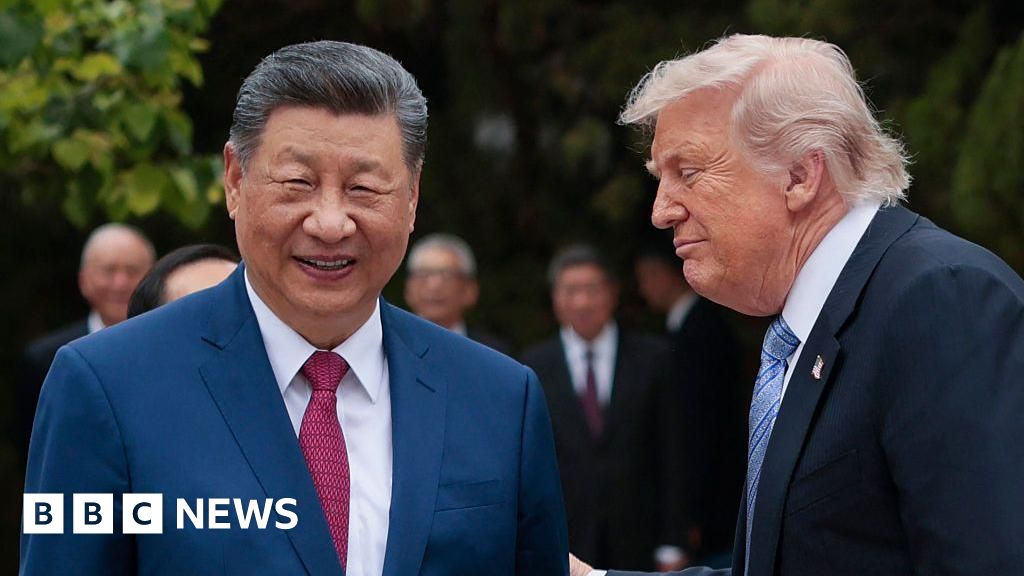
In general, respondents expressed low confidence in both US President Donald Trump and Chinese leader Xi Jinping, though Xi scored higher than Trump.
While the US was still seen to respect personal freedoms more than China, China was seen to interfere in other countries' affairs less than the US.
Pew polled more than 42,000 people in 36 countries between February and May.
Respondents were asked if they had a very favourable, somewhat favourable, somewhat unfavourable, or very unfavourable opinion of each superpower.
The research centre found that in 25 of the 36 countries, there were more people who had favourable views of China than of the US.
It marks the first time the centre, which has been tracking global sentiments towards the superpowers since 2002, has seen such a result in so many countries, according to Jonathan Schulman, one of the study's researchers.
Pew has seen previous dips in positive views of the US - in 2008, at the end of George Bush's administration, and in 2017, at the start of Trump's first term.
Even then, however, favourable views of China tended to be on par or slightly lower, Schulman told the BBC.
Spain, Indonesia, Italy, Greece and Canada were among the countries that saw the biggest swings towards China.
Only six countries in this year's survey still favour the US more, most of which are staunch US allies: Poland, the Philippines, South Korea, India, Japan and Israel.
Separately, the centre found that the median favourable opinion of the US across 20 countries had dropped steadily in recent years while the median favourable opinion of China had been rising.
Researchers also found that favourable views of China had increased in more than a third of the countries surveyed in recent years, based on an expanded dataset including the US.
And positive views of China reached record highs in some places surveyed this year, including Italy, Spain, Colombia, Mexico, Indonesia, Malaysia, Nigeria, and Turkey.
Researchers found that in general, middle-income countries tended to have positive views of China while wealthier countries tended to have more negative views.
One exception to this pattern was Singapore, which had the highest GDP per capita of the countries surveyed and a high level of positivity towards China.
The most positive - and the most negative - views of China in the survey came from the Asia-Pacific. About 90% of Pakistanis appear to favour China, while just 11% of Japanese do.
The survey also asked respondents if they had confidence in Xi and Trump to do the right thing in terms of world affairs.
Overall, confidence levels in both leaders were generally low, with most of the scores below 50%. But many of the surveyed countries tended to have more confidence in Xi than in Trump.
The highest and lowest ratings for Xi in the survey came from Pakistan and Japan respectively, at 83% and 7%.
For Trump the highest rating was 68% from the Philippines and the lowest was 4% from the West Bank/East Jerusalem.
Schulman said their survey found in general that "people don't have that strong an opinion on Xi as they do for other leaders".
Meanwhile for Trump, "people were more likely to give an answer, and give an answer on the extremes".
The survey also found that while more people still believed the US government respected its people's personal freedoms than China's government did, the gap had narrowed.
Pew asked additional questions in several middle-income countries to find out views on the superpowers' foreign policies.
A median of 75% felt that the US interfered in the affairs of other countries a great deal or a fair amount, while 45% said the same of China.
'Volatility of US puts many on edge'
Other institutions have carried out similar research in recent years.
Polling company Gallup found that China surpassed the US in global approval ratings last year, with the widest gap recorded in China's favour in 20 years.
But US think tank Asia Society's yearly Global Public Opinion on China survey suggested that China's image, which dipped during the pandemic, had only made a modest recovery since.
Chong Ja Ian, a non-resident scholar with Carnegie China, said Pew's latest results were not surprising.
"The volatility of US policy, including the use of force and the resulting economic harm, has put many on edge," he noted.
Pew's survey began not long after Trump intensified his rhetoric about annexing Greenland and the US captured Venezuela's leader Nicolas Maduro. The US also launched its war with Iran during the polling period.
Dr Chong added that "whether China is absolutely popular is an open question, but it seems like a more predictable entity at present. Beijing has also been working hard to burnish its image", especially in developing countries.
On the disparity between the high favourability scores for China and the relatively lower confidence in Xi, Dr Chong said that while China "may be more predictable and therefore makes some more comfortable, it does not take away from the fact that Xi is a major authoritarian figure".
He pointed out that under Xi's leadership China had "adopted more assertive and expansive claims, including more insistence that others align with its view of the world" - and questions remained about the treatment of minorities in the country.
"I suppose people attribute the more coercive and economically less helpful policies to Xi personally but associate more positive elements, such as technological advances, to China more broadly."
Related Stories
 World
World
Frontier Announces Collaboration with Disney for New Video Game
50 minutes ago
 World
World
Decommissioning of Chernobyl units progressing
51 minutes ago
 World
World
‘I'd be the last to know’: Stars of The Gentlemen react to Meghan reports
51 minutes ago
 World
World
2025 Mid
1 hour ago
 World
World
Snoop Dogg wants to pay you $10K a month to taste ice cream all over the world
2 hours ago
 World
World
'Genital theft' accusations: How social media fuelled rumours that turned deadly
2 hours ago
 World
World
Staten Island man survives lightning strike caught on doorbell camera
2 hours ago
 World
World
From ‘psyops’ to ‘hysterical hysteria’: how GB News and Talk TV lost their cool in the heatwaves
3 hours ago