
Political Language in India: How War Metaphors Erode Democracy
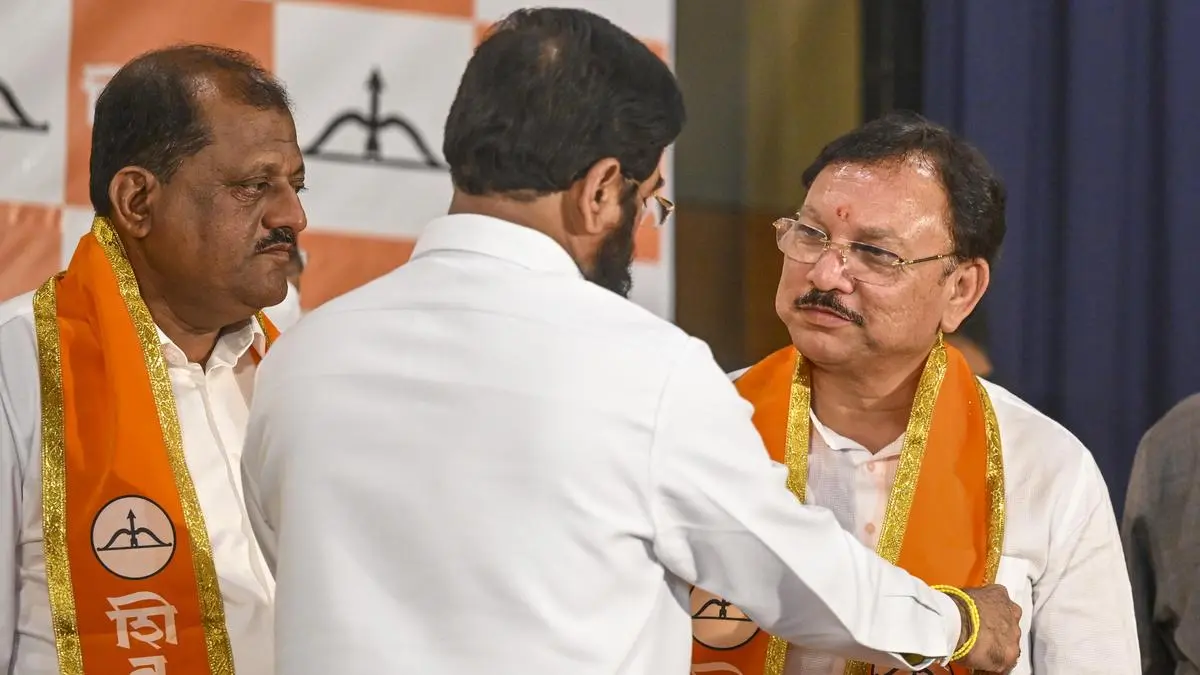
Since May 4, after the West Bengal Assembly election, Indian politics has seemed to be in constant churn: electoral results in States and the Rajya Sabha, political defections followed by more defections, followed by predictions of more to come. In this churn, one would be excused for thinking that the country’s legislative bodies are being run by tactical field commanders rather than elected politicians.
Take the recent political drama in Maharashtra, in which six Shiv Sena (UBT) Lok Sabha MPs defected to the Shiv Sena. These defections were instantly code-named “Operation Tiger” by news channels and political players, who called it first is a chicken-and-egg question. While defections of MPs and MLAs should ideally lead to discussions about a crisis of ideology or a breach of public mandate, the coverage focused on who reached where, when, to meet whom, and how—a redesigning of journalism’s five Ws and one H.
Over the past decade, political communication and reporting in India have undergone a process of linguistic militarisation. Democratic exercises built on negotiation, institutional consensus, policy debate, and representation have shifted into the vernacular of raw combat, led by political parties and celebrated by the media. Treating EVMs as battlefields and governance as psychological warfare has rewritten how the public perceives democracy.
Today, shadowy political manoeuvres are stripped of their constitutional and ethical weight and repackaged in the lexicon of military operations. Take “Operation Lotus”, the term used for the recurring phenomenon of elected representatives switching sides overnight, subverting mandates and breaking trust, and creating institutional crises. By using the term “operation”, historically reserved for actual military deployments (Operation Sindoor, for instance), the media has repeatedly sanitised backroom political manoeuvres into masterful, covert, commando tactics. Readers and viewers are invited to admire the tactical brilliance of the politics rather than question its ethics.
This militarised language is everywhere. A government’s welfare scheme, or a party’s decision to field a surprise candidate, is routinely termed a Brahmastra, a weapon of mass destruction in Hindu mythology. Sudden policy decisions such as the 2016 demonetisation were widely cheered by the media as “surgical strikes” on black money. Borrowing this specific military term helped shield a complex economic experiment from due scrutiny, and continues to do so.
While India’s vernacular adaptations draw uniquely on mythology and regional identity, the framing of politics as warfare is a global practice. Western political and media culture has built this architecture over decades. The term “war room”, for instance, is widely associated with its first prominent use in modern political campaigning, during Bill Clinton’s 1992 US presidential campaign. There, candidates drop “bombshells”, unleash “scorched-earth” campaigns against opponents, and rely on the “heavy artillery” of unlimited money from Super PACs (a political spending vehicle with no donation caps and no direct candidate ties). Terms such as “battleground states” for swing states, or “trench warfare” for partisan gridlock, create a similar psychological climate in Indian politics and media narratives today. When politics is discussed in the shadow of war, it can divide citizens into hostile factions and shrink whatever space for compromise remains.
Why does this semantic shift matter? How an issue is framed changes how people think about solving it. The deeper danger of militarised political language lies in its effect on democratic discourse itself. A healthy democracy needs an agnostic politics in which opponents are adversaries whose continued existence and opposition are essential to the system. But the discourse of warfare recasts opposition as an existential enemy to be eradicated. In India, such enemies have acquired newer tags, from “anti-nationals” to, on occasion, “cockroaches”.
Total destruction is the goal in a war. Compromise looks like surrender; concessions look like treason. Viewed through this lens, long-term structural problems—public health, unemployment, poverty—become impossible to resolve. A healthy republic needs negotiation and consensus-building, not only with the political opposition but with citizens at large. If either is treated as an enemy rather than an adversary, the space for consensus shrinks and the health of democracy diminishes with it.
Such framing also turns citizens from participants into spectators. Television news, in particular, runs on high-adrenaline content to hold viewers and ratings. Deeper debates on fiscal policy, agrarian distress, or education rarely generate the same adrenaline as a political ambush, as the “Operation Tiger” coverage showed. For viewers, it becomes a space to cheer their side’s strategic dominance over the enemy, rather than to ask critical questions of the party they support.
Language shapes public thought and, when it is filled with the vocabulary of combat, it can degrade a country’s political consciousness into permanent hostility. George Orwell, in his essay “Politics and the English Language”, wrote: “Political language—and with variations this is true of all political parties, from Conservatives to Anarchists—is designed to make lies sound truthful and murder respectable, and to give an appearance of solidity to pure wind.” In India’s present context, political language is being designed to turn routine electoral politics into an arena of conquest, one that can occasionally turn violent.
What matters now is making politics accountable again by lowering the temperature of the language used to describe it. Politicians, journalists, analysts, and citizens alike need to resist the glamour of military metaphor. A political defection should be called out for what it is—a breach of public trust and mandate—rather than a tactical coup; policy announcements should face scrutiny on their merits rather than be cheered as surgical strikes; and electoral victories should be understood as mandates to serve, not mandates for conquest. Restoring the civil language that democracy was built on will be an essential step towards that end.
Ashutosh Nagda is a Senior Researcher with the Institute of Peace and Conflict Studies (IPCS), New Delhi. He is a former German Chancellor Fellow (2023–24) and writes on India’s foreign policy and domestic politics.
Also Read | Maharashtra’s opposition disoriented as BJP tightens grip on the State
Also Read | The merger escape clause
Related Stories
 India
India
Tilvin Silva’s India visit What it says about JVP’s socialisation in international politics
2 hours ago
 India
India
GOPIO Announces 2026 Biennial Convention and Conference in Mumbai
2 hours ago
 India
India
Former IAS officer Divya Mittal announces entry into politics, says will begin journey from Uttar Pradesh
6 hours ago
 India
India
Gyanesh Kumar: India's election chief at the centre of a growing political storm
11 hours ago
 India
India
Indian scientists settled abroad reverse decades of brain drain under new VAIBHAV network
16 hours ago
 India
India
Ahead of INDIA Bloc's meeting, Suvendu Adhikari attacks Mamata Banerjee for making friends with 'Dimagi Na
17 hours ago
 India
India
UP Rajya Sabha polls: Smriti Irani, Kumar Vishwas on BJP’s list; SP too steps up preparations
17 hours ago
 India
India
More than 120 join Viksit Bharat Run in Suva
18 hours ago