
Prices at Canadian pumps rising again as oil climbs to 4
Prices at Canadian pumps rising again as oil climbs to 4-week highs
Average price at Canadian pumps was up 3.4 cents midday Tuesday
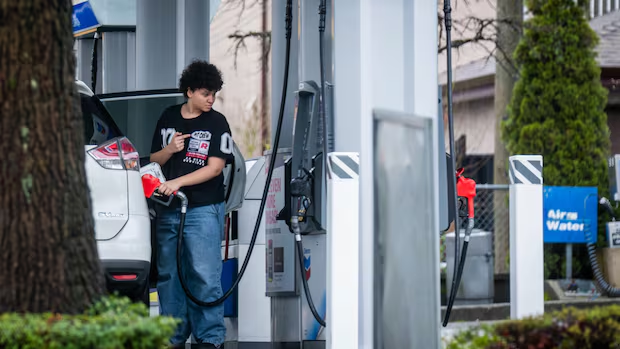
As oil prices climb again, costs at Canadian gas pumps are also on their way back up — and it's not all because of the Iran war, according to an analyst.
The average price of a litre of gas across Canada is at $1.674 as of midday Tuesday — up 3.4 cents from last week's average, according to price tracking site GasBuddy.com.
Patrick De Haan, head of petroleum analysis at GasBuddy, says prices could rise further to about $1.70 on average by the end of the day.
"I think most Canadians will see increases of anywhere from five to 10 cents a litre," in the coming days, De Haan predicted.
That's mostly due to the U.S. war with Iran sending oil prices up, as tensions have risen following a breakdown in the memorandum of understanding that had stopped fighting in the Middle East until last week, though Russia's war with Ukraine has also weighed on supply in recent weeks.
Brent crude rose to its highest price since June 12 — before the U.S. and Iran ceased fighting — at about $86 US per barrel early Tuesday, before dropping a bit to just above $84 per barrel midday.
That's above where prices have been over the past month, when a barrel of Brent crude fell into the low-$70 US range at points, but below the highs seen earlier in the war, when it exceeded $110.
De Haan says it usually takes three to five days for gas prices to fully catch up to shocks, but given the situation in Iran is volatile and ongoing, he says where pump prices will shake out in the end is hard to predict.
"If the U.S. and Iran continue to trade attacks, we could see increases continuing beyond this week," De Haan said.
U.S. President Donald Trump has so far reinstated a blockade of Iranian shipping and proposed, but then walked back, charging a 20 per cent fee to guard the Strait of Hormuz — the critical shipping route that carried about a fifth of the world's oil supply prior to the start of the war.
Shipping data on Monday also showed the number of tankers transiting the Strait of Hormuz fell in the past day to the lowest level in two months.
Yemen's Houthis also declared a ban on Israeli shipping in the Red Sea; if they extended a blockade to the Bab el-Mandeb Strait connected to it, experts worry that could further pinch oil traffic.
"Despite signing the memorandum of understanding and having a deal, this did not last for even a few weeks. So that's the concern the market is trying to price right now," ANZ analyst Soni Kumari told Reuters.
"What we think is that the peak of the escalation is behind us, but there are upside risks to oil prices if these disruptions continue, and that will keep prices in the $85-$90 range."
Oil prices jump as conflict between U.S., Iran escalates
At the same time, hits to Russia's oil infrastructure are adding stress.
Ukraine has stepped up its strikes on Russian oil refineries and storage facilities in recent weeks as part of its response to Russia's ongoing war.
Ukraine keeps striking Russian refineries and supply routes. How close is the country to an energy crisis?
Russia's refining capacity in particular has been hit hard, hampering the ability to turn oil into lighter products like fuels, according to Josephine Mills, a senior analyst for Enverus.
"That … impacts the entire industry from upstream to downstream," Mills said.
As a result, the International Energy Agency last week cut the number of barrels of oil it expected Russia to produce this year by three per cent, while Russia has banned the export of diesel in order to save supply for itself.
GasBuddy's De Haan says for Canadians, the impact on Russia is showing up in Atlantic provinces most, because they're competing with the demand in Europe driven by the loss of Russian products.
"Areas of the Maritimes which directly compete with Europe for availability are now having to pay a higher price to attract that gasoline volume," De Haan said.
According to GasBuddy's regional price tracking, Newfoundland and Labrador's average gas price midday Tuesday sat at $1.934, with Prince Edward Island not far behind at $1.883 and Nova Scotia at $1.840.
That means they're now outpacing British Columbia's gas prices, which had been some of the highest in the country earlier this year because of the Iran war.
Because prices are already on their way up, De Haan suggests drivers wanting to save a few bucks would want to fill up their tank sooner rather than later.
Abby Hughes is a writer with CBC News based in Toronto. Originally from Orillia, Ont., she studied journalism at Toronto Metropolitan University. She covers news from the worlds of business, entertainment, health, science and education, and her favourite stories focus on the real people in those areas — the customers, fans, patients, citizens and students. You can reach her with story ideas at abby.hughes@cbc.ca.
Related Stories
 Canada
Tibi Spring 2027: Where’s Dolly?
45 minutes ago
 Canada
Carney wants Canada to be an ‘associate member’ of the EU: report
45 minutes ago
 Canada
Trump drops tariff on Irish whiskey while booze ban looms for Canada
45 minutes ago
 Canada
Israeli-made film about Gaza gets 25
46 minutes ago
 Canada
Two Windsor McDonald’s managers recognized among top leaders in Canada
1 hour ago
 Canada
Donald Trump doubles down on Irish unity remarks
1 hour ago
 Canada
Lindsay Clancy’s holdout juror shows ongoing skepticism of the ‘insanity defence’
2 hours ago
 Canada
Canada not seeking EU membership in any capacity: source
2 hours ago