
Punjab’s politics needs change
Punjab’s politics needs change
The central challenge is much larger than deciding which party should govern
Contemporary Punjab's history is defined by strategic upheavals and a vibrant political life shaped by religion, caste, language and agriculture. Understanding its political decline requires examining key developments from the 1947 Partition through the critical post-terrorism period after 1992.
The Partition devastated Punjab, displacing millions and transforming its socioeconomic structure. After Independence, the Congress dominated until the 1960s. Pratap Singh Kairon's stability fostered rural development and laid the groundwork for the transformative Green Revolution. However, the 1966 reorganisation of Punjab, the rise of the Akali Dal and the advent of fragmented coalition politics in 1967 eroded this stability, turning political institutions into arenas for factional competition.
The crisis intensified through the 1970s and 1980s due to Central intervention, religious manipulation and Congress-Akali confrontation. This polarisation culminated in terrorism, Operation Bluestar and the militarisation of Punjab's political life. While the 1985 Rajiv-Longowal Accord and the subsequent Barnala government briefly promised a democratic return, internal Akali divisions and persistent terrorism triggered its 1987 dismissal. The resultant President's rule lasted until 1992, centraliding governance around security and creating a profound political vacuum that set the stage for Punjab's post-1992 political era.
The 1992 elections marked a decisive turning point. After years of terrorism and political violence, the Congress government led by Beant Singh restored elected government and revived political activity from the village level to the state legislature and Parliament. Despite years of violence and insecurity, the people of Punjab demonstrated their desire for democratic government and political normalcy.
However, restoring peace did not automatically restore the health of Punjab's political institutions. The years between 1978 and 1992 had left serious structural damage. Political institutions had weakened, civil administration had become excessively dependent on the police and bureaucracy, ideological politics had declined and money and family networks increasingly influenced political competition. Politics gradually became less about competing visions for Punjab and more about acquiring and retaining power.
The Beant Singh government succeeded in restoring relative peace, but the period also witnessed allegations of human-rights violations, increasing police dominance and corruption. Beant Singh's assassination in 1995 further destabilised Congress politics. The party's internal factionalism and declining credibility contributed significantly to its defeat in the 1997 elections. A Lokniti post-election study identified police excesses, corruption, bureaucratic dominance and the arbitrary behaviour of Congress leaders among the major reasons for the party's defeat.
The 1997 election therefore represented more than a routine change of government. The people gave the Akali Dal-BJP alliance a massive mandate, hoping that it would restore political accountability and address Punjab's deeper problems. But the opportunity was largely missed. Instead of undertaking substantial institutional and structural reforms, the government increasingly relied on populist measures, electoral incentives and vendetta politics.
Non-discriminatory freebies to various sections of society, the Shagun scheme, subsidised food, pensions and other welfare measures provided immediate benefits to parts of society, but they lacked a comprehensive strategy to strengthen Punjab's economy, administration, education, employment or political institutions. Populism gradually replaced structural governance. Government and party leaders also became increasingly involved in grassroots institutions, weakening local government autonomy and contributing to political factionalism.
The Congress government led by Amarinder Singh (2002-2007) initially raised expectations of administrative reform and action against structural fault lines in the working of the system, but did not achieve the desired success. As electoral competition intensified, traditional forms of vote-bank politics became increasingly important, including relationships with extra-constitutional centres, ie, religious leaders and deras. The growing distance between political leadership and ordinary citizens further weakened public confidence.
The decade from 2007 to 2017 was particularly important in accelerating the perception of political decline. The second successive Akali-BJP government consolidated considerable political and economic power. Critics increasingly associated the period with corruption, political vendetta, the influence of sand, liquor, transport and cable interests, drug abuse, unemployment, gangsterism and the politicisation of the police and bureaucracy. Peaceful protests were often met with administrative and police measures rather than political engagement.
The government's Sangat Darshan model, while presented as a way to address citizens' problems directly, also weakened established local institutions. Instead of strengthening Panchayati Raj institutions and holding the bureaucracy accountable through constitutional channels, political intervention increasingly became the primary way citizens sought government assistance. This personalised governance, through the appointment of halqa in charges from opposition parties, weakened institutional accountability.
The political decline was therefore not simply the result of individual leaders or particular governments. It reflected a broader transformation in political culture. Dynastic politics, concentration of power, money, religious influence, populism, bureaucratic dominance, and weakening ideological commitment gradually displaced institutional politics. Political parties increasingly treated elections as the primary objective, while long-term questions concerning Punjab's economy, agriculture, employment, education, migration, drugs, and social development received inadequate attention.
Punjab's economic and social difficulties further intensified the political crisis. The state's agricultural model faced growing structural pressures, while unemployment pushed young people to migrate. Drug abuse, crime, gangsterism and the weakening of public institutions contributed to a sense of insecurity. At the same time, political parties frequently responded to these problems through short-term announcements rather than sustained institutional reforms.
The 2017 elections demonstrated the extent of public dissatisfaction. The emergence of the Aam Aadmi Party as a major political force challenged the traditional Congress-Akali-BJP structure. But the Congress government that followed again struggled to translate public expectations into structural change. Although questions of corruption, drugs, employment, and governance remained central to political debate, factionalism within the ruling party weakened its effectiveness.
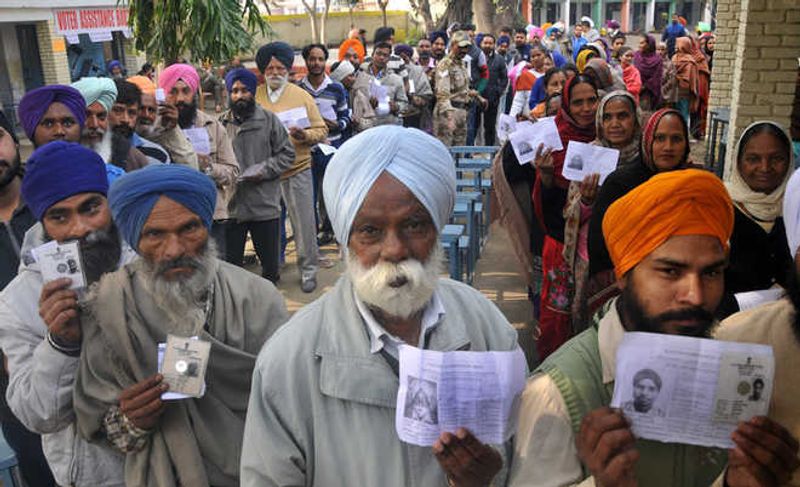
The 2022 elections produced another major political realignment. The people of Punjab decisively rejected the traditional political establishment and gave the Aam Aadmi Party an overwhelming mandate. This was a significant expression of democratic dissatisfaction. Voters appeared to be demanding a new political culture, greater accountability, cleaner governance, and solutions to persistent social and economic problems.
But the outcomes of Lok Sabha and urban body elections during this period show that the political system and political culture have continued to display elements of the earlier pattern, with the ruling party focusing only on electoral considerations rather than addressing Punjab's deeper institutional, economic, social, and governance problems.
The fundamental question remains whether a party change can change Punjab's political system. A government can change, but political culture changes only when institutions, accountability mechanisms, administrative practices, and relationships between citizens and political representatives also change. Merely replacing one ruling party with another cannot resolve problems that have accumulated over decades.
Punjab's political decline since 1992 is therefore best understood as a crisis of institutions and political culture rather than simply a succession of electoral defeats. The restoration of peace in the early 1990s was a historic achievement, but the restoration of democratic institutions remained incomplete. Political parties increasingly prioritized electoral calculations, personalities, family networks, religious influence, and populist measures over institutional reform.
The central challenge before Punjab is consequently much larger than deciding which party should govern. It is about rebuilding political institutions, restoring accountability, strengthening local democracy, reducing bureaucratic and police politicization, encouraging ideological and policy-based politics, and creating a political culture in which public welfare takes precedence over the pursuit of power.
The people of Punjab have repeatedly demonstrated their capacity to reject governments when expectations are not fulfilled. The electoral shifts of 1997, 2002, 2007, 2017, and especially 2022 demonstrate that voters remain politically conscious and willing to challenge established parties. This process may continue in the coming elections in 2027 and beyond if elected leadership fails to meet the electorate's expectations and convert this mandate into lasting reform.
Punjab again stands at a critical juncture. Its political future will depend not merely on which party wins the next election but on whether its leaders can move beyond the politics of power, populism, personality, and patronage. The real task is to restore institutional credibility and make politics once again an instrument for addressing the people's economic, social, and political concerns. The fundamental question, therefore, is not simply who will govern Punjab, but who will change the political culture that has brought it to its present condition.
Related Stories
 Finance
BC Conservatives plan to tackle street disorder while BC NDP targets health care
27 minutes ago
 Finance
Alberta economy expected to grow despite referendum uncertainty: ATB
27 minutes ago
 Finance
Economic info at your fingertips: ConstructConnect launches Canadian Construction Economy Snapshot
7 hours ago
 Finance
U.S. resident charged for allegedly giving advice, money to Tumbler Ridge shooter
8 hours ago
 Finance
Hundreds of schools in France blockaded in biggest day of student protests so far
12 hours ago
 Finance
Quebec election: Parti Québécois to form next provincial government, CBC News projects
12 hours ago
 Finance
Coalition’s migration plan risks breaching India free trade agreement and damaging economy, advocates warn
13 hours ago
 Finance
Premier says economy strong as he exits
16 hours ago