
Qatar win first World Cup point but is FIFA’s offside technology working? Viewers aren’t sure
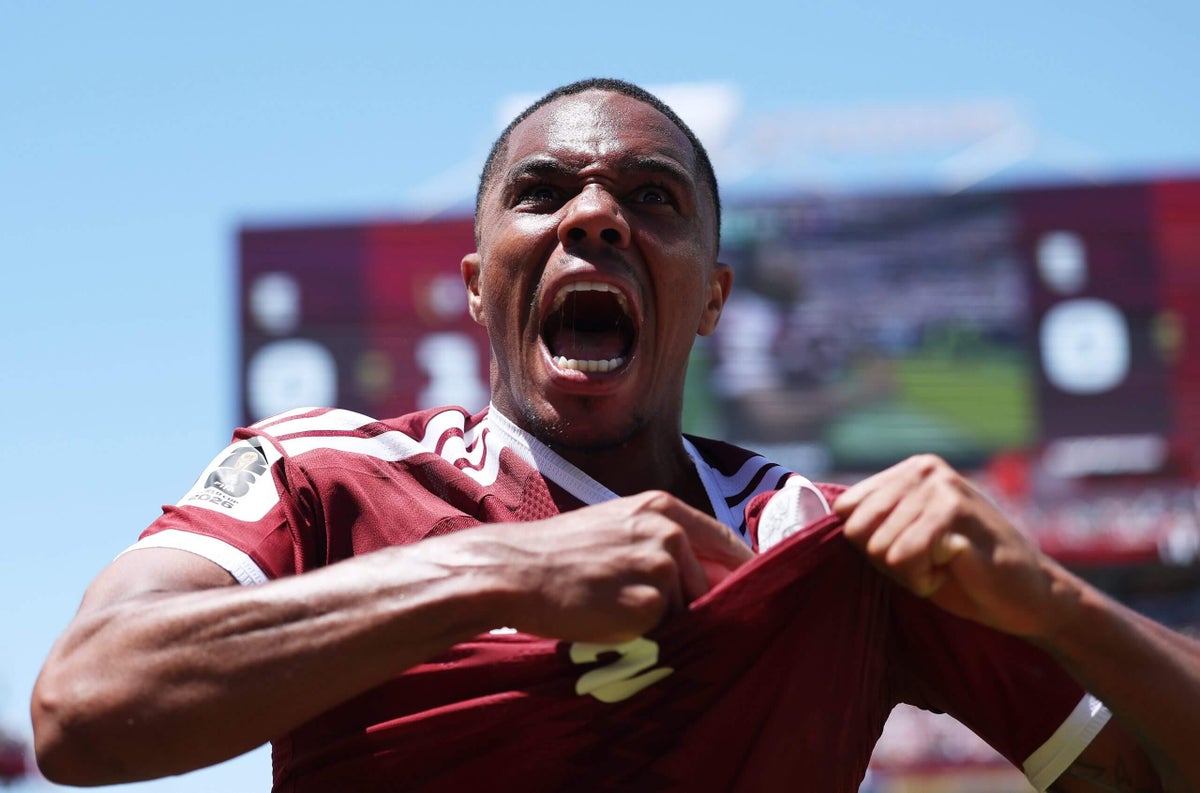
Qatar scored four minutes into second-half stoppage time to earn a 1-1 draw with Switzerland, their first ever point at a World Cup.
Boualem Khoukhi headed in for the side ranked 50th in the world, denying the 19th-ranked Swiss victory as the Gulf team achieved the first notable surprise result of this tournament.
Perhaps it was justice of sorts for Qatar, given there was plenty of confusion surrounding the game’s opening goal.
Charlotte Harpur and Dermot Corrigan analyse the main talking points.
How big a moment was this for Qatar?
After losing all three games while hosting the 2022 tournament, conceding seven times and scoring just once, Qatar are aiming to be more competitive this time around.
In the intervening years, the tiny Gulf state won the 2023 Asian Cup, while a first ever World Cup qualification (they were allowed in automatically as hosts four years ago) was achieved under Spanish head coach Julen Lopetegui, via clutch victories over neighbours Iran and the United Arab Emirates.
Speaking to The Athletic before this tournament, Lopetegui honestly pointed out the limitations within his squad, and predicted they would have to defend a lot during all three group games.
And so it transpired through the first half in Santa Clara, California, on Saturday, with Qatar’s busiest player being Mahmud Abunada, their goalkeeper. Abunada, who was born in Qatari capital Doha but has Palestinian heritage, was arguably unlucky with the penalty incident (albeit he did clatter into Remo Freuler — more on that below) and made three important saves through the opening 45 minutes.
Qatar had very little possession, but they did make chances. Edmilson Junior almost capitalised on a mistake by Swiss defender Manuel Akanji in the second minute, and just before half-time he was again denied by goalkeeper Gregor Kobel.
The second half was a similar story, but Qatar kept their defensive organisation and were never overrun. Lopetegui gradually introduced fresh legs and more attacking options, and they created a few promising situations without any clear chances.
But Qatar had stayed in the game until the end. And then, in the 94th minute, captain and centre-half Khoukhi rose superbly at the back post to power in a header.
Switzerland had made many more chances, but missed almost all of them. Qatar had earned some luck, and took the opportunity when it came, to claim their first point in World Cup finals history.
This tournament was always going to be a different experience for them, without the pressures or advantages of hosting. They remain on paper the weakest team in Group B, but will gain huge confidence from this result.
Why is FIFA being criticised for Switzerland’s goal?
“It is owed to all the TV viewers in the world,” said Gabi Ruiz, former Leeds United technical director, in commentary for DAZN in Spain.
Switzerland took the lead thanks to Breel Embolo’s 17th-minute penalty, the first spot-kick of this World Cup, but there was controversy in the build-up.
As Akanji whipped in a teasing delivery from the right, Embolo headed the ball down. Freuler latched onto it before goalkeeper Abunada collided with him, prompting the referee to point to the penalty spot. Monitors around the stadium showed VAR to be checking the decision.
After a lengthy delay for Abunada to receive treatment, players were waved out of the area and the choice to award a spot kick was confirmed.
Many people watching the game on TV were surprised, since replays seemed to suggest Freuler had been offside before being clattered by Abunada.
When the original cross came in towards Embolo, there was also a question mark over whether he was onside…
…but the main issue surrounded the positioning of Freuler after the striker’s header.
Was he offside? FIFA uses technology to help assist in the officials’ decision-making, so that presumably shows Freuler was not actually ahead of the last defender and that the awarding of the penalty was the right call.
In many domestic matches, including the Premier League, lines are shown on the screen to help explain to viewers when a forward is either onside or offside, so it can be seen clearly.
But no such visualisations were shown on Fox coverage in the U.S., nor on British or Spanish television broadcasts, leaving fans around the world confused, given screengrabs did seem to suggest Freuler might have been offside.
Asked about the incident by The Athletic, FIFA said it does not comment on refereeing decisions.
About three hours after the game, FIFA released a statement saying that a “brief technical outage prevented the onside animation graphic from being generated ahead of the penalty awarded to Switzerland in the 14th minute. The issue was quickly resolved”.
It then posted the two following images, saying: “The workflow of the VAR was not affected by this issue and followed the normal procedure in checking the on-field decision. The lines used by the VAR to check the position of the relevant players did not show the attacking player to be in an offside position in either of the two situations immediately before the penalty decision.”
How many empty seats were there?
The prospect of watching these sides battle out their opening game of the tournament was not necessarily the most mouthwatering contest of the World Cup’s group stage.
But there was certainly a buzz around the Levi’s Stadium concourses ahead of kick-off, and both teams had a strong contingent of travelling fans behind the two goals.
Even Xhaka was surprised by the turnout. “To be honest I didn’t expect so many people to be here but this shows the country loves the football, they love the soccer.”
The red block of Swiss supporters contrasted with the Qataris in their traditional white dress. Some Swiss fans had flown in from Zurich, while other attendees we spoke to, born in Yemen but living locally in the San Francisco Bay Area, were rooting for Qatar. Other people living in the area and fans of the Premier League turned out just to watch some live World Cup football, while another American family had travelled 13 hours to northern California from the state of Utah for their son’s birthday in the hope of seeing a few goals.
Even though the attendance was announced as 67,966, 861 shy of the stadium’s official capacity (it is the sixth largest of this World Cup’s 16 venues), the place appeared only around three-quarters full. Empty seats could be seen dotted throughout each of the four tiers. The fans in the upper stands, so steep that just looking down from them may make you feel sick, did well to endure the punishing sunshine at a game that kicked off at noon local time.
“Official attendance figures reflect the number of tickets scanned and spectators present within the stadium footprint, rather than visual assessments of seating occupancy at any given moment during the match,” read a FIFA statement on the opening day of the tournament.
“FIFA works closely with stadium authorities and ticketing teams to ensure all published figures are based on verified operational data.”
What does this mean for co-hosts Canada?
The Canadians will have been watching this game very carefully, after they started with a 1-1 draw in Friday’s Group B opener against Bosnia and Herzegovina.
Qatar were viewed by most pundits as the outsiders for this section, so getting a draw definitely changes the complexion of what comes next, with all four teams now on one point.
Canada next face Qatar on Thursday in Vancouver, and Jesse Marsch’s team will be confident of securing their nation’s first victory in a World Cup finals.
Getting to four points would almost certainly guarantee qualification for the round of 32, with eight of the 12 third-placed teams going through. Canada might also fancy their chances of scoring more goals against the Qataris than the Swiss managed here. That would boost their goal difference, especially if they can improve their finishing from game one.
That would then set things up very nicely for game three against Switzerland, also in Vancouver, the following Wednesday. That match could go a long way to deciding who tops Group B and plays their last-32 game on Canadian soil against one of the tournament’s third-placed finishers. The second-placed team from this section go to Los Angeles to play the runners-up from Group A (potentially South Korea or Mexico), so there is extra motivation for Canada to chase first place.
Related Stories
 World
World
Trump administration announces global economic war on Iran
14 minutes ago
 World
World
Video. Latest news bulletin | August 24th, 2026
1 hour ago
 World
World
GE Aerospace Partners with NASA, BETA Technologies, and Boeing on World’s First High
1 hour ago
 World
World
The world inches toward catastrophic climate events: ‘Bigger shocks are on the way’
2 hours ago
 World
World
4 arrested after world champion boxer Zolani Tete shot dead, woman injured in South Africa
2 hours ago
 World
World
Oceaneering Becomes Authorized Starlink Reseller
2 hours ago
 World
World
The World of Motorcycling- News detail
3 hours ago
 World
World
Saudi Arabia’s MBS visits Macron in France: What to expect
3 hours ago