
Responsible use of artificial intelligence and machine learning for food security early warning systems
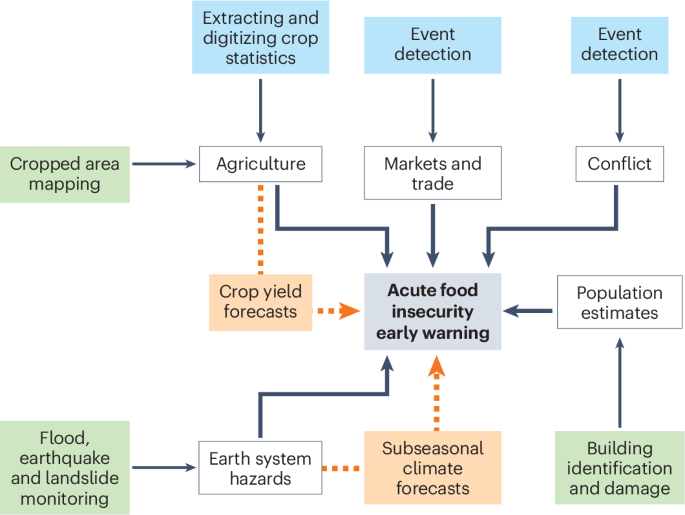
Artificial intelligence and machine learning are already enhancing food security early warning systems by improving data collection, event monitoring and forecasting. However, to avoid costly errors, artificial intelligence and machine learning should be applied selectively alongside expert oversight, robust governance and transparent practices to maintain accountable and effective humanitarian decision-making.
This is a preview of subscription content, access via your institution
Prices may be subject to local taxes which are calculated during checkout
Martini, G. et al. Nat. Food 3, 716–728 (2022).
Balashankar, A., Subramanian, L. & Fraiberger, S. P. Sci. Adv. 9, eabm3449 (2023).
Article PubMed PubMed Central Google Scholar
Herteux, J. et al. Commun. Earth Environ. 5, 611 (2024).
Lentz, E. C., Michelson, H., Baylis, K. & Zhou, Y. World Dev. 122, 399–409 (2019).
Machefer, M. et al. Glob. Food Secur. 45, 100859 (2025).
Busker, T. et al. Earth’s Future 12, e2023EF004211 (2024).
Backer, D. & Billing, T. Glob. Food Secur. 29, 100510 (2021).
Zhou, Y., Lentz, E., Michelson, H., Kim, C. & Baylis, K. Appl. Econ. Perspect. Policy 44, 893–910 (2022).
Miller, E., Kishi, R., Raleigh, C. & Dowd, C. Sci. Data 9, 593 (2022).
Maxwell, D. et al. J. Humanit. Affairs 6, 40–53 (2025).
Davis, K. F. et al. Environ. Res. Lett. 20, 052001 (2025).
Tiggeloven, T. et al. iScience 28, 113689 (2025).
Wardrop, N. A. et al. Proc. Natl Acad. Sci. USA 115, 3529–3537 (2018).
Article ADS CAS PubMed PubMed Central Google Scholar
Vesco, P. et al. Int. Interact. 48, 860–896 (2022).
Carneiro, B. et al. Sci. Rep. 15, 36709 (2025).
The scientific results and conclusions, as well as any views or opinions expressed herein, are those of the author(s) and do not necessarily reflect those of NOAA or the Department of Commerce. Part of this research is being implemented by CGIAR researchers from the Alliance of Biodiversity International and CIAT.
B.C. received funding from the CGIAR Science Program on Food Frontiers and Security. Y.L. and R.V. received funding from the Google.org Foundation and the CGIAR Accelerator on Digital Transformation. P.V. acknowledges funding by the ANTICIPATE project from the European Research Council Advanced Grant (grant agreement no. 101055176). A.J.T. was supported by the Patrick J. McGovern Foundation (grant no. 1556), the Wellcome Trust (grant no. 308679/Z/23/Z) and the Gates Foundation (grant no. INV-088965). Y.L. and R.V. thank all funders who supported this research through their contributions to the CGIAR Trust Fund: https://www.cgiar.org/funders/. W.A. was supported by NASA Harvest grant 80NSSC23K042.
Department of Geographical Sciences, University of Maryland, College Park, MD, USA
Weston Anderson & Inbal Becker-Reshef
AI for Good Lab, Microsoft, Strasbourg, France
Inbal Becker-Reshef & Robert Trigwell
University of Strasbourg, Strasbourg, France
International Organization for Migration, Geneva, Switzerland
Bioversity International, Coimbra, Portugal
American Institutes for Research, Arlington, VA, USA
Physical Sciences Laboratory, National Oceanic and Atmospheric Administration, Boulder, CO, USA
FEWS NET Decision Support Team, Chemonics International, Washington, DC, USA
International Food Policy Research Institute, Washington, DC, USA
Joint Research Centre, European Commission, Ispra, Italy
Seidor Consulting, Barcelona, Spain
School of Global Studies, University of Sussex, Brighton, UK
WorldPop, School of Geography and Environmental Science, University of Southampton, Southampton, UK
Peace Research Institute Oslo, Oslo, Norway
Search author on:PubMed Google Scholar
Correspondence to Weston Anderson.
The authors declare no competing interests.
Nature Food thanks Markus Reichstein and the other, anonymous, reviewer(s) for their contribution to the peer review of this work.
Anderson, W., Becker-Reshef, I., Bodanac, N. et al. Responsible use of artificial intelligence and machine learning for food security early warning systems. Nat Food (2026). https://doi.org/10.1038/s43016-026-01400-6
Version of record: 06 August 2026
DOI: https://doi.org/10.1038/s43016-026-01400-6
Related Stories
 AI News
Liminal Junctions: Spiritual Yearnings and the Pharmakon of Artificial Intelligence
59 minutes ago
 AI News
Will anybody use AI as much as coders? | Technology News (HT Tech)
2 hours ago
 AI News
AI won’t replace jobs, but Vietnam’s professionals feel less confident
2 hours ago
 AI News
Governance by design: Turning AI policy into executable controls
2 hours ago
 AI News
Employees, union raise concerns about AI tools amid WSIB layoffs
2 hours ago
 AI News
'Constant eyes': Toronto police’s new AI plate readers explained
3 hours ago
 AI News
Vibe Coding Was the Magic Wand for Singapore's Struggling Tech Scene
3 hours ago
 AI News
Taiwan identifies sovereign AI, satellite communications as key technology priorities
3 hours ago