
As Canada tariff talks collapse, who’s calling the shots in Trump’s trade team?
Having reportedly read Victor Hugo’s Les Misérables, in French, during a military tour of duty in Iraq, Jamieson Greer considered himself an unlikely target for accusations of francophobia.
But Donald Trump’s US trade representative, hitherto one of the president’s less high-profile cabinet members, found himself in that uncomfortable position amid the acrimonious collapse of bilateral trade talks with Canada that now threatens to degenerate into an all-out trade war between the two close trading partners whose economies are tightly intertwined.
An apparent pending deal between Washington and Ottawa aimed at avoiding damaging tit-for-tat tariffs broke down at the last minute, with Canada’s prime minister, Mark Carney, claiming his country had come “under attack” from the US.
Among the multiple and complex points of disagreement was a Canadian accusation that US negotiators had pressed for a weakening of legal protections for the French language, which is most heavily spoken in the province of Quebec.
Canadian provisions include legislation that mandates streaming and online video companies to invest in and promote Canadian content and promote the French language. Carney cast US objections to such regulations as a deal breaker, and said they amounted to “threats to French language and culture”.
For Greer, a fluent French speaker who once served as a Mormon missionary in Belgium, France and Luxembourg, the charge was too much. “I speak French, too,” he told CNBC, dismissing the claims as “a funny, fake story”.
“My kids speak French,” he said. “One of my kids was born in Paris. So I like the Québécois, and I like that they speak French. What we don’t like is a situation where Canada, the federal government, forces American tech companies to take their earnings and give a percentage to their competitors in Canada.”
The controversy may be the closest glimpse the public will see of Greer being rattled. By Thursday, in what was being being seen by some Canadian officials as a potential olive branch, he was peddling a softer line on the language issue.
“President Trump, myself and the US government recognizes the importance and sensitivity of the French language in Canada,” he told CBC, the Canadian broadcaster. “We know that this is quite sensitive and quite important, and we actually champion the use of French.”
The impact was undermined hours later, however, when Trump publicly signed a retributive executive order supposedly changing the name of Lake Ontario – one of the Great Lakes which has shores on both countries – to Lake America. Petty as the act was, it seemed to graphically illustrate the limited freedom of manoeuvre held by anyone representing a president so preoccupied with trade.
And Greer is not the only official seeking to steer the president’s aggressive agenda on trade – raising questions over who is really in control.
Those who have met and worked with Greer describe the 46-year-old – who served as a military lawyer in Iraq, where he is reported to have read Hugo’s classic novel between bombardments – as a model of calm and expertise.
“I have high respect for him. He been pretty creative in terms of trying to thread the needle with other countries as he tries to promote Trump’s trade policies,” said Wendy Cutler, a former US trade representative’s negotiator who has met Greer several times. “From a professional viewpoint, he’s extremely impressive. His reputation as being very level-headed, a very calm demeanor, and not someone who loses his temper or who grandstands.”
It is not known if Greer retained his sang-froid in private as the talks with Canada unravelled, just days after Trump himself publicly declared a deal was at hand.
According to reports, the agreement was derailed after Howard Lutnick, the US commerce secretary, objected to the scale of proposed tariffs reductions on imports of Canadian steel, aluminium and cars, sectors falling under his responsibility after Trump declared them areas of national security under the 1962 Trade Expansion Act.
Carney, explaining why Canada decided to abandon the talks, pointed to disunity among the US negotiators. The White House has denied claims of division between Greer and Lutnick, but seasoned commentators are skeptical.
“Lutnick viewed all this as his turf, and here is Greer, who is the designated guy to be effectively the trade minister if you think about it in the context of other countries, conducting the negotiations,” said William Reinsch, a senior adviser to the Center for Strategic and International Studies and a former undersecretary for commerce. “It appears Greer was willing to go farther than Lutnick was.
“From the Canadian point of view, this was a disagreement that developed late in the day and led the Canadians to believe that the United States was moving the goalposts.”
Cutler, who served Republican and Democratic administrations during a 27-year stint as a US trade negotiator, said tensions within negotiating teams were not unprecedented, but were normally ironed out before talks reached the critical stage.
“I think the challenge under this administration is that you have Greer in charge of the trade portfolio, but Lutnick’s in charge of Section 232 investigations [restricting foreign import on national security grounds] and that’s where a lot of the sensitive issues are,” said Cutler, now vice-president of the Asia Society Policy Institute.
Greer cut his trade negotiating teeth as chief of staff to Robert Lighthizer, US trade representative in Trump’s first presidency, who played the leading role in renegotiating Washington’s economic ties with Mexico and Canada, and the former North America Free Trade Agreement (Nafta), which was replaced with the United States-Mexico-Canada Agreement (USMCA) in 2020.
He was chosen for the position when Lighthizer apparently indicated he did not wish to be considered for the post a second time. “Greer plays the same role that Lighthizer played,” said Reinsch, who noted, however, that Greer lacked his former boss’s intimate understanding of Congress.
“He figures out legal ways to do what Trump wants to do, and to get as much of Trump’s objectives accomplished as is possible within the framework that he has to operate in,” added Reinsch. “So that allows him to come back to Trump on occasion and say, ‘there’s a better way to get what you want than what you’ve employed so far.”
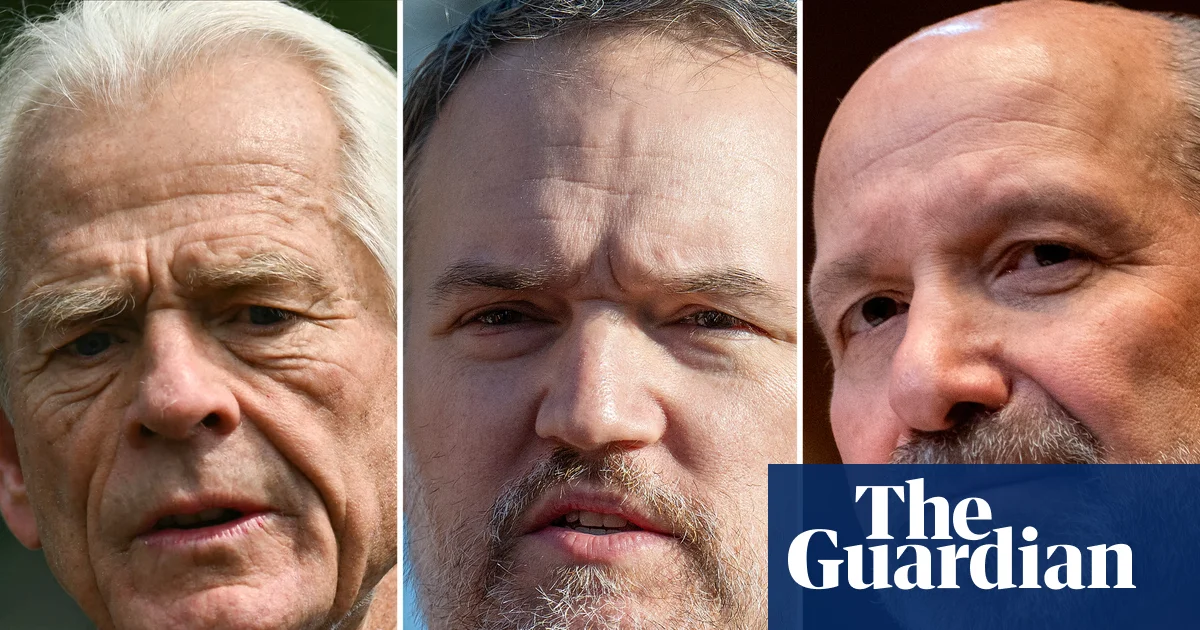
Another complicating element may be Peter Navarro, the president’s senior counsellor for trade and manufacturing.
He is reckoned by analysts to be a “Trump whisperer” on Canada, despite a belief that his influence has been marginalized compared with the first Trump presidency, when it was widely joked, according to Reinsch, that Lighthizer was reluctant to travel outside Washington for fear that Navarro would persuade the president to adopt impractical trade policies in his absence.
Navarro, who went to jail for contempt of Congress after refusing to comply with a subpoena from the committee investigating the 6 January 2021 insurrection, vented in an appearance on the C-Span network last week.
Asked to respond to an article in the Guardian by the Canadian writer Jen Gerson, who wrote that US retaliation should be taken as a warning by other western allies, Navarro said: “Madam, your country screws us. You’re in bed with the Chinese and playing games with us.
“Look in the mirror at your tariffs codes. You are the problem.”
Navarro has voiced concern that Canada has allowed the import of nearly 50,000 Chinese-manufactured electric vehicles under a most favoured nation agreement, which he fears will ultimately end up crossing the border to be sold in the US.
“Navarro’s worried that the whole USMCA negotiation is really about how do we prevent Canada and Mexico from being a backdoor to Chinese stuff,” Reinsch said. “He would probably have argued last week that the deal wasn’t any good because it wouldn’t shut down Chinese imports in the United States.”
Yet the focus on Trump’s advisers cannot obscure the president’s own fixation with tariffs. Carney referred to agreements being “signed in pencil”, suggesting that Trump would try to change terms even after the details had been hammered out.
“The larger Canadian objection was not due to interagency American disagreement,” Reinsch said. “Trump has very strong fixed views on trade. He thinks tariffs are good. So if you’re going to blame somebody, don’t blame Lutnick or Greer. Blame Trump, because I’m quite confident he had the last word on this.”
Regardless of where blame is apportioned, the consequences of Carney’s defiance will reverberate beyond Canada, analysts say, as other countries forced to confront Trump’s threats of tariffs reassess and recalibrate how they should respond.
“Other countries are watching the developments with Canada very closely,” said Cutler. “Some of our other trading partners have expressed similar frustrations [to the Canadians] to me privately, and so we could be at a turning point.
“It is possible that what we’re experiencing with Canada now spreads to other countries.”
Related Stories
 Canada
Oshawa plant adds truck as unionized Canadian GM members ratify new deals
53 minutes ago
 Canada
Local journalism is going extinct in Canada
53 minutes ago
 Canada
Could Ford's fight with Trump swing key byelections to the PCs? Experts weigh in
1 hour ago
 Canada
Voters head to the polls for 3 federal byelections in Ontario, Quebec and B.C.
1 hour ago
 Canada
BC Conservative Party in turmoil
2 hours ago
 Canada
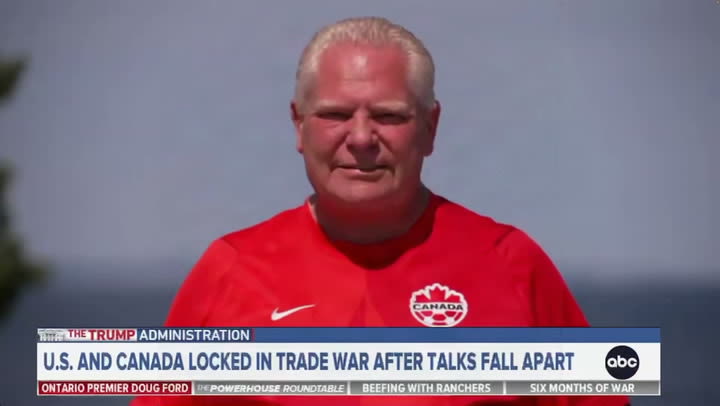
Trump Rages at Canada After Leader’s Embarrassing Lake Diss
2 hours ago
 Canada
The US
2 hours ago
 Canada
Waterfalls of New Brunswick: Walton Glen Gorge Falls
2 hours ago