
Student Politics Beyond Education: Lessons from India’s Student Movement
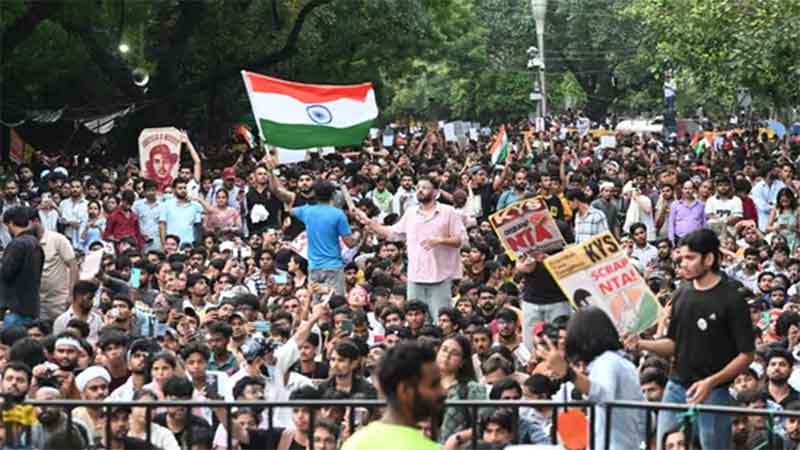
The student movement in India is encouraging at a time when the country has experienced a significant democratic decline (Figure 1). Students have been protesting against a poorly governed educational system in which examination paper leaks have become commonplace. They have received support not only from their parents but also from farmers and broader sections of the non-student population. Their protests have been strengthened by the organizational skills of Left students. The protesting students have suffered at the hands of a brutal security apparatus employed by an authoritarian government, even though their protests have been peaceful.
The student movement in India raises important questions about education and its relationship to the wider society. The protests demonstrate that decades of communal politics promoted by right-wing forces inside and outside the state have not extinguished people’s democratic and egalitarian instincts. The government’s violent response to the student movement suggests that, whether a protest is peaceful or not, if it challenges the state (or corporate power) beyond the level of tolerance of the system, this level being very restricted in a right-wing regime, it is likely to be met with state brutality. The state remains the violent machine that exists to maintain capitalist class rule.
The vast majority of people—around 75 percent—suffer because of a free-market economic policy that serves corporate interests, introduced by the liberal predecessors of today’s right-wing rulers. To distract attention from the failures of this policy and to weaken people’s movements against it, the government promotes a divisive ideology based on the claim that the religion of the majority is superior to those of minorities and that the nation belongs to the majority religious community. Yet the overwhelming majority of the population—again, around 75 percent or so—do not accept this divisive ideology. To implement these two mutually reinforcing policies, the government must rely increasingly on authoritarian methods.
An authoritarian government has little need to be accountable when it makes mistakes. It judges its own performance and invariably concludes that it is satisfactory, even when it falls far short of meeting people’s needs. Because it is not accountable to the public, it has little incentive to perform its functions competently—for example, to conduct examinations properly or provide public services effectively. Its elected representatives and bureaucrats may be highly incompetent and yet retain their positions simply because they promote the government’s right-wing ideology, demonstrate loyalty to the supreme leader, or remain close to those in power. Authoritarian governments are therefore prone to incompetence. Examination paper leaks, lack of accountability, and brutality against peaceful protesters—as well as actions such as changing electoral rolls to disenfranchise millions and facilitating the near-complete capture of major parts of the state—are all manifestations of authoritarian governance.
Data Source: Freedom House, Freedom in the World (annual reports, 2017–2026).
It is to be hoped that the movement will not only raise the political consciousness of students and other sections of the population but also win its immediate demands. However, education is one moment in the social reproduction of capitalist society, so educational struggles cannot achieve lasting victories unless they develop into struggles over the wider conditions of social reproduction. The struggle for education—which has emerged as an important expression of progressive politics at a time when such politics appeared to be in decline—must therefore be linked to broader struggles against exploitation, unemployment, inequality, and attacks on democratic rights. This article develops that argument by examining how employment, state spending, democratic rights, environmental conditions, and other dimensions of social reproduction shape education and student struggles.
Education as a part of the wider society
Society as a process does not just exist. It has to continue to exist. Social relations and conditions need to be reproduced. Social reproduction refers to continued existence of bodily and mental conditions of an individual. To continue to live as a flourishing human being, one has to eat and drink and have access to shelter, healthcare and transit, a favourable/sustainable physical environment, and a safe built environment and social spaces, as well as culture, including education.
Education is indeed a key moment in the social reproduction. Therefore, every major determinant of social reproduction—employment, wages, housing, access to food, agriculture, democracy, science, ecology, state spending, and national economic and political right to self-determination or independence—also becomes a determinant of education.
Students are future workers—wage earners, salaried employees, and small-scale self-employed producers. Many of them work part-time. Many also work to save money before returning to school or college. Most students’ parents are workers or small-scale (self-employed) producers of goods and services. Students’ lives are therefore closely connected to what happens in the world of work (or employment). Educational demands cannot be permanently secured unless the social conditions that produce problems concerning education along with other problems are transformed.
There are two major attributes of students. Students are citizens, even if they are citizens in an unequal and exploitative society where the state basically works for and on behalf of the employing and exploiting class and where the state imposes many obstacles to the people exercising their rights as citizens. Everything that affects students as citizens affects them as students qua students. This attribute of students emerges from people’s relationship with the state.
Perhaps a more fundamental attribute of students is being a worker/employee, i.e. as owner of labour power, and that attribute emerges from students’ relation to their employer. Labour power is their mental and physical ability to work. As a key component of social reproduction, education — like health — contributes to the production and reproduction of labour power. Everything that affects labour power as such eventually affects education.
Education is part of the value of labour power because it provides, directly or indirectly, the technical and non-technical skills and other abilities needed to work. The quality of education therefore shapes the post-student lives of today’s students. Moreover, it is not enough to have a good education. If there are no jobs available, what is the value of a good education? Education is therefore connected to all the other areas of life that shape people’s economic conditions, the conditions of the parents of current students and of the future workers who are currently students. Thus, education not only reproduces labour power; it is also shaped by the way the profit-driven private sector functions. It is further shaped by the fact that the state is bound by the logic of profit-making. Students’ lives—like those of their parents—are shaped by what the state provides to, or takes away from, people, and by how democratically the state functions. Therefore, students’ lives depend on much more than what happens within the educational sector. How?
Social Determinants of Education
Education depends on students’ innate abilities and hard work. But there are more fundamental determinants of education. As with health, these are the social determinants of education.
Education depends on the material conditions of students and their parents
A basic premise of any rational analysis is that one has to eat, drink, have shelter, and meet other basic needs in order to live as a human being and fulfil one’s potential. In our society, meeting these needs requires money because most goods and services have to be purchased. A hungry stomach cannot support an active mind.
Students’ living expenses are generally covered by their parents and educational institutions, although some students also contribute through their own earnings. To the extent that parents finance their children’s education—and often do so with great difficulty, including by selling their land or cutting back on their own subsistence needs—students cannot pursue their education unless their parents have adequate incomes. Adequate incomes, in turn, require expanded opportunities for secure employment with adequate wages. Moreover, without such opportunities, many of those who are currently students will remain unemployed or underemployed after completing their education. The value of a corruption-free examination system becomes limited if there are no secure, well-paying jobs.
Everyone must have access to employment with an adequate wage which can support educational and other needs. The expansion of secure employment opportunities with adequate wages requires a people-oriented economic development. This requires that the public sector, small-scale production (in both rural and urban areas), and cooperatives expand and create secure, socially useful, and sustainable employment, and that common people exercise greater control over the corporate private sector. Further, economic development has to be sustainable. Environmental degradation, including climate change, affects students and their parents. Consequently, students’ lives, both during and after their education, will continue to be adversely affected unless the state addresses environmental change.
Many students have parents who are affected by what I call ‘expanded primitive accumulation’ (EPA), which is forcibly orchestrated and defended by the state. This includes the privatization of government-owned companies, leading to job losses. Students and their parents depend on the public provision of healthcare, public transportation, and other essential services. The withdrawal of these services, itself a form of EPA, lowers the living standards of both students and their parents. EPA includes forcible dispossession of small-scale owners of land — many of whom are Adivasis — to make way for corporate industrialization. EPA also includes people losing access to their land and homes because of urban redevelopment, special economic zones, corporate mining, forest clearance, eco-tourism, solar projects, and infrastructure projects, all of which are driven by corporate profit-making.
Many rural people, whose children are in colleges and universities, suffer because they do not receive remunerative prices for their agricultural products, which undermines their livelihoods. This occurs partly because the state has withdrawn much of its earlier support, and such withdrawal is a form of EPA. Many farmers and self-employed in urban enterprises also suffer because of unequal foreign competition as earlier protection is withdrawn. Unless a country has economic sovereignty, parents’ incomes are adversely affected, and this in turn affects students. Unless EPA is halted, many students cannot fully live the lives of students.
Education depends on state spending priorities
To the extent that educational institutions support students through scholarships and bursaries, there must be greater public funding of universities. Without expanded university funding, employment opportunities for students who aspire to academic careers will remain limited.
The state must invest in education at all levels. The Indian state invests far less than the minimum 6–8 percent of GNP that it should. Eliminating inflated expenditure on defence, corporate welfare (e.g. subsidies, tax exemptions, loan write-offs and government contracts at inflated prices), government advertisements aimed at merely celebrating its own so-called achievements, and money used by ruling parties to buy legislators from competing parties as well as for direct transfer of limited amount of cash to selected voters which effectively serves as a bribe for votes, in place of creating collective means of subsistence (state-funded quality education, schools, transit system, parks, etc.) – all these would make more resources available for education and other needs. Therefore, demands for such reductions—or, in some cases, elimination—must be part of the struggle to improve education.
Education depends on democratic rights and an accountable state
Unless the communalization of society and of the state is halted, and unless attacks on secularism and egalitarian values are reversed, the curriculum will become less scientific and less socially relevant, teachers will continue to be appointed because of their loyalty to a right-wing agenda rather than their intellectual qualifications, and campuses will increasingly be filled with political hatred based on religion and other forms of social division without any scientific basis. Without the protection of democratic rights, even the struggle for immediate concessions to students becomes difficult.
Students and their parents’ lives will improve if the functioning of the various branches of the state is democratized so that politicians, bureaucrats, police officers, and other public officials are accountable to the people. No one should have to rely on bribes or personal connections in order to enjoy their rights or obtain public services.
Education involves the production of ideas that are innovative, grounded in reason, empirically verifiable, and critical of ideas, individuals, and institutions that produce and disseminate inadequate knowledge. Therefore, freedom of the media, academic freedom, the protection of minorities, and secularism all create conditions conducive to education.
Education does not happen only in classrooms or conference halls. An important part of education takes place in the spaces of everyday life. It takes place in sites of protest against injustice; against attacks on the scientific attitude; against attacks on the right to produce food without relying on seeds whose scientific value has not been established; and against attacks on human decency, secularism, and egalitarianism. For people to participate fully in these spaces of public life, they must be safe for everyone, including women, disabled people, and other oppressed groups, and there must be no violent repression by the state.
The point of the above discussion is that education is connected to many other key areas of life. Therefore, demands for a corruption-free examination system and affordable education, important though they are, must be seen as part of a broader set of demands that, when realized, will improve the lives of students today, the lives of their parents, and the post-student lives of those who are students today.
As the student movement grows, and if it seeks lasting change, it must broaden its demands beyond education alone. It must defend the interests of students as students, as well as the interests of workers and small-scale owners—the social groups to which the parents of most current students belong and to which today’s students themselves will belong after completing their education. Therefore, the struggles of students must be united with the struggles of workers, peasants, Adivasis, women, minorities, and all other oppressed people.
Just as it is important that workers’ and small-scale producers’ struggles for immediate concessions develop into broader social struggles, similarly students’ struggle may begin with immediate demands (e.g. resignation of a Minister or a bureaucrat) and then logically extend into a programme of wider social transformation.
Students’ demands should therefore include, among others:
Note: From one angle, the above list includes immediate demands, institutional reforms, and strategic goals. From another angle, these are democratic demands, economic demands, social welfare demands, developmental demands, and anti-imperialist demands.
Students are not just students. They are future workers. Many of them are already workers. They are citizens with rights. Education is part of society, and the governance of education is part of the governance of society as a whole. Therefore, demands concerning education—such as corruption-free examinations, affordable education, and so on—must be understood as part of a broader set of demands for social change. Students should avoid educational sectionalism—the idea that they should fight only for educational demands. The struggle for education necessarily expands into a struggle over society as a whole. A student movement that seeks lasting victories must therefore broaden its social and political horizon.
Governments generally respond to protests through four strategies: coercion, concession, consent, and confusion. They use brutality and seek to instill fear. They make limited concessions—for example, by transferring an official or forcing a politician to resign. Such concessions can create consent or an unwarranted sense of trust when the regime says, ‘Look, we listened to you. We are not as bad as you think.’ Often, however, these concessions are temporary or reversible. Governments also try to convince protesters and the wider public that conditions are not as bad as they believe; that the nation is above all else; and that protest is anti-national or even opposed to a particular religion or other identity. They also create confusion by changing their responses unpredictably—for example, by alternating between police repression, offers of negotiation, promises of new policies, attempts to buy off movement leaders, and other tactics. Therefore, students need a broader understanding of society as a whole. They must be firmly committed to democracy—including the democratization of the state and the defense of democratic rights—as well as to egalitarianism. They must also understand that, no matter how independent ministers and bureaucrats may appear, they ultimately serve the interests of the business class people.
It is not enough simply to say that students should support workers and peasants; of course, that is true. It is equally important to recognize that students have an objective material interest in broader social transformation—in the world of work and employment and in the way the state functions—because both their education and their post-education lives depend on it. Students should support workers and peasants not only out of solidarity but also because the conditions under which workers and peasants—including many students’ parents—live directly shape the conditions under which students study. Of course, workers and small-scale owners must support students’ protests in part because many of the students are their children.
Without greater university funding—which provides partial financial support to students and creates academic and other employment opportunities for some graduates—and without improvements in parents’ incomes, students’ educational opportunities remain constrained. Without democratic rights throughout society, students’ ability to organize and to learn through collective action is limited. Without state support for science, the quality of education suffers. Without the public provision of healthcare, housing, and public transportation, and without effective state action to address climate change, students’ lives are adversely affected. And so on.
The struggle of students must be not only for a corruption-free and affordable education but also for such values and practices as decency in public life, democracy, egalitarianism, and secularism. When this broader struggle reveals the forces opposed to these values and practices, it must become a struggle against those forces—corporate power and the state that defends it.
That requires more than jokes and mimicry or periodic protests that last a month or two and then dissolve after securing a few concessions. It requires rigorous theory, the courage to draw practical lessons from theory, skillful agitation, and disciplined democratic organization. It will reveal the limits of a mere popular-front-type—that is, multi-class—mobilization and, consequently, the need for a mobilization based on the political leadership of the exploited classes: workers and small-scale producers, including peasants.
It will also reveal the need to move beyond a democratic consciousness, which informs the struggle for democratic rights, and beyond an economic (trade-union) consciousness, which guides the struggle for economic rights from employers and the state, including the struggle for an efficient, corruption-free education system, toward a political or class consciousness. Such a consciousness enables students and others to understand that the fundamental interests of the corporate class and the political-bureaucratic elite allied with it are incompatible with the fundamental interests of most students and their parents, who depend on wages and salaries or on small-scale farming and other forms of petty production.
Significant and lasting concessions, whether in education or in any other sphere, are always the by-product of a process of political mobilization that goes beyond immediate demands. They are the by-product of a genuinely radical upsurge of the masses. Yet the student movement for justice is a remarkable beginning, even if it is temporarily halted or ends prematurely.
Get the latest CounterCurrents updates delivered straight to your inbox.
Raju J Das, Professor, York University, TorontoEmail: [email protected]
Related Stories
 Education
Anti-government protests sparked by Kushner
1 day ago
 Education
‘Pretty shoddy’: Prof says N.B. education plan attributes to him an article that doesn’t seem to exist
1 day ago
 Education
Kamal Mitra Chenoy: JNU professor’s education, career and why he is in the news?
3 days ago
 Education
French police detain teen pupil suspected in school shooting in which 2 were wounded
4 days ago
 Education
Mum of disabled girl tells of 'fight' for childcare
5 days ago
 Education
PTM politics hots up; teachers say education taking back seat
1 week ago
 Education
(1) French high school protests continue despite PM’s promise of action
1 week ago
 Education
French police suspend use of stun grenades at school protests as minister rejects accusations of brutality
1 week ago