
This is how Google plans to send artificial intelligence chips into orbit
This is how Google plans to send artificial intelligence chips into orbit
Project Suncatcher is a long-term venture: solar-powered satellites, linked together via laser, could one day house computing infrastructure for AI. First, however, they must prove they can withstand the conditions of space.
For feedback, please contact english@ilsole24ore.com
The next data centre might have neither walls nor a roof: just solar panels, chips and the cosmic void. This is the vision – yet to be verified – of Project Suncatcher, the research project through which Google aims to determine whether a network of satellites could one day support artificial intelligence workloads in low Earth orbit, where the sun never truly sets: the very thing needed to power the next generation of computing.
The project forms part of the increasingly energy-intensive race to expand the computing capacity required for artificial intelligence. Moving part of this infrastructure into space could offer more continuous access to solar energy, but it raises many questions: launch costs, maintenance, the lifespan of components and the environmental impact of the satellite constellations.
We’ll have to wait and see, but in the meantime, Google is the first to trial this possibility. The prototype satellite, developed in collaboration with Planet and set to launch as part of SpaceX’s Transporter-18 rideshare mission, is designed to test whether Google’s Tensor Processing Units can withstand the extreme conditions of space: launch vibrations, cosmic radiation and temperature fluctuations in the absence of an atmosphere.
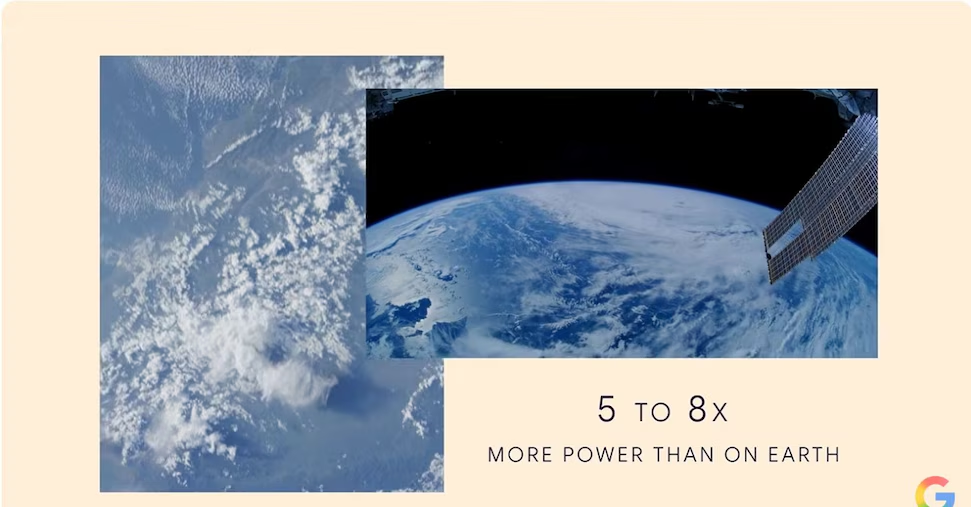
The initiative, first announced last year, is based on an energy-related consideration: in low Earth orbit, a satellite can rely on almost constant sunlight, generating up to eight times more energy than an equivalent plant on Earth. The long-term aim, explains Google, is to connect entire constellations of satellites capable of handling large-scale AI workloads in a distributed manner, powered by virtually unlimited solar energy.
In terms of mechanical strength, the team subjected the satellite to three-axis vibration tests to simulate the frequencies of an actual launch, during which the spacecraft experiences sustained accelerations of up to 10 g and individual components – including TPU chips – can reach peaks of between 50 and 100 g. According to Google, the results were encouraging: the hardware withstood the stresses better than the team itself had expected.
The issue of radiation is more delicate. Outside the Earth’s atmosphere, solar events and cosmic rays can cause errors in circuits, such as so-called bit flips. To assess the impact of this, Google tested its Trillium chips – its latest generation of TPUs – at a proton beam facility at the Crocker Nuclear Laboratory at the University of California, Davis, whilst they were actively processing AI workloads during exposure. Preliminary results indicate that the chips can withstand a total dose of ionising radiation greater than that which they would receive during a five-year space mission. However, there remains one aspect that only a real-world orbital mission can clarify: hence the decision to send the first TPUs into space in the coming days.
Another challenging issue from an engineering perspective concerns cooling. On Earth, data centres dissipate heat partly through air circulation; in a vacuum, this option is not available, and the only solution is radiation via radiators. Google is experimenting with a combination of heat pipes and radiators, which has so far been tested in a thermal vacuum chamber that replicates the environmental conditions of space: the system’s actual behaviour in orbit will be one of the most eagerly awaited findings of this first mission.
Looking beyond the individual satellite, the project aims for an architecture in which each orbiting unit will carry dozens of TPU chips, communicating with neighbouring units via ultra-high-bandwidth laser links over very short distances – the opposite, Google emphasises, of most existing laser systems, which are optimised for low speeds over long distances. The company compares the precision required to hitting a coin-sized target kilometres away, with both points in motion. This aspect will be put to the test in 2027, when two satellites will be launched specifically to test the laser interconnection.
As Travis Beals, Senior Director for Paradigms of Intelligence at Google Research, points out, this is a deliberately incremental process: first, determining whether the hardware can physically withstand the conditions, then gradually refining the cooling and connectivity systems. Before envisaging a cloud amongst the stars, Google must prove that a processor can survive the journey. The company compares this approach to the lengthy cycles of experimentation that preceded autonomous driving and quantum computing, before they became viable systems on a real-world scale.
Related Stories
 AI News
China’s leader urges ‘healthy’ competition with US
1 hour ago
 AI News
AFP and Dalet Partner to Strengthen Authenticity of News Video
1 hour ago
 AI News
Artificial Intelligence and Chinese Communism: Innovation, Information and Security as a Recurring Stress
1 hour ago
 AI News
Xi Jinping got the red carpet treatment from Trump
2 hours ago
 AI News
Morgan Freeman: Using artificial intelligence to replicate voice is ‘stealing’
2 hours ago
 AI News
Time to say goodbye to artificial intelligence and live our lives freely?
2 hours ago
 AI News
Tech Firms Embed Responsible AI Innovation
3 hours ago
 AI News
Experts weigh in on 'winning the AI race', the balance between regulation and innovation
3 hours ago